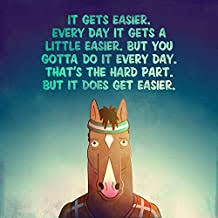
Tomorrow morning will be January 31st, the day Netflix releases the last eight episodes of Bojack Horseman. I'll probably leave work early to come home and drink it all in, possibly while actually drinking. Whatever those eight episodes contain, it's already likely the best comedy I've ever seen.
Bojack Horseman is a show about sadness. More specifically, about sadness with an ill-defined cause. It's about sadness making you hurt the people around you, making you even sadder.
If Bojack Horseman, about to finish its run on Netflix tomorrow after six too-short seasons, is a great show, it's because it spoke to the age it was made in as few stories have. The animated show about a half-man, half-horse, has-been TV star who suddenly becomes a star again but cannot get out of his own way and stop "fetishizing his own sadness" resonated because the culture viewing it is full of an alarming number of people who also can't stop feeling sad. In the midst of plenty, we're full of misery.
What I've loved about this show is what it isn't. It isn't anything you can easily condense into a simple message. It's not about Bojack having some lovable core deep down inside.
It's not about Bojack being flawed but relatable, someone who can make us feel less bad about ourselves. Season Five pretty much destroyed that as a viable reading of the show.
Bojack is not really admirable. He's barely redeemable. But I don't think it's true, either, as one writer put it, that the point of the show is simply to "not be like Bojack." He's not just a cautionary tale. We like Bojack. We forgive Bojack. Eventually. Even when he nearly has sex with a near-minor, or when he contributes to the death of a woman who looks up to him like a father, or when he is drugged out and attacks his co-star/lover. The reason he's able to get away with things is because people naturally like him. Which Bojack knows, feels he doesn't deserve, and feels terrible about when he doesn't really face the comeuppance he knows he deserves.
The last episode in October left us wondering if that comeuppance is about to finally come. When it does, how Bojack reacts will give us all the final word on what this series was aiming at. But I think it's already been written into the show. There's not going to be a single, epiphanic moment when Bojack figures it out. He's had many small epiphanies, and he's maybe improved a bit with some of them. During the rehab arc, he really seemed to be on a good path. Will the revelation of secrets derail him?
I think it might, but the point of the series seems to be that there's no real secret to anything. You have to do the work and keep doing it.
The last eight episodes will reveal whether Bojack, having suffered a setback, will be able to commit to continuing to do the work.
The show doesn't discount modern psychiatric remedies for sadness. Diane's decision to take anti-depressants seems to be the right one, in spite of her weight gain. But it also reminds us that anti-depressants alone won't do it.
It's easy to say that we're all unhappy because of something unprecedented in our society today. There is plenty of that, to be sure. Our constant connectivity, lack of mental down time, and social media constantly ratcheting up our over-reactions all hurt our mental health. But there's another unprecedented factor in our society, which is our unprecedented lack of a sense of responsibility. It's easy for us to complain about the political system not caring about people, but it's harder to ask ourselves if we do. It's easy to blame distractions in society for our sense of malaise, but it's harder to look at our own decisions and how they affect our well-being.
The show is hyper-modern, but also quite old-fashioned. It's full of irony, but its irony is never cynical. It's almost preachy, in a charming, funny, nihilistic way. I've never seen anything like it, and even though I resisted watching it until three seasons had passed, now that I've watched it, I don't know what I'll do without it.
Thursday, January 30, 2020
Sunday, January 19, 2020
Environmentalism is not for hippies: "Synchronicity" by John Keeble
We often treat caring about the environment as though it belonged psychologically to the same class of people who listen to flute music played in caves while trying to align their chakras with crystals. It's for hippies, for those who worship some benign and feminized nature goddess and think there's a spirit in every blade of grass.
If there's one thing "Synchonicity" by John Keeble, the second story in the 2019 O.Henry Prize Anthology, does, it's to uncouple this connection. The story takes place in a world where a series of environmental threats are facing the population of a rural Northwest American community. There's a roaming buffalo herd that escaped their corral. There are fires. There's blight of native flora and fauna. There's drought. It's a world a lot like ours now, in other words. But the hero of this world is not the dreamy guy looking to join a nature-worshipping cult. It's a man of action who is expert in fixing things. Ward and Irene's lives have a "deep-seated sobriety and intactness," while Ward cannot understand his sister-in-law's new age religion: "But what does she mean that God is in the trees and rocks of the world, in every animal and plant?"
The first two people we meet are Ward and Irene, anachronisms who don't own a cell phone or a computer. But man, can Ward fix things. He's extremely capable, and so is Irene. The narrator is always coming to Ward for advice on how to fix his farm tools or to borrow equipment. The opening act is Ward looking through a tractor manual to talk the narrator through fixing his John Deere, while Irene is cooking the tongues of two buffalo Ward had to put down. Telling the story of those buffalo bulls is the majority of the action of the story.
The bulls came into the story when Ward's spacey brother-in-law, Leland, the husband of Irene's sister, bought them in order to take them to the compound of a nature-worshipping cult preparing itself for the end times. But Leland didn't prepare for the bulls correctly, and they immediately escaped. Ward has to come to the rescue, and afterwards, Leland is so scared of the two bulls he asks Ward to keep them.
Ward prepares and takes action. Leland does not. Leland is the one who believes the "right" things about the environment in the sense that he understands the situation is dire; he is preparing for the end of the world by trying to join the cult. But Ward is the one who prevents waste by keeping things running and getting the maximum value out of everything. Even Ward's name seems to suggest he is a protector, of his family and neighbors for one, but also of nature, since he's the one who is able to successfully corral the bulls for a time.
When Ward rescues the bulls, Leland insists that they were set off by a group of escaped buffalo from an Indian reservation miles away. The story of the escaped Kalispel herd has been on the news, and Leland thinks they came to bring his buffalo away. Ward doesn't believe it. He thinks Leland has an over-active imagination.
Leland imagines that an almost divinely ordained coincidence of events took his buffalo away. The narrator tries to sympathize with Leland by putting a word to all of the things happening at the same time: synchronicity. It's a word that in many ways means the same thing as "coincidence." Both refer to things happening at the same time. But while coincidence is often used specifically to deny divine intervention, as in "it's just a coincidence," synchronicity includes the idea that someone is making those things all happen with a particular timing. The narrator himself isn't quite sure what the word means, but he suspects it "has something to do with the paranormal." Moreover, the word helps to bring "the paranormal within the bounds of intelligibility. It was a question of things falling together in time, a kind of simultaneity...Two things connected by meaning, but not by cause and effect." The narrator seems to be playing it both ways. He uses synchronicity as both "coincidence"--things happening at the same time that seem meaningful--but at the same time not something that someone caused to happen at the same time. So why synchronicity rather than coincidence? Is the narrator himself unsure whether he sides with Leland or Ward? Does he find so many things happening at once too unnerving to write off as caused by blind forces?
The narrator is thinking of a larger synchronicity than just Leland's bulls and the Kalispel herd. He has a long list of things that have happened in one summer. It includes the bulls, but also the drought and fires. He and his wife like to joke that it began with a cow who had a miscarriage and now has put a curse on the year. But maybe their joke hides a real belief in mystical explanations for calamities they are too proud to state out loud. They are not as practical as Ward and Irene. They cannot abandon the idea that the gods are angry.
More than anything, the story debunks this mystical belief in why things are happening to us. As long as human civilization has been around, it's been tempting to ascribe bad things that happen to a community to divine anger. The gods are unhappy with our sacrifice, or our performance of some religious duty, or with how we are selling liquor on Sundays now, or with how our society does not provide for the poor.
Ward refuses this mystical notion of cause and effect. Things have a practical reason. Moreover, the reason isn't really what matters to him so much as how to fix it. Ward has a pragmatic sense of time to match his pragmatic sense of causality. Rather than concerning himself with metaphysical synchronicity, Ward tends to follow "farmer's time," which means something like doing a job when it's time to do it.
Ward never shows his practicality more than when he faces a setback. Ultimately, he fails to keep the bulls safe. They escape one day. The didn't seem to break out; the door was just open. He has to shoot the two bulls, which is why the story opens with Irene cooking their tongues. He could philosophize on why he has failed to be a "ward" or protector of the bulls. He could see divine intervention in the fact that the door was open, but instead he stays focused on practical matters.
Essentially every mention in the story of anything Native American--which we tend to laud in environmental philosophy as the model for how to think of the environment--is derided as hogwash, something gullible white people buy into. The only mention of actual Native Americans is of the "enterprising"--that is, practical--tribe that raised the Kalispel herd. The point isn't to criticize Native Americans themselves, but how Americans are sometimes happy to rewrite their culture as a Mazola commercial. We choose the mystical explanation when there's a plain-sense explanation right in front of us. Environmental calamities have a natural explanation, and either we try to fix that natural cause or, if there's nothing we can do about it, we ignore it and get to work cleaning up the mess.
If there's one thing "Synchonicity" by John Keeble, the second story in the 2019 O.Henry Prize Anthology, does, it's to uncouple this connection. The story takes place in a world where a series of environmental threats are facing the population of a rural Northwest American community. There's a roaming buffalo herd that escaped their corral. There are fires. There's blight of native flora and fauna. There's drought. It's a world a lot like ours now, in other words. But the hero of this world is not the dreamy guy looking to join a nature-worshipping cult. It's a man of action who is expert in fixing things. Ward and Irene's lives have a "deep-seated sobriety and intactness," while Ward cannot understand his sister-in-law's new age religion: "But what does she mean that God is in the trees and rocks of the world, in every animal and plant?"
![]() |
| This PSA's sentiment is not the environmentalist sentiment of "Synchronicity" |
The first two people we meet are Ward and Irene, anachronisms who don't own a cell phone or a computer. But man, can Ward fix things. He's extremely capable, and so is Irene. The narrator is always coming to Ward for advice on how to fix his farm tools or to borrow equipment. The opening act is Ward looking through a tractor manual to talk the narrator through fixing his John Deere, while Irene is cooking the tongues of two buffalo Ward had to put down. Telling the story of those buffalo bulls is the majority of the action of the story.
The bulls came into the story when Ward's spacey brother-in-law, Leland, the husband of Irene's sister, bought them in order to take them to the compound of a nature-worshipping cult preparing itself for the end times. But Leland didn't prepare for the bulls correctly, and they immediately escaped. Ward has to come to the rescue, and afterwards, Leland is so scared of the two bulls he asks Ward to keep them.
Ward prepares and takes action. Leland does not. Leland is the one who believes the "right" things about the environment in the sense that he understands the situation is dire; he is preparing for the end of the world by trying to join the cult. But Ward is the one who prevents waste by keeping things running and getting the maximum value out of everything. Even Ward's name seems to suggest he is a protector, of his family and neighbors for one, but also of nature, since he's the one who is able to successfully corral the bulls for a time.
When Ward rescues the bulls, Leland insists that they were set off by a group of escaped buffalo from an Indian reservation miles away. The story of the escaped Kalispel herd has been on the news, and Leland thinks they came to bring his buffalo away. Ward doesn't believe it. He thinks Leland has an over-active imagination.
Leland imagines that an almost divinely ordained coincidence of events took his buffalo away. The narrator tries to sympathize with Leland by putting a word to all of the things happening at the same time: synchronicity. It's a word that in many ways means the same thing as "coincidence." Both refer to things happening at the same time. But while coincidence is often used specifically to deny divine intervention, as in "it's just a coincidence," synchronicity includes the idea that someone is making those things all happen with a particular timing. The narrator himself isn't quite sure what the word means, but he suspects it "has something to do with the paranormal." Moreover, the word helps to bring "the paranormal within the bounds of intelligibility. It was a question of things falling together in time, a kind of simultaneity...Two things connected by meaning, but not by cause and effect." The narrator seems to be playing it both ways. He uses synchronicity as both "coincidence"--things happening at the same time that seem meaningful--but at the same time not something that someone caused to happen at the same time. So why synchronicity rather than coincidence? Is the narrator himself unsure whether he sides with Leland or Ward? Does he find so many things happening at once too unnerving to write off as caused by blind forces?
The narrator is thinking of a larger synchronicity than just Leland's bulls and the Kalispel herd. He has a long list of things that have happened in one summer. It includes the bulls, but also the drought and fires. He and his wife like to joke that it began with a cow who had a miscarriage and now has put a curse on the year. But maybe their joke hides a real belief in mystical explanations for calamities they are too proud to state out loud. They are not as practical as Ward and Irene. They cannot abandon the idea that the gods are angry.
More than anything, the story debunks this mystical belief in why things are happening to us. As long as human civilization has been around, it's been tempting to ascribe bad things that happen to a community to divine anger. The gods are unhappy with our sacrifice, or our performance of some religious duty, or with how we are selling liquor on Sundays now, or with how our society does not provide for the poor.
Ward refuses this mystical notion of cause and effect. Things have a practical reason. Moreover, the reason isn't really what matters to him so much as how to fix it. Ward has a pragmatic sense of time to match his pragmatic sense of causality. Rather than concerning himself with metaphysical synchronicity, Ward tends to follow "farmer's time," which means something like doing a job when it's time to do it.
Ward never shows his practicality more than when he faces a setback. Ultimately, he fails to keep the bulls safe. They escape one day. The didn't seem to break out; the door was just open. He has to shoot the two bulls, which is why the story opens with Irene cooking their tongues. He could philosophize on why he has failed to be a "ward" or protector of the bulls. He could see divine intervention in the fact that the door was open, but instead he stays focused on practical matters.
Essentially every mention in the story of anything Native American--which we tend to laud in environmental philosophy as the model for how to think of the environment--is derided as hogwash, something gullible white people buy into. The only mention of actual Native Americans is of the "enterprising"--that is, practical--tribe that raised the Kalispel herd. The point isn't to criticize Native Americans themselves, but how Americans are sometimes happy to rewrite their culture as a Mazola commercial. We choose the mystical explanation when there's a plain-sense explanation right in front of us. Environmental calamities have a natural explanation, and either we try to fix that natural cause or, if there's nothing we can do about it, we ignore it and get to work cleaning up the mess.
Friday, January 3, 2020
Turns out the key to making an unlikable character engaging is to have something happen in the story: "Funny Little Snake" by Tessa Hadley
I was reminded recently while watching the film Uncut Gems how hard it is to create a story with an unlikable main character and still draw the audience into the spell of the narrative. Watching the movie was Mrs. Heretic's choice, not mine, and after the first 45 minutes, when I got up to go to the bathroom, I gave very serious thought to just continuing on to the parking lot and texting Mrs. Heretic that I went outside to read, because I hated the movie that much.
I'm glad I went back in. There was a very smart scene soon after I got back that involved a broken security door, and it ratcheted up the tension a lot, where it stayed. I left still not thinking it was a very good movie, because it's supposed to be a suspense movie, but the main character, played by Adam Sandler, is such a terrible person, it's hard to care if anything bad happens to him. This isn't a person who is flawed but still human and empathetic. He has multiple opportunities in the movie to show a redeeming quality, and he fails every test.
The next day, though, I woke up thinking that maybe it wasn't such a bad movie, because it resisted the impulse to show him as flawed but still likable. It also resisted the audience's natural desire to want to make him empathetic, or to root for a fairy tale ending he didn't deserve.
The first entry in the 2019 O.Henry Prize Anthology, "Funny Little Snake," has a lot of unlikable characters in it. There might not be one in it who is easy to like. The main character, Valerie, is at least someone easy to relate to, because when her disengaged, quiet, dull stepdaughter Robyn comes to visit, all Valerie wants is for the child to go back to her mother so Valerie can be alone again. For the first third of the story, I only wanted what Valerie wanted, which was to get rid of the girl and go back to life as it was. I breathed a sigh of relief along with her when Valerie finally dropped her off.
"Funny Little Snake" reminded me in many ways of the story "Omakase," which was in both the 2019 Best American Short Stories collection and in the O.Henry, making it one of a small handful of stories that have done both. I didn't really like "Omakase" much, but it's easy to see parallels between "Omakase" and "Snake." Both have women being taken advantage of by men who spout liberal principles but who at heart want a woman to just shut up and get with the program. Both have women slowly coming to the realization that they shouldn't be with these men much longer, although neither has gone beyond just getting the first real inklings of that epiphany by the end.
So why do I love "Funny Little Snake" but feel ambivalent toward "Omakase"? Because Omakase is more or less a debate going on in a woman's head while she goes through the privileged act of eating sushi. There's no challenge in her way, other than the very small challenge of facing micro-aggressions during dinner. There are no stakes. She can have the realization she needs to have now, or she can have it in a few weeks, or in a year, or she can learn to live with it and never really leave her stupid man. Whatever.
Valerie, though, faces an unexpected challenge that tests her humanity, and she has very little time to reflect on it. There are sudden and terrible stakes, and just as Valerie must go suddenly from selfish to selfless, we also must suddenly move from indifference to her to caring deeply about her choices.
There are six characters in "Funny Little Snake." One is the child, Robyn, who is too young and has too sad a childhood to be held responsible for her character. Another is Valerie's mother, who seems unlikable, but isn't on stage enough to make a real judgment. The other four characters are all bad people, although to varying degrees.
There's Gil, Valerie's fifty-year-old husband (she's twenty-four). He's a narcissistic history professor who had to leave one college because he imagined everyone was out to get him and go to another, where he's again sure the game is rigged. He insists on bringing Robyn, his daughter from his first marriage, out to his house up north for a week, but then he leaves Robyn to his new wife while he goes to his office to work on his book. He doesn't seem to like his daughter, and probably only brought her up for the week to make a point to his ex-wife, whom he calls all manner of names, mostly ones with "whore" in them. He charmed Valerie through his intelligence and frumpy sophistication, but now that she is married to him, he shows occasional flashes of a bad temper. His ex-wife says he used to beat her, but she's such a piece of work, we're not sure she's right about that.
The ex-wife is Marise, an aging hippie who seems to drift from man to man--Gil isn't wrong about that. She neglects her daughter, Robyn, and allows her live-in boyfriend du jour to be a letch. She's also a narcissist, and she provides almost no discernible parenting to Robyn. She's more like a barely cognizant babysitter, doing the minimum with her charge to she can get back to shagging the boy she brought over.
The boyfriend is Jamie. He doesn't say much. He's in a band, he's much younger than Marise, and he gazes with unsettling sexual frankness at Valerie. He's obviously just hanging out with Marise and living at her place, taking advantage of her need to have someone like him around and having a good time for the nonce. He smokes pot, which isn't necessarily a big deal, except Robyn is in the house, and the smell has gotten into her clothes. Most unsettlingly, Valerie finds him in Robyn's bedroom in only his underwear. He may not be abusing the girl, but he's definitely not a good influence.
And then there's Valerie herself. She's the least awful of the four, but she's not a great person at the start of the story, either. She isn't really happy in her marriage, but she figures putting up with Gil is "part of the price she paid for having been singled out by the professor among the girls in the faculty office at King's College London." In other words, she cashed in on her beauty while she was young to find someone who could take care of her, and if she's not in love, that's just part of the deal. So she keeps her opinions to herself, and she rationalizes away the professor's bad behavior: "...important men had to be selfish to get ahead. She understood that--she wouldn't have wanted a softer man who wasn't respected." She is vaguely impressed by his intellect, but not intellectually curious herself, drifting off to thoughts about the drapes when he is talking about the English Revolution.
Her central vice is self-centerdness. Valerie watches Robyn for Gil out of a sense of duty, but she doesn't like the child. She tries to make Robyn like her, but "the truth was that she couldn't wait for Robyn to go home. She longed to be free of that dogged unresponsive little figure following her everywhere around the house." The universe is trying to send her a sign in the form of the girl to get out of her own solipsistic fog, but Valerie is resisting it, "gasping for her solitude like a lungful of clean air."
While Valerie starts off as a passive character, events don't allow her to stay that way. First, Gil asks her to take Robyn back to Marise in London, rather than Gil driving the girl down. Once there, Valerie gets a peek into Robyn's life, and it's horrifying. Marise is half insane. She doesn't feed Robyn beyond dry cornflakes or crackers. She doesn't take care of Robyn's hygiene or keep her clothes clean. The girl doesn't have a bed, and she doesn't know how to dress herself. Suddenly, it becomes clear why the girl seemed so unresponsive during the week she was with Valerie, why she seemed "hardly to know the names of things."
Still, it isn't really Valerie's place to intervene. She can legitimately claim that. She's the stepmother. This isn't her fight. She did a good job for a week of taking care of child not her own, and now she's entitled to go back to her life.
But it snows, and the next morning, she can't go back home. She can't stand to talk to her mother whose house she spent the night at, so she wanders about. Valerie finds herself liking the "strangeness" of the snow and the "disruption it caused." By keeping her in London one day, it's about to cause the biggest disruption of her life, because Valerie decides to go back to the house where Robyn lives. She tells herself she "didn't even know why she came back," except maybe to take a second chance at acting cooler in front of Marise. That might have been the truth, or it might have been what she told herself in order to be brave enough to do what she sensed she ought to do, but either way, when the time to act arrives, she is ready.
Robyn is looking out her window, and sees Valerie coming. For the first time, the girl shows a clear preference for something. "In the whole week of her visit, she hadn't reacted so forcefully to anything." She nearly falls out the window with excitement, and when Valerie comes in the open door and finds Robyn, the girl asks Valerie to take her back home with her. Valerie refuses, which leads to the girl kicking and crying--again, the first time the girl is showing her own wants. Valerie finds she "likes Robyn better with her face screwed into an ugly fury, kicking out with her feet."
Robyn undergoes a sudden epiphany that leads to immediate action. She looks "around with a new purposefulness, assessing quickly. 'Where's your coat? Do you need the bathroom?'"
Marise wakes up from her nap to stop Robyn from leaving, evoking a confrontation during which Valerie accuses Marise of negligent parenting. But Valerie can't just take the girl, so she leaves, defeated.
I won't give the end away. There's a coda. But Valerie's action in the coda is already decided by her epiphany in the scene before. In two minutes, she has become a mother.
This one action makes her suddenly aware of another she may one day need to take--that of leaving Gil. Much like wanting one thing awoke a whole flood of bottled-up desire in Robyn, so wanting one thing has allowed Valerie to allow herself to want other things for herself.
To return to "Omakase" for a moment, its protagonist ends up in a similar place to where Valerie is at the end of "Snake"--sensing a confrontation may one day come, and she will need to find the anger and desire for her own happiness to arise to meet it. But in "Omakase," the protagonist hasn't actually done anything. There's been no challenge laid upon her to meet, and so we don't really see if she's changed. The story ends with her picturing herself doing something violent to her obnoxious boyfriend, but that might actually be a step backwards rather than forward.
There's no ambivalence about Valerie's arc. She's a different person. She's gone from passive selflessness--not speaking her needs in order to keep the peace--to active selflessness--making her wishes align with fulfilling the wishes of someone else who needs her.
It's definitely a more satisfying story. But is it realistic? Did I dislike "Omakase" for the same reason I almost walked out on "Uncut Gems"? Because I just don't like facing what people are really like?
I'll admit that more people in life, when faced with the knowledge they need to change, either forcibly block out that message, like Howard Radner in "Gems," or they just chew ineffectively on the message, like "the woman" in "Omakase." Mediocre students in the school of life don't typically get a 100% on the big pop quiz life drops on them.
But there's a reason we often choose stories that aren't typical life. That's why the logic of stories doesn't work like life. If fiction really just "mirrored" life, as in the old trope, what would we need stories for? Stories are for telling us what could be as much as what is. So while most people do not ace their big test in life the way Valerie did, IF someone is going to do the unexpected and rise to the occasion, then the way Valerie did it is as believable a story of that happening as I can imagine reading.
I'm glad I went back in. There was a very smart scene soon after I got back that involved a broken security door, and it ratcheted up the tension a lot, where it stayed. I left still not thinking it was a very good movie, because it's supposed to be a suspense movie, but the main character, played by Adam Sandler, is such a terrible person, it's hard to care if anything bad happens to him. This isn't a person who is flawed but still human and empathetic. He has multiple opportunities in the movie to show a redeeming quality, and he fails every test.
The next day, though, I woke up thinking that maybe it wasn't such a bad movie, because it resisted the impulse to show him as flawed but still likable. It also resisted the audience's natural desire to want to make him empathetic, or to root for a fairy tale ending he didn't deserve.
"Funny Little Snake" and "Omakase"
The first entry in the 2019 O.Henry Prize Anthology, "Funny Little Snake," has a lot of unlikable characters in it. There might not be one in it who is easy to like. The main character, Valerie, is at least someone easy to relate to, because when her disengaged, quiet, dull stepdaughter Robyn comes to visit, all Valerie wants is for the child to go back to her mother so Valerie can be alone again. For the first third of the story, I only wanted what Valerie wanted, which was to get rid of the girl and go back to life as it was. I breathed a sigh of relief along with her when Valerie finally dropped her off.
"Funny Little Snake" reminded me in many ways of the story "Omakase," which was in both the 2019 Best American Short Stories collection and in the O.Henry, making it one of a small handful of stories that have done both. I didn't really like "Omakase" much, but it's easy to see parallels between "Omakase" and "Snake." Both have women being taken advantage of by men who spout liberal principles but who at heart want a woman to just shut up and get with the program. Both have women slowly coming to the realization that they shouldn't be with these men much longer, although neither has gone beyond just getting the first real inklings of that epiphany by the end.
So why do I love "Funny Little Snake" but feel ambivalent toward "Omakase"? Because Omakase is more or less a debate going on in a woman's head while she goes through the privileged act of eating sushi. There's no challenge in her way, other than the very small challenge of facing micro-aggressions during dinner. There are no stakes. She can have the realization she needs to have now, or she can have it in a few weeks, or in a year, or she can learn to live with it and never really leave her stupid man. Whatever.
Valerie, though, faces an unexpected challenge that tests her humanity, and she has very little time to reflect on it. There are sudden and terrible stakes, and just as Valerie must go suddenly from selfish to selfless, we also must suddenly move from indifference to her to caring deeply about her choices.
The four terrible people in "Snake"
There are six characters in "Funny Little Snake." One is the child, Robyn, who is too young and has too sad a childhood to be held responsible for her character. Another is Valerie's mother, who seems unlikable, but isn't on stage enough to make a real judgment. The other four characters are all bad people, although to varying degrees.
There's Gil, Valerie's fifty-year-old husband (she's twenty-four). He's a narcissistic history professor who had to leave one college because he imagined everyone was out to get him and go to another, where he's again sure the game is rigged. He insists on bringing Robyn, his daughter from his first marriage, out to his house up north for a week, but then he leaves Robyn to his new wife while he goes to his office to work on his book. He doesn't seem to like his daughter, and probably only brought her up for the week to make a point to his ex-wife, whom he calls all manner of names, mostly ones with "whore" in them. He charmed Valerie through his intelligence and frumpy sophistication, but now that she is married to him, he shows occasional flashes of a bad temper. His ex-wife says he used to beat her, but she's such a piece of work, we're not sure she's right about that.
The ex-wife is Marise, an aging hippie who seems to drift from man to man--Gil isn't wrong about that. She neglects her daughter, Robyn, and allows her live-in boyfriend du jour to be a letch. She's also a narcissist, and she provides almost no discernible parenting to Robyn. She's more like a barely cognizant babysitter, doing the minimum with her charge to she can get back to shagging the boy she brought over.
The boyfriend is Jamie. He doesn't say much. He's in a band, he's much younger than Marise, and he gazes with unsettling sexual frankness at Valerie. He's obviously just hanging out with Marise and living at her place, taking advantage of her need to have someone like him around and having a good time for the nonce. He smokes pot, which isn't necessarily a big deal, except Robyn is in the house, and the smell has gotten into her clothes. Most unsettlingly, Valerie finds him in Robyn's bedroom in only his underwear. He may not be abusing the girl, but he's definitely not a good influence.
And then there's Valerie herself. She's the least awful of the four, but she's not a great person at the start of the story, either. She isn't really happy in her marriage, but she figures putting up with Gil is "part of the price she paid for having been singled out by the professor among the girls in the faculty office at King's College London." In other words, she cashed in on her beauty while she was young to find someone who could take care of her, and if she's not in love, that's just part of the deal. So she keeps her opinions to herself, and she rationalizes away the professor's bad behavior: "...important men had to be selfish to get ahead. She understood that--she wouldn't have wanted a softer man who wasn't respected." She is vaguely impressed by his intellect, but not intellectually curious herself, drifting off to thoughts about the drapes when he is talking about the English Revolution.
Her central vice is self-centerdness. Valerie watches Robyn for Gil out of a sense of duty, but she doesn't like the child. She tries to make Robyn like her, but "the truth was that she couldn't wait for Robyn to go home. She longed to be free of that dogged unresponsive little figure following her everywhere around the house." The universe is trying to send her a sign in the form of the girl to get out of her own solipsistic fog, but Valerie is resisting it, "gasping for her solitude like a lungful of clean air."
Stakes
While Valerie starts off as a passive character, events don't allow her to stay that way. First, Gil asks her to take Robyn back to Marise in London, rather than Gil driving the girl down. Once there, Valerie gets a peek into Robyn's life, and it's horrifying. Marise is half insane. She doesn't feed Robyn beyond dry cornflakes or crackers. She doesn't take care of Robyn's hygiene or keep her clothes clean. The girl doesn't have a bed, and she doesn't know how to dress herself. Suddenly, it becomes clear why the girl seemed so unresponsive during the week she was with Valerie, why she seemed "hardly to know the names of things."
Still, it isn't really Valerie's place to intervene. She can legitimately claim that. She's the stepmother. This isn't her fight. She did a good job for a week of taking care of child not her own, and now she's entitled to go back to her life.
But it snows, and the next morning, she can't go back home. She can't stand to talk to her mother whose house she spent the night at, so she wanders about. Valerie finds herself liking the "strangeness" of the snow and the "disruption it caused." By keeping her in London one day, it's about to cause the biggest disruption of her life, because Valerie decides to go back to the house where Robyn lives. She tells herself she "didn't even know why she came back," except maybe to take a second chance at acting cooler in front of Marise. That might have been the truth, or it might have been what she told herself in order to be brave enough to do what she sensed she ought to do, but either way, when the time to act arrives, she is ready.
Robyn is looking out her window, and sees Valerie coming. For the first time, the girl shows a clear preference for something. "In the whole week of her visit, she hadn't reacted so forcefully to anything." She nearly falls out the window with excitement, and when Valerie comes in the open door and finds Robyn, the girl asks Valerie to take her back home with her. Valerie refuses, which leads to the girl kicking and crying--again, the first time the girl is showing her own wants. Valerie finds she "likes Robyn better with her face screwed into an ugly fury, kicking out with her feet."
Robyn undergoes a sudden epiphany that leads to immediate action. She looks "around with a new purposefulness, assessing quickly. 'Where's your coat? Do you need the bathroom?'"
Marise wakes up from her nap to stop Robyn from leaving, evoking a confrontation during which Valerie accuses Marise of negligent parenting. But Valerie can't just take the girl, so she leaves, defeated.
I won't give the end away. There's a coda. But Valerie's action in the coda is already decided by her epiphany in the scene before. In two minutes, she has become a mother.
This one action makes her suddenly aware of another she may one day need to take--that of leaving Gil. Much like wanting one thing awoke a whole flood of bottled-up desire in Robyn, so wanting one thing has allowed Valerie to allow herself to want other things for herself.
Needing to rise to the occasion made Valerie better, and it also made the story better
To return to "Omakase" for a moment, its protagonist ends up in a similar place to where Valerie is at the end of "Snake"--sensing a confrontation may one day come, and she will need to find the anger and desire for her own happiness to arise to meet it. But in "Omakase," the protagonist hasn't actually done anything. There's been no challenge laid upon her to meet, and so we don't really see if she's changed. The story ends with her picturing herself doing something violent to her obnoxious boyfriend, but that might actually be a step backwards rather than forward.
There's no ambivalence about Valerie's arc. She's a different person. She's gone from passive selflessness--not speaking her needs in order to keep the peace--to active selflessness--making her wishes align with fulfilling the wishes of someone else who needs her.
It's definitely a more satisfying story. But is it realistic? Did I dislike "Omakase" for the same reason I almost walked out on "Uncut Gems"? Because I just don't like facing what people are really like?
I'll admit that more people in life, when faced with the knowledge they need to change, either forcibly block out that message, like Howard Radner in "Gems," or they just chew ineffectively on the message, like "the woman" in "Omakase." Mediocre students in the school of life don't typically get a 100% on the big pop quiz life drops on them.
But there's a reason we often choose stories that aren't typical life. That's why the logic of stories doesn't work like life. If fiction really just "mirrored" life, as in the old trope, what would we need stories for? Stories are for telling us what could be as much as what is. So while most people do not ace their big test in life the way Valerie did, IF someone is going to do the unexpected and rise to the occasion, then the way Valerie did it is as believable a story of that happening as I can imagine reading.
Wednesday, January 1, 2020
On New Year's Day, at the crossroads as always
On the first day of the new year, I think all aspiring writers are supposed to feel the way this Tweet encourages us to feel:
| Am I an aspiring writer? I mean, I write already. I even get published sometimes. I guess I aspire to more with writing, but isn't that every writer? Isn't every writer "aspiring"? |
My own current mental state is somewhat less ardent. I never make resolutions, but I do sometimes use the New Year to re-focus on something I've been letting slide. In the past, that has sometimes meant writing. Last year, I submitted stories to a slew of venues on the first day of the year. And 2019 turned out to be a very encouraging year, writing-wise. I got three stories accepted, one of which just got published in what was probably the journal with the biggest cache I've gotten into yet. More importantly, a whole slew of top-tier journals that have never done anything but ignore me before at least gave personal responses. (It's really hard for me to convince friends of mine who aren't writers that getting a personal rejection from some journals is actually a big deal and hard to get.) After six years of focused effort, I felt like I had at least gotten some signs that I was moving the rock up the hill.
But here at the outset of 2020, I find myself unable or unwilling to make a push to capitalize on that momentum. In the past, my ambivalence about continuing to push forward with writing has usually been values-based. I've questioned whether putting so much effort into a project I'm not likely to succeed at, one where even if I do "succeed," I'm not likely to have much tangible positive impact on the world, wasn't terribly self-indulgent. I don't worry about that now. It is self-indulgent, but I'm at a point in my life where I realize how much we all need indulgences if we're going to be able to convince ourselves to keep stumbling through life.
The issue is that I'm just at the crux of both my professional and parenting life. At work, I've never felt more pressure to get everything right. That requires a lot of my time, not just at work, but at home. When I finished my annual commentary on the Best American Short Stories collection several weeks ago, I wanted to continue right on with the O.Henry Anthology, because I feel like all these close readings of the best American short fiction has been the most important factor in improving my own writing outcomes over the last two years. But I just couldn't justify the time when what I really need to do with my limited spare time is comb Korean news, improving both my language skills and my awareness of what's going on.
Meanwhile, although I don't want to invade my son's privacy by putting all his business out here, I will say that his performance in school over the last few years has gotten to a point where it now requires my almost constant intervention. Making sure he's ready for adulthood in a few years is now practically a second full-time job for me. So between my actual full-time job, my de facto second full-time job, my desire to focus on improving my professional skill as a translator, and the need to at least be present enough as a husband that my marriage doesn't disappear, I'm about tapped out.
I know, I know, we're not as busy as we think we are. There's always time. I've usually been the chief cheerleader saying those very things. All I can say is that right now, I feel tapped out. Something's got to give, and for right now, that thing is writing. That's unfortunate for me, because I've finally felt like I was getting somewhere. But I think it's the right thing to do.
It is an inconvenient but unmistakable truth. 2020 is going to be a year of going backwards, at least with writing. Hopefully, that going backwards with writing will allow me to move forward in my life enough that when I come back to writing, I have fewer distractions overall and will make up the lost ground quickly. But if I don't pay attention to some other things right now, then all the success in the world won't matter, because I won't respect myself for the choices I made to make it happen.
I'm not saying I won't write at all in 2020. There is a tiny bit of room to squeeze things in, although it will likely involve cutting back my already cut-back time with a group of friends I enjoy spending time with even further. But even with those sacrifices, writing this year is just not going to be what the last few years were. I'm still going to try to do the occasional short story analysis; I just won't do the entirety of O.Henry or Pushcart.
I neither believe fully in "follow your dreams wherever they lead" nor in keeping my feet on the ground to the exclusion of all dreams. It's better to stay in flux between the two poles, adapting as needed to the situation before you.
Wherever you are in your dream chasing, I hope 2020 brings some progress to you. Thanks for reading and making my catalog of dream-chasing part of your life.
Monday, December 30, 2019
Why don't the best literary fiction writers tell stories the way our best story-telling friends do?
I knew a guy in the Marine Corps who'd been an honest-to-god cowboy before joining the military. He'd also spent a few years at Colgate, but by far, the more fascinating part of his past was that he'd once ridden a horse, carried a rifle to protect against bears, and herded animals. His first name was Michael, but he always went by his middle name, Bevan. Bevan! Have you ever known a Bevan? He's the only one I've ever come across, and his stories were as unique as his name.
His companion on many of his cowboy adventures had been a dog named Dog, who once--as Bevan told it--saved him from a giant rat that was leaping toward his throat out in the barn by catching the rat mid-leap and ripping him into two pieces with one shake of his head.
Bevan was a natural storyteller. He had a sonorous voice, and he knew how to draw out a story, build suspense, and get a laugh. People loved to listen to him.
It occurs to me from time to time, while reading the best literary fiction, that stories in, say, The New Yorker don't read like the kinds of stories Bevan would tell. All that metaphorical language that must have taken days of fasting and psychedelic drugs to come up with. All that tightness of language. When a scene is described, it's never in the language a normal person uses when telling a story. I can't imagine Bevan saying this, for example: "He was wearing a tattered coat and a faded black shirt, which gave him a penurious appearance. He ordered a coffee. I ordered a mint tea." (From "Sevastopol" by Emilio Fraia.) Or this: "There were six of us in the house. We were all about the same age, and at some point during the summer—I had moved in at the beginning of March, when the mornings were still cold, veins of ice glittering over the front steps—this became claustrophobic, unbearable. The house smelled of sweat and bike tires and something at the back of the oven being charred over and over again." (From "Old Hope" by Clare Sestanovich.)
What gives? Why don't the best story writers write stories that sound like the people we think of as the best storytellers?
Part of it is obviously the difference between the spoken medium and the written. Bevan can use his voice or his body language as a tool to convey feeling, emotion, or humor. The writer can't. All the writer has is the word on the page, so she has to sometimes use her tools in ways we don't normally think of in order to get the same effect. We're all familiar with the concept of having different vocabularies for speaking, listening, writing, and reading, with reading being the one where we know the most words and can handle the most complexity. So it's only natural that writers would push language to limits it isn't build to handle in the spoken word.
Nonetheless, I wonder sometimes if we aren't missing out by how seldom the tone of the spoken story influences the written one. It wasn't always that way. American literary history is full of writers whose voice could easily transfer to the stage or the barroom, from Twain to O.Henry to Vonnegut.
The distance between modern American fiction and the spoken story is nearly as great as the distance between modern American written poetry and music. I don't really want every poem I read to be as easily understandable on first listen as a typical song lyric. Most of the poems I encounter, I'm going to encounter in written form, and if it's a written story, then it needs to use the full set of tools the written word has at its disposal in order to be engaging. But every time I go to a poetry reading and have absolutely no idea what a poet is talking about when I hear a poem I've never seen before read out loud, I wonder if the propagation of the printed word hasn't robbed poetry of some of its organic pleasure. Poetry, more than any other genre, ought to be pleasant--dare I say fun??--to hear out loud. A modern poem that delights in upsetting expectations and resisting meaning provides one kind of enjoyment, but it's a different one from words that make music that conveys a feeling we've all had but couldn't find words for. A poem that requires hours to dissect, one that literally nobody can make much sense of hearing it read aloud without studying it beforehand, is providing a very different experience to the reader from what poetry offered for thousands of years of human history.
Storytelling has followed a similar, albeit less extreme, path. I'm not suggesting we all start telling stories the way Ira Glass does. The truth is, I'm not a great oral storyteller. In fact, I'm kind of bad at it. When I tell a story at work, I tend to get more "cool story, bro" type responses than fascination. So naturally, I'm going to lean toward the page-centric, written literary story when I've got something to say. But I think it's worth considering, when writing those dense stories, whether what we're writing has the potential to captivate a non-literary specialist, and if it doesn't, whether maybe it should. It doesn't necessarily have to be "fun." I don't think writing about child soldiers or rape or abuse is going to lead to a story that's fun to read. But it can still be captivating. It can still cast a spell on a reader that makes the reader feel he must keep reading, as opposed to a story a reader only gets through out of a sense of duty.
The last story I had published, "The Lifesaver on Board the Jamaica Mon," was me re-discovering what I myself find captivating. I actually had fun writing it, which I don't think has happened since I got serious about writing six years ago. After years of trying to learn how I'm supposed to write, I feel like how I'm supposed to write and how I want to write are finally re-converging a little bit. (Yes, I'm annoyed by an editorial insertion in the first sentence that put a questionable hyphen where a comma should go, but I'm trying not to let that spoil my fun.)
This is what I want to do from now on. I feel like I'm sort of figuring out style and voice. I know what a Jacob R. Weber story is, at least sort of. It's kind of a big step for me. And maybe the strongest evidence that it's really happening isn't so much the stories I'm writing, but my ability to quit chasing false leads and spend hours and hours writing stories that aren't really the kind of story I want to write.
Tuesday, December 24, 2019
Just in time for Christmas, Another Chicago Magazine drops my story about how cruise ships are from Satan
I don't want to take up your valuable time on Christmas Eve. (Who are those of you visiting this site today? Go be with your family!) But when you get around to it, and if you're so inclined, please visit Another Chicago Magazine, who just dropped my story about cruise ships, social inequity, and the end of the world. It's kind of long, so sorry to those of you who don't like reading digital versions of long text.
Here's the Randy Stonehill song I heard back when I was sixteen-year-old Bible thumper that probably first put the seed of this story in my head thirty years ago. This song plus maybe Johnny Cash's "When the Man Comes Around" are a good soundtrack for this story.
Thanks for reading! And thanks to ACM for believing in this story!
Friday, December 20, 2019
Okay, the hell with it, I will give a wrap-up post on Best American Short Stories 2019
I said I wasn't going to do it, because I didn't think there was any way to force unifying ideas onto this year's Best American Short Stories collection. In reality, trying to summarize BASS in any year will be fraught with peril, because the stories are just individually written pieces that nobody intended to go with the other choices in the volume. As an accidental anthology, it's not unlike the Bible, and for me to pretend one story echoes or responds to another is as shaky as suggesting the author of the Epistle of James not only wasn't contradicting the author of Romans, but that the two actually work together quite nicely.
So my point isn't to try to force some unifying theme out of these twenty stories, but maybe to offer a quick observation on good and bad applications of diversity. It's been decades now since Best American Short Stories, following trends in American intellectual circles, began to see diversity as a legitimate aim of its anthologies. The stories should not just be written about a diversity of subjects, but the actual demographics of the writers themselves ought to be considered in putting it together. This can mean different things to different editors. Last year, Roxane Gay included only four cis-men in the 2018 BASS. Just under half the writers were white. She isn't the first guest editor in the Best American universe history to take this approach.
Anthony Doerr, meanwhile, took a more conventional approach. The demographics of the writers he chose is a little more in line with the demographics of America, or at least as much as that is possible with a pie that can only be sliced twenty ways. There's at least some representation from pretty much every kind of group that "ought" to be there. The only exception might be LGBTQIA+ writers. I don't look deeply into the biographies of the writers, typically, so I might be wrong, but I don't think there were any LGBTQIA+ writers this year. There might have been, and they just chose to write about something other than queer/gender identity issues. But otherwise, Doerr gave us everything we've come to expect in terms of the range of stories and the range of writer identities.
You'd think that Doerr would have produced the better collection. Since Gay had a political axe to grind and Doerr was not aiming as specifically to promote writers from traditionally neglected groups, you'd think that Doerr would have found more compelling work. That's because Doerr would have: A) Had a larger pool of work to choose from, and B) Been more interested in quality of the work than in the identity of the writer.
But it didn't work out like that at all. Gay's anthology felt fresh, with an outsider kind of angry energy. Doerr's collection felt staid and flat. It felt establishment. The stories all had artistic merit. Some were outstanding. But there wasn't much novelty in most of the stories, nothing that isn't already a prominent feature of the American literary landscape.
There's a term I've picked up from my son through Internet culture: normie. It's a derogatory term used by various niche cultures on the Internet to describe those who will lazily accept what is mainstream. Normies will eventually embrace elements of outsider culture as they inevitably tire of the same fare over and over, but only after they have co-modified it and homogenized it to meet mainstream tastes. Normies will never innovate. Normies will be suspicious of whatever is outside their experience up to the moment when they find a version of it they like, at which point they will ruin whatever was unique about it as they consume a bastardized version of the once-edgy thing.
That was BASS 2019. In 2018, Roxane Gay gave us a raw version of diversity, which means she explored some of the weird and unknown manifestations of diversity that truly undiscovered voices can give us. Doerr picked enough stories from non-white authors and enough stories about subjects with topics related to diversity that he wouldn't be accused of being racist or sexist.
But while the stories he chose from white authors were very strong, he didn't pick great ones from non-white writers, with the notable exception of "No More Than a Bubble" by Jamel Brinkley. And I don't think the stories from non-white writers are the kinds of stories the communities those writers come from would have picked to represent themselves. It's like if YouTube wanted to honor meme culture in a "Best of YouTube" clip and picked "Behind the Meme" as its choice. Yes, a lot of people watch that channel, but they're not the people who create the memes in the first place, the ones always pushing the envelope of the weird and the creative. Gay, in other words, picked interesting stories precisely because she was deep enough in certain outsider cultures she found something that wasn't already played out in the mainstream. Doerr picked outsider things that appealed to his mainstream perspective, which ended up feeling nearly the same as just picking mainstream things.
The concept of diversity is fantastic. It's an attempt to channel the best of democracy by ensuring we are listening to all the great ideas, not just the mainstream ones. But we have to recognize that we are several decades into diversity as a concept itself becoming mainstream. Alongside truly outsider diversity is a co-modified establishment diversity, one that isn't really revolutionary or trail-blazing or even very interesting. Like establishment religion, it can be faked, with equally tepid and unconvincing results.
I think the best way to avoid falling into establishment diversity in future volumes is for the editors to feel freer to choose what really enchants them. The diversity in stories should be a function of diversity in editors, which means some years are going to focus more on traditionally marginalized voices than others. Gay chose nearly all stories from traditionally marginalized voices, and the results were phenomenal. (Interestingly to me, the two weakest stories I thought she picked were the two stories by white men. This parallels how the weakest stories Doerr picked were those not by white people.)
Having been picked to guest edit BASS, I think editors should honestly pick what fascinates them. If you're an angry, black, bisexual woman and you pick eighteen stories by something other than white men, great. At least there's a good chance I'll be reading the best of what you love produced that year. And even your choices from traditionally heard voices will be interesting, even if they're not great. By the same token, if you're a stodgy, white guy who went to Brown and you produce a stream of 800-page novels on the hypocrisies of white middle-class America, feel free to pick seventeen stories by white men. At least those might be the best stories by white men that year.
That's not to say a white guy couldn't pick eleven stunners written by Latina feminists. It's certainly not to say Doerr knowingly made his selections cynically. But the result was similar to what a cynically chosen list would have produced. The only way to ensure that the stories any editor picks really resonate is for the editor to feel no obligation whatsoever to satisfy any sort of establishment, even an establishment that was created to support as beautiful an idea as diversity.
So my point isn't to try to force some unifying theme out of these twenty stories, but maybe to offer a quick observation on good and bad applications of diversity. It's been decades now since Best American Short Stories, following trends in American intellectual circles, began to see diversity as a legitimate aim of its anthologies. The stories should not just be written about a diversity of subjects, but the actual demographics of the writers themselves ought to be considered in putting it together. This can mean different things to different editors. Last year, Roxane Gay included only four cis-men in the 2018 BASS. Just under half the writers were white. She isn't the first guest editor in the Best American universe history to take this approach.
Anthony Doerr, meanwhile, took a more conventional approach. The demographics of the writers he chose is a little more in line with the demographics of America, or at least as much as that is possible with a pie that can only be sliced twenty ways. There's at least some representation from pretty much every kind of group that "ought" to be there. The only exception might be LGBTQIA+ writers. I don't look deeply into the biographies of the writers, typically, so I might be wrong, but I don't think there were any LGBTQIA+ writers this year. There might have been, and they just chose to write about something other than queer/gender identity issues. But otherwise, Doerr gave us everything we've come to expect in terms of the range of stories and the range of writer identities.
You'd think that Doerr would have produced the better collection. Since Gay had a political axe to grind and Doerr was not aiming as specifically to promote writers from traditionally neglected groups, you'd think that Doerr would have found more compelling work. That's because Doerr would have: A) Had a larger pool of work to choose from, and B) Been more interested in quality of the work than in the identity of the writer.
But it didn't work out like that at all. Gay's anthology felt fresh, with an outsider kind of angry energy. Doerr's collection felt staid and flat. It felt establishment. The stories all had artistic merit. Some were outstanding. But there wasn't much novelty in most of the stories, nothing that isn't already a prominent feature of the American literary landscape.
![]() |
| Posting this is possibly the most normie thing I could do, but it gets the point across |
There's a term I've picked up from my son through Internet culture: normie. It's a derogatory term used by various niche cultures on the Internet to describe those who will lazily accept what is mainstream. Normies will eventually embrace elements of outsider culture as they inevitably tire of the same fare over and over, but only after they have co-modified it and homogenized it to meet mainstream tastes. Normies will never innovate. Normies will be suspicious of whatever is outside their experience up to the moment when they find a version of it they like, at which point they will ruin whatever was unique about it as they consume a bastardized version of the once-edgy thing.
That was BASS 2019. In 2018, Roxane Gay gave us a raw version of diversity, which means she explored some of the weird and unknown manifestations of diversity that truly undiscovered voices can give us. Doerr picked enough stories from non-white authors and enough stories about subjects with topics related to diversity that he wouldn't be accused of being racist or sexist.
But while the stories he chose from white authors were very strong, he didn't pick great ones from non-white writers, with the notable exception of "No More Than a Bubble" by Jamel Brinkley. And I don't think the stories from non-white writers are the kinds of stories the communities those writers come from would have picked to represent themselves. It's like if YouTube wanted to honor meme culture in a "Best of YouTube" clip and picked "Behind the Meme" as its choice. Yes, a lot of people watch that channel, but they're not the people who create the memes in the first place, the ones always pushing the envelope of the weird and the creative. Gay, in other words, picked interesting stories precisely because she was deep enough in certain outsider cultures she found something that wasn't already played out in the mainstream. Doerr picked outsider things that appealed to his mainstream perspective, which ended up feeling nearly the same as just picking mainstream things.
The concept of diversity is fantastic. It's an attempt to channel the best of democracy by ensuring we are listening to all the great ideas, not just the mainstream ones. But we have to recognize that we are several decades into diversity as a concept itself becoming mainstream. Alongside truly outsider diversity is a co-modified establishment diversity, one that isn't really revolutionary or trail-blazing or even very interesting. Like establishment religion, it can be faked, with equally tepid and unconvincing results.
I think the best way to avoid falling into establishment diversity in future volumes is for the editors to feel freer to choose what really enchants them. The diversity in stories should be a function of diversity in editors, which means some years are going to focus more on traditionally marginalized voices than others. Gay chose nearly all stories from traditionally marginalized voices, and the results were phenomenal. (Interestingly to me, the two weakest stories I thought she picked were the two stories by white men. This parallels how the weakest stories Doerr picked were those not by white people.)
Having been picked to guest edit BASS, I think editors should honestly pick what fascinates them. If you're an angry, black, bisexual woman and you pick eighteen stories by something other than white men, great. At least there's a good chance I'll be reading the best of what you love produced that year. And even your choices from traditionally heard voices will be interesting, even if they're not great. By the same token, if you're a stodgy, white guy who went to Brown and you produce a stream of 800-page novels on the hypocrisies of white middle-class America, feel free to pick seventeen stories by white men. At least those might be the best stories by white men that year.
That's not to say a white guy couldn't pick eleven stunners written by Latina feminists. It's certainly not to say Doerr knowingly made his selections cynically. But the result was similar to what a cynically chosen list would have produced. The only way to ensure that the stories any editor picks really resonate is for the editor to feel no obligation whatsoever to satisfy any sort of establishment, even an establishment that was created to support as beautiful an idea as diversity.
Subscribe to:
Posts (Atom)