Wednesday, August 28, 2024

I used to think a watchful uncertainty was the sign of someone paying attention. Boy, I miss those days.

I've been effectively off social media for about a year, I think. I left for two reasons. One was my sanity, the other was because I got tired of everyone complaining about how much they thought Elon Musk was the devil but then stayed on Twitter/X, because they didn't hate the devil as much as they wanted to keep the platform the devil provided. But my sanity was the bigger of the two. It was partly that I already feel like a huge underachiever in life, and seeing all the perfect lives others project--even when I know they're probably fake--made me feel even worse about myself. But it also had to do with how so many of the people I followed seemed so certain about so many things in the world, when I myself am seldom certain about much of anything. 

My lack of certainty in the face of so much sincere confidence about the right answers made me feel somehow deficient. It didn't used to be that way. When I got out of the Marine Corps and started college, the world that belonged to intellectuals seemed like a haven far away from the Marine Corps precisely because smart people were permitted to be uncertain. Ambivalent, even. Look at almost any intellectual subject that has been discussed since the beginning of written history, they'd say. You'll find highly learned scholars at this school who feel one way about it, and equally learned scholars who feel a different way. That doesn't mean that you can't have an opinion yourself, but it does mean that you should approach your opinion with a certain amount of circumspection.

Last week, I started parallel blogging on Substack. Substack is sort of a blend of social media and a blog site; there's a feed where you can see the people you follow post things, and their post can be short, like Twitter, but it can also be a direct link to their Substack blog. I've ended up in the stream of comments a few times this past week almost by mistake as I've been trying to figure out how Substack works. 

What I've seen is a deluge of posts from people I either know and chose to follow or who Substack thinks I ought to want to follow concerning the situation in Palestine. And man, are they sure they've got the answer. They sure they've got the answer, and they're so mad that anyone wouldn't accept their answer, they're willing to let someone with a clearly worse answer win an election in order to increase their relative bargaining power. 

Bojack basically gave this answer to say, "I'm trying hard not to make anyone angry here," but this answer is as likely as any to make people angry now. It's more important to take sides than it is to be circumspect.


I might have once believed I had the right answers for most of the major geopolitical hotspots in the world, but I am cured of that belief now. What cured me was going deep on just one of those areas. I may not be the most knowledgeable person in the world on the Korean Peninsula, but I do know a hell of a lot about it. With the exception of one reader of this blog, I know a lot more than you do. Going deep on just this one area of the world has made me see how incredibly complicated it is, and I'd assume most other areas in the world are at least that complicated as well. Complicated enough that while I probably have a responsibility to at least understand the broad outlines of what the issues are, I should also keep my face shut about what the right answers are to fix the problem. 

I've spent so much of my life trying to understand just one problem in depth, I probably have neglected my duty to understand as many broad outlines elsewhere as I should have. When the latest flare-up in Palestine started last year, I tried to amend that shortcoming at least a little bit. I read The Hundred Years War on Palestine by Rashid Khalidi. I know some people will think I'm a rube and that I only read the Palestinian side of the story, but that was kind of the point. I'd heard the mainstream version before. I wanted to get the Palestinian version, knowing that it might not be the truth, but it would be a side of the story I hadn't subjected myself to before.

I thought the book was reasonably convincing. Rashid was mostly objective, although there were times I thought he was downplaying atrocities from the Palestinian side. My general takeaway was that yes, the Palestinians have a legitimate gripe with both Israel and the West, especially the U.S., and they deserve a state of their own. 

That doesn't mean I know what the situation on the ground is, what steps it would take to create such a state, or how seriously to take Israeli insistences that they remain under serious threat. Moreover, I don't know how close we are to this blowing over into a regional war. Most of all, I don't know what steps a president can take--or a presidential candidate can promise to take--and still get elected. 

The world being complicated isn't a reason to do nothing, ever, of course, but I do think it means the general attitude of thoughtful people on most issues should be watchful uncertainty. We should be alert for evidence that a particular course is warranted, but always ready to change course if more evidence comes in to change that belief. This...does not seem to be the attitude most people in my orbit adopt.

I'm particularly surprised that people in the writing world, who I'd think would be the most likely to be willing to believe issues are complicated and have many sides to listen to, are often the quickest to call for uncompromising action. This has put me back in the same malaise I was in a year ago before I finally got off social media. Either I am wrong about the importance of watchful uncertainty, or I'm completely off my rocker about specific situations in the world. Either way, I seem to be in a minority, and I'm not nearly certain of myself enough that I'm comfortable believing I'm right where so many others are wrong. 

Monday, August 19, 2024

Goldtooth

I was born in 1972 to parents who had both been at Kent State University during the 1970 shooting. At the time of the massacre, they were living in married student housing while Dad was finishing his degree. Mom had graduated a year earlier and was working as a teacher. She was pregnant with my older brother on the day of the shooting, and soon she’d take the next ten years off of teaching to raise kids. A few weeks before the shooting, she participated in the first Earth Day, where she was scolded for being pregnant and contributing to Earth’s overpopulation.

            Their mixed experience with progressive movements at the time probably explains why their parenting philosophy was a blend of hippie idealism grafted uncomfortably onto the depression-era conservativism they were both raised with. My siblings and I were raised on books like TA for Tots, which our family read and discussed together like we were all in a book club. My parents let me play records at night to help me sleep. One was called Free To Be You and Me, and it consisted of a number of then-noteworthy celebrities singing or acting out short dramas encouraging gender neutrality and being comfortable with your own identity. Although it wasn’t my favorite part of the album, I will never forget the chorus to the record’s eponymous opening anthem. It promised that if you took the singer’s hand, you would soon find yourself:

In a land where the river runs free

In a land through the green country

In a land to a shining sea

And you and me are free to be you and me


            My parents believed in the ideals of the sixties, but they also believed in the bootstraps, no-excuses achievementism passed on to them by their steel factory fathers. I played piano for three years, although I don’t remember ever asking for lessons. Was this because they were nurturing, new-age parents who wanted to encourage me to have confidence in myself, or was it an old-school belief that children needed culture, discipline, and productive tasks? Yes to both, I think.

            We were a similar mix of future and past when it came to racial ideology. My biological brothers (my only siblings until I was eleven) and I knew and understood that prejudice was wrong, and cruelty to anyone based on any kind of difference they couldn’t control would result in swift retribution. We knew that we should not treat the racial or cultural “other” badly, but that didn’t mean we put much effort into seeing the world from their point of view. A lot of our ideology could be summed up by the show M*A*S*H, which we watched endlessly after taping all the episodes. Hawkeye would fiercely defend Korean farmers or Chinese enemy combatants or Black American soldiers from bigots, but there were hardly ever any moments in the show when Korean farmers or Chinese soldiers had agency. Most of the “Koreans” who appeared on the show were whatever generically Asian actors the producers could scrounge up. Rewatching the show now that I speak Korean, I can tell most had only learned to say a few lines and didn’t actually know the language.

 Like most well-intentioned white Americans who might have voted for either party until the culture wars of the 90s took off and made us solid Democrats for life, our racial ideology was probably centered around two concepts: the notion of color blindness and the belief in the white savior.

            Color blindness is universally rejected by liberals as a racial ideology now, but back then, it seemed like the cutting edge of hip progressivism. People who practiced color blindness, as I saw it, were what we would now call woke. They were aware in a way others were not, like Neo in the Matrix. This was confirmed for me by En Vouge’s 1992 hit “Free Your Mind,” which regarded color blindness as achievable only by those who had emerged from something like Plato’s cave:

Free your mind

And the rest will follow

Be color-blind

Don't be so shallow


Color blindness wasn’t regressive; it was something only those woke enough to free their minds could accomplish. It didn’t even feel like something I could achieve, because I didn’t feel cool enough. It was like being a saint: ordinary people could only hope to imitate the truly holy.

One of the reasons color-blindness as a model is discouraged nowadays is because it denies identity and agency to people of color. If I can’t see color, I can’t appreciate the differences of others and learn from them and adapt to them. I don’t think, though, that most people ever conceived of color blindness in a literal way. En Vogue wasn’t telling us we should convince the rods and cones of our eyes that they were lying to us so we literally couldn’t tell others were different. It was more limited than that. The idea was simply that you were to treat everyone the same, in spite of the fact that you could see they looked different. It wasn’t far off from the adage that you shouldn’t judge a book by its cover. En Vogue linked it to this adage in their song, because the verses are mostly about not judging the narrator by the clothes she wears or the fact that she dates white guys or that she likes to shop. Color blindness as an ideology might have been restated like this: Once you have seen that someone looks different—which you of course cannot help but do—try to act as impartially with the “other” as with those within your group.

Blindness as a metaphor invoked the image of the woman holding the scales of justice with a blindfold over her eyes. One reason for its appeal was that it didn’t require anybody to actually change how they felt about others. You could maintain your ancient prejudices as long as you could set those prejudices aside when taking part in social, business, and legal interactions. It was, perhaps, a not totally useless stepping stone for the first generation of American society raised after the Civil Rights Movement, when younger people would be learning a new way of interacting with otherness while the foundations of the old way were still visible. Its simplicity and rough-and-ready pragmatism were at least comprehensible to the masses and provided some guidance about how to act.

The notion of the white savior was less clear, because unlike color blindness, it wasn’t something we talked about directly. It was an idea we absorbed indirectly from the way in which every narrative we knew that involved an interaction between whites and non-whites ended up with the whites benefiting the non-whites more than the other way around. This was certainly true in M*A*S*H, with Father Mulcahy running his orphanage for local children who lost parents in the war. Do I even need to dissect the message behind Different Strokes? White saviorism was something a well-meaning white person would imbibe from an avalanche of narratives in which the praiseworthy, proto-woke white person showed their modern and progressive attitude toward people of color by helping them to adapt to and succeed in a world ruled by white people. Neo-liberal progressivism owes much of its roots to mid-to-late 19th century social progressives largely coming from a Protestant background, and the missionary impulse was still there in the late 20th century, even if the movement had largely secularized.

 The upshot of the prevailing progressive ethos in the 1980s concerning race was that our family adopted two children from Hong Kong. Nowadays, there is a long-overdue movement advocating the rights of adopted children, and one of the points it stresses is the need to undo the narrative that adopted children of color were saved by heroic white parents. I don’t believe that my parents adopted children to be admired. There is a fine line between doing a deed because you believe it is admirable and doing a deed to be admired, and we all likely struggle at times to have pure motives. I’m sure my parents struggled, too, but I believe they were at least aware of the struggle and tried, as much as they were able, to do it out of love rather than the desire to be admired.

Their motives might have been blameless, but looking back on it now, I can see that our family was in no position to support the emotional needs of our new siblings. My parents did what they could. They found someone in Ohio who spoke Cantonese to help interpret when we couldn’t communicate with them. We made an attempt to preserve some notion of Chinese culture for them by celebrating Chinese New Year and occasionally going to eat at a Chinese restaurant. We did this on special days, like the day they became naturalized U.S. citizens. For my own part, I know that I must confess to mostly viewing them as strange-speaking, lovable but funny oddities, and only in my best moments did I manage the empathy to try to imagine what the experience must have been like for them.

The weakness of the dual color blind/white savior framework showed itself. This framework gave me enough of a foundation to defend my siblings against the—depressingly substantial—number of people in North Canton, Ohio who still used terms like “gook” and “chink.” It meant I recognized that these were my siblings as much as my biological brothers. It even meant that I recognized I had some responsibility to help them, but that responsibility mostly consisted of treating them with “color blindness,” i.e. treating them like everyone else, partly in order to help them to adapt to being American. Color blindness taught us to treat others how we’d want to be treated, but it didn’t give us the imagination to realize others might want treated differently from us.

Families in northeast Ohio who adopted Chinese kids in the 1980s tended to know everyone else in the area who had done the same. We got together for potlucks and camping trips. Some families had far more children than we did, and many were very religious, so the missionary impulse in their decision to adopt was much more evident than it was in my quasi-agnostic, quasi-nominally-Catholic family. I wonder what kinds of conversations my parents had with the other grown-ups while the kids were off playing together.

Maybe because of my 80s-version-of-woke upbringing, my best friend for years, until he moved away, was one of the few black kids in North Canton. He was one of three adopted black kids in his family, the children of a Methodist minister. When my family got together with them, I think it’s quite possible we had a sizable percentage of all the people of color in North Canton under one roof. Once, during an intramural sporting event, some of the older kids in our middle school yelled at him that he should “go back to the plantation.” He laughed at it. What else could he do? I certainly didn’t leap to his defense. Those kids would have pummeled me. I didn’t think being a white savior meant I should actually sacrifice myself. White saviors lectured stupid people, they didn’t get their asses kicked.

Color blindness and white savior thinking made sense to me in an environment where people of color were extreme minorities. Why would they ever want anything but to adapt and fit in? And someone had to be there to stand up (not always very successfully or bravely) to the casual and not-so-casual racism they faced. This was the entirety of the responsibility of a conscientious white person toward people of color as I understood it.

I had occasional glimpses into worlds where people of color were not minorities. We’d play basketball against all-black or nearly all-black schools from Canton or Akron (and lose, badly). Although it was obvious that with these kids, they weren’t looking to fit into my world or act like white kids, that they in fact had their own, autonomous ways of acting and speaking and living in the world, I somehow always wrote that off as an exception. America was mostly a monocultural white society, I thought, with occasional pockets of idiosyncratic non-conformity. But these pockets were in “the inner city,” a place that seemed as exotic and unreal to me as Korea in M*A*S*H.

And then, I joined the fucking Marine Corps

 After high school, I entered the Marine Corps. It was the first time I’d lived in an environment in which whites weren’t a clear majority. When my platoon in boot camp lined up at night in the squad bay wearing only towels, half along a yellow line on the port side and half along a similar line on the starboard side, it was the most black skin I’d seen in my life. It wasn’t majority black, perhaps, but it wasn’t majority white, either. The recruits to my left and right as I stood on the line were black. Three of my four drill instructors were black, including the senior.

The Marine Corps encouraged its own form of color blindness, one it believed made the Corps a unique haven of racial utopia among the mess of society we all came from, a society for which it could not possibly express its contempt strongly enough. The Marine Corps didn’t see black and white, they said. There was only light green and dark green. That was the actual vocabulary used. If you needed to describe a person to someone who didn’t know them, you said they were light green or dark green. If it was a very dark-skinned person, you’d say dark-dark green. (I don’t know why they picked green, the color of our camouflage utility uniforms, when the Marine Corps colors, as they never grew tired of telling us, were scarlet and gold.)  

Although the Marine Corps claimed to be color blind, it could also be cruelly observant about the physical features of recruits. It is, I have since learned, not unlike China or Korea, where someone a little bit overweight is likely to be called “fatty” by his friends. Our black senior DI called a very “dark green” recruit “Daffy Duck.” The black recruit I was probably closest with in boot camp was Wilkens. I don’t know his first name. We didn’t use first names then, and nobody called him Wilkens, either. He had a prominent gold cap on his front tooth, and the drill instructors, with all their imagination, dubbed him “Goldtooth.”

Because Wilkens’ surname was the closest one in the alphabet to mine, he stood to my left and slept in the bunk next to mine. He was a big guy, and this presented problems for us every night when we had to perform a sweeping ritual. We were supposed to grab our “scuzz brushes”--little hard-bristled brushes--run to the bulkheads (walls) behind our bunks, then duckwalk between our bunks, sweeping up the squad bay as we went. When the two sides of the squad bay met in the middle, we’d clank our scuzz brushes on the deck (floor) in unison to get the last of the dirt out, and then the two recruits who had the first shift of fire watch that night would sweep them up. The rest of us would run back to our bunks, tuck the brushes into our boots under the bunks, and return to stand on line. Woe to the recruit who straggled getting back.

Yet straggle I often did, because Goldtooth and I couldn’t both fit into the space between our bunks. One night, out of desperation, as Goldtooth and I turned from the middle of the squad bay to run to return our brushes, I reached out and took his from him. It surprised him, but thankfully, he got the point in time for me to run back and drop both our brushes off and return to the line much faster than I usually did. This went on for a few nights until he surprised me by reaching out to take mine. For the rest of boot camp, we took turns like that, and we were faster than anyone else at getting back to the line before lights out.

After we’d been doing this a few weeks, one night a drill instructor noticed what we were doing. It was a night when it was my turn to carry the brushes for both of us, so all Goldtooth had to do was go straight to the line. Realizing I was carrying his brush for him, the drill instructor asked, in the impossibly sardonic voice only a D.I. can accomplish, “Does he always carry that for you? Is he your little errand boy?”

“We take turns,” Goldtooth answered. He had a high and soft voice that you wouldn’t expect to look at him.

“Welllllll, isn’t that sweet,” the D.I. retorted. “Ebony and Ivory.” He didn't even notice that Goldtooth had used the pronoun "we" instead of the proper "these recruits." 

I think Ebony and Ivory would have become our new nicknames, except that D.I. was suddenly replaced in the middle of boot camp.

When I went to Defense Language Institute to learn Korean, all I knew about Korea was what I’d learned in M*A*S*H, which wasn’t much. As class went on, I realized something about the racial attitudes of fellow classmates. Some who started out training not openly racist at all would become so during training. They were frustrated, I think, with so much immersion into total otherness all at once. I’d been raised to think that racism was always the result of not knowing people of color, and that if we just got to know each other, the world’s problems would be solved. That might be true, but there’s a curve to it. Before things get better, they sometimes get worse as people get their first dose of realizing otherness can be so, well, other.  You have to keep going deeper in to get past the disorienting feeling of it all before you can get to an acceptance based on knowledge rather than a general principle. This takes time and work. Some students got stuck in the early phase.

I am told by a much younger, currently active Marine that “dark green” and “light green” have all but disappeared, and that only very old Marines will still say it. “Most Marines now acknowledge color,” he told me when I asked him. That seems to be the way society has moved, also. The song “Ebony and Ivory” that my drill instructor referred to claimed that, “We all know that people are the same wherever you go,” another attempt from that generation to achieve color blindness by insisting the differences between us didn’t matter. Nowadays, we are just as insistent that people are not the same, and that we need to understand, appreciate, accommodate, and account for our differences.

 Where we go from here

The rise of Trump has led to increased visibility for openly racist groups, the kind that the 70s and 80s were trying to get rid of, the kind I thought were all but gone by the turn of the century. Many people read this as proof that old-school racism never really went away and was just lying low, awaiting its moment. That’s certainly one way of reading it, but I think that among white swing voters in places like Ohio who turned the state from Obama twice to Trump twice, the number of whites who wouldn’t dream of carrying a tiki torch but who are nonetheless unhappy with the change from color blind ideology to the anti-racism they see in their social media outnumber the carriers of torches by at least ten to one. Every person I grew up with in Ohio who voted for Trump fits into this category. They all accepted the notion of color blindness in the 80s, so they have a hard time accepting the label of racist today. To them, racism still means what it did in the 80s: a person who said things like “gook” and “chink.” Changing it to a subtler meaning of supporting systemic inequity and then lobbing the term at political opponents feels unfair. As one friend I know said in 2016 when explaining his vote for Trump, “I got tired of being called a racist.” It was a vote of defiance. If you’re going to call me a racist anyway, I might as well go all-in.

I was born at the beginning of what has been called “third-wave anti-racism.” The first wave was the end of slavery, the second the Civil Rights movement, and the third a post-Civil Rights movement to counter, as John McWhorter put it, “a different form of abuse, psychological rather than institutional.” Judging from the practical outcomes, the third wave has used one effective strategy and one ineffective one.

The effective strategy has been the explosion of narratives from people of color. One of the weaknesses of 70s and 80s color-blind ideology was that the default “neutral” position was white and male. Hawkeye spoke for the person of color, rather than letting the person of color speak for herself, denying her agency. Nowadays, the available novels, memoirs, network dramas, Netflix standup comedy specials, and blockbuster movies written by and starring people of color absolutely dwarfs that which was available forty years ago. I tend to think that if only this change had been made, many of the other changes third-wave anti-racism wanted to achieve would have happened on their own. The default neutral position of color blindness would have changed for enough people that the “psychological abuses” would have changed, too. Even Trump voters from Ohio watch these narratives enthusiastically. If our culture had been able to pass a generation with new voices speaking, the political goals might have followed the culture far more easily.

The less effective strategy has been to call people who still cling to some form of the racial ideology of the early post-Civil Rights years racist.


My wife Amy grew up in the same part of Ohio, with as little racial diversity as I did. We went to graduate school in Chicago, moved to Maryland in 2004, and she began working as a teacher in an all-black middle school in Baltimore in 2006. Her only real preparation for her job was that she’d focused in undergraduate and graduate school on black writers. She was a middle class, white woman from rural white Ohio, now teaching poorer, black kids. On her first day of class, she had students fill out index cards with their information. One line asked them to write “something you think I should know about you.” One student wrote, “I hate white people.”

I wouldn’t have believed it, but the two dozen or so black writers Amy had read during college actually was a halfway decent preparation for her job. As a lit major myself, I always harbored the fear that literature was probably kind of useless in the real world, but her experience suggested that isn’t so. She knew the worst verbal mistakes to avoid, and she was able to interpret remarks from the perspective of her students with reasonable accuracy. She has always been one of her students’ favorite teachers. Her social media today is made up of hundreds of former students who love her. One of those former students is now our daughter, and when I deal with the issues involved in trying to meet her needs even with all the resources available today, I can only marvel at the sheer moxie my parents had, flying nearly blind in the 80s.

No DEIA curriculum prepared her for her job. She had no anti-racism set of principles laid out. She was an empathetic person with passion who had read stories from people similar to her students. That was enough to get started with.

The limitations of the color-blind ideology we grew up with meant that only going in with a determination not to judge her students by appearance would not have been enough for her to succeed. In fact, even during the heyday of color blindness as an accepted idea, the cracks in it were apparent. They were apparent in that same En Vogue song, as a matter of fact, because at the same time as the narrator is asking for color-blindness, she also tells those judging her that, “Before you can read me/You got to learn how to see me.” The song realized that blindness has its limitations. Nonetheless, Amy, who like everyone from our time started with color blindness as an ideology, was able to adapt from there. Color blindness, with all its faults, had been a somewhat effective bridge.

For me, thrown into a situation I was also not prepared for, if I had ever been to DEIA training, I don’t know if I’d have ever reached out and taken Goldtooth’s brush. Was that being insensitive? Was I assuming too much? What unconscious biases might be leading me to take the lead? Should I wait for him to tell me what he thought we should do? Instead, I made the assumption that “people are the same wherever you go,” and that he would quickly see the advantages to the arrangement. He did.

This is the strength of the simplistic racial ideology we were brought up on. It allows for action. An imperfect but committed action is sometimes better than well-informed inaction. The 80s gave me ideas that allowed me to do something. My workplace DEIA courses, and the discourse on anti-racism, for all their claims to be about action, leave me wondering sometimes what the hell I’m actually supposed to do.

Rather than blowing color blindness out of the water, I think it would have been more effective to simply refine it. It could have been updated to: If dealing with someone whose background might mean they view the world differently from you, start with the assumption that what you like, they will also like, and then refine from there. Our culture now gives us tools to refine. Color blindness is like the advice given to beginning chess players, such as to avoid placing your knight on the edges of the board. There are situations where you will want to put your knight on the edge, but that comes with playing and learning. A simple heuristic, though, will at least get you playing. The relative complexity of third-wave anti-racism’s message, though, has encouraged many people from my generation who used to think they were progressive to drop out of engagement with racial discourse. Social media’s tendency to flood their timelines with the most extreme forms of anti-racist messages, because those are what provoke rage-based engagement, tend to make it all much worse.


One thing both the old generation and the new have in common is a wistful, hands-thrown-in-the-air questioning of why we can’t do better. This was voiced many ways pre-2000, from Rodney King’s “Can’t we all just get along?” to “Ebony and Ivory’s” “Oh Lord, why can’t we?” to “Free Your Mind’s” “Why, oh why, must it be this way?” However, I think the exasperation of the older generation was different from today. Today, the frustration is that the problem seems too complicated to solve. A generation ago, the disgust was that the problem seemed so simple to fix, if only people would do what they obviously should.

There is always a relationship between culture and politics. What has changed since 2016 is there has been a much more intentional attempt to use politics to change culture, rather than the other way around. This was occasioned by one group believing that the culture influencing politics had become too “woke,” which was another way of saying one group did not understand how the goals and aims of anti-racism were an improvement on the color blindness preached a generation earlier. Calls for “equity” seemed to them like the antithesis of color blindness, and the attack on color blindness itself seemed like an attack on something that had done some good compared to the 50s and 60s.

There is always a balance between idealism and pragmatism. If the goal is the elimination of what may be termed “sneaky” racism, there will need to be a mix of unbending calls for absolute justice and also political deals struck to achieve less than the full goal. It seems to me, though, that time is on the progressive’s side, and there was never any need to rush. Rather than blowing color blindness out of the water, a better strategy for the present might have been to refine color blindness by saying it’s a good place to start, but that afterwards, listening and reflection might refine your thinking. Culture is doing a good job now of providing grist for that reflection by producing so many great stories by new voices. If pushing too hard for change all at once is causing a reaction, it might be okay to practice a little Taoist wuwei and back off for the moment, letting the inertia culture is creating do its work. This isn’t about coddling sensitive white people who see their privilege threatened. It’s about a change in rhetoric to avoid losing an election that might mean the end of the world.  


Sunday, August 4, 2024

Hoping I know the difference between a skeptic and an asshole: a personal reaction to Molly Cooney's "Transition: The Renaming of Hope"

Note: I first wrote this more than four years ago. Since then, I've been too afraid to publish it, partly because I thought it might invoke an angry response and partly because I wasn't sure I knew what I was talking about. By now, I think I'm reasonably sure nobody cares what I write enough to get angry about it, and while I'm still not sure I really know what I'm talking about, it seems that there is enough uncertainty, even among liberals, about some points advanced by pro-trans rights groups that it might be worth this effort to explain, even imperfectly, what some of those doubts are. The NYT's decision recently to publish an op-ed questioning gender-affirming care made me decide to go back in and dust this off. I may be wrong about everything, but at least this might serve as an expression of what the doubts of a thoughtful liberal might be. For those advocating trans rights, it might help them to refine their message to address these kinds of doubts. 

I've left most of the anachronisms below in place. Where I thought it necessary, I've added notes to make it clear that the statement was written years ago. For some reason, when I wrote this, I cited a bunch of articles from Medium as statements of what trans advocates claim. I've read better articles since, but I'll leave what I have in place. I feel like I should say that the reason I've revived this oft-abandoned project isn't because of the furor over Olympic boxer Imane Khelif, who I realize is not a trans woman. Imane is an example of many things, including how the public struggles to see differences between one issue that makes it uncomfortable and another, and also how TwitterX is poison, but she isn't a trans woman. It was mostly the NYT article, as well as another article I can't find now about how Democrats are split on trans issues, that made me think it might be worth putting this out.

I still feel the same empathy for Cooney's partner I did when I wrote this piece. I want a world where they can be safe and pursue happiness. That's more what I remember four years later than the questions I wrote about below. 

Here's the piece..

---


When I blogged my way through the 2019 Pushcart Anthology last year, I only looked at the fiction. It's the only thing I can claim enough skill in to critique with some authority, so I passed over everything else. But my blogging pal Karen Carlson wrote about one of the non-fiction pieces from Pushcart in a way that intrigued me. I went in and read it, and was glad I did. I then wrote about it, sat on what I wrote for over a year, and am putting it out now in spite of strong doubts about the wisdom of publishing this. ((Note from present day Jake: I must have added that last sentence in 2021, a year after I originally wrote this, when I was considering publishing it belatedly before deciding not to. Obviously, I've been unsure about publishing this since the minute I wrote it.)) 

You see, I have a confession. I'm a bad liberal. I'm secretly not orthodox with some of the things all liberals are supposed to believe. I used to be; there was a time when most of the things you'd expect a liberal to believe were also things I believed. But the "T" in LGBTQIA+ has been a stumbling block for me. I mostly keep it to myself, because skepticism on certain points is just not something the people I hang around are expected to express. Curt Buckley wrote a piece on how skeptics of mainstream conclusions by the medical community about trans-gendered people are often just the same old bigotry masquerading as healthy skepticism. I'll try to be as acutely aware of Buckley's criticism as I can and to keep the line between skeptic and asshole clear.

I'd have continued keeping quiet about my reservations if not for two things. One is how moved I was by the piece that appeared in Puschart. Called "Transition: The Renaming of Hope," it is Molly Cooney's description of what it's like living with a partner who is about to transition from biological female to male. Her partner, Anne, is already taking testosterone, or "T" as Cooney calls it throughout the article. What makes Cooney's story so compelling is that there isn't a trace of sentimentalism, politicking, or whitewashing of the experience. It's uncomfortable. Cooney has profound misgivings about it. Although she loves her partner and wants what's best for her, her partner's transition poses challenges to Cooney's own identity. (I would ordinarily call Anne "him" to fit his identity, but Cooney is fluid about the pronouns she uses for Anne, mostly using "her" to speak of the person she has known so far, so I will do the same. "She/her" is the person Anne has been, and "he/him" is the person she will become, although I realize trans-advocates will say Anne has always been a man.)

I found myself genuinely pulling for this family. Cooney's story is almost magical in its ability to make me feel what her family is like. Not only is she a good writer, but she seems like an absolute gem of a spouse, because of how well she understands Anne. It was possible, in a way I've never experienced before, to understand the psyche of a person considering sex reassignment surgery, as well as the people around them.

The second reason is the current fuss about comments J.K. Rowling has made. ((Note from current Jake: Who knows which iteration of Rowling comments I was thinking of when I wrote that? There have been so many. God, I hate TwitterX.)) I'm not posting this  now to agree with Rowling. I simply want to say that there are some people like me, people who are generally on the same side of the political spectrum as trans-advocates, but still have questions. I believe trans-advocates should work to answer these questions without just trotting out "transphobia" as an attack. Before this is a political issue, it's an intellectual issue, and I'd like to be able to discuss it neutrally, outside the political implications, before making up my mind on how I'd like to align myself with those fighting for trans rights.

I felt such respect for the family in Cooney's essay, I've decided to make my long-held doubts public. When you respect someone, you're honest with them, the way Cooney was honest in her story. Before I launch into this, I want to reiterate that what motivated me to do this was how moved I was by what Cooney wrote.

I'm not any kind of expert on this subject. It's off-brand for me, you might say, to even talk about it. But maybe that's why it's worth thinking about what people like me might be thinking. I'm a reasonably intelligent, reasonably well educated non-specialist who has to make up his mind on an issue where much of the evidence is technical beyond his ken. I'm someone who's done a reasonable amount of research on this and who just can't get himself to come around to the view people in my normal political camp seem to want me to arrive at.

The doubts

Part One: Some history, both personal and cultural 

Back in the late 90s and early aughts, as an undergraduate and then graduate student in the humanities, I thought I understood the relationship between sex and gender. Sex was something nobody had control over. You got one or the other at birth. Yes, there were some exceptions, some people born with disorders of sex development, where the chromosomes said one thing, but the gonads said another. But at most, that was not quite 1% of people. For most of the world, sex was, I thought, a zero or a one. 

Gender, or the outward expression of sex-based characteristics, was once believed to be tied infallibly to sex. Men were "supposed" to hunt and try to have sex with women and fight. Women were "supposed" to be nurturing and supportive and knit. But we now know better: gender is not completely biological. It is a cultural construct. Men don't behave "like men" just because of testosterone and a Y chromosome. We're taught how to act like men. And what can be taught can be untaught, what can be learned can be unlearned. 

"Man" and "woman" referred to sex, as did "male" and "female." The terms "masculine" and "feminine" referred to gender. To quote Toril Moi, "It has long been an established practice among most feminists to use "feminine" (and "masculine") to represent social constructs (patterns of sexuality and behaviour imposed by cultural and social norms), and to reserve "female" and "male" for the purely biological aspects of sexual difference. Thus "feminine" represents nurture and "female" nature in this usage. "Femininity" is a cultural construct: one isn't born a woman, one becomes one, as Simone de Beauvoir puts it. Seen in this perspective, patriarchal oppression consists of imposing certain social standards of femininity on all biological women, in order precisely to make use believe that the chosen standards for "femininity" are natural."  

According to how I saw it back in grad school, challenging the cultural expression of man/woman and its necessary link to masculine/feminine--a process known as queering gender--was the project of those committed to re-thinking gender and society. It seemed to me back then that one of the most important projects of gender studies was to take the Venn diagram of what constituted male and female behavior, make both circles much larger, and then make the intersection between them so unpredictable and weird it would need the same math used in quantum calculations to figure out. Or, as Moi put it, to "disentangle this confusion (of femininity and femaleness)." I was on board with that. By that point, I'd experienced two versions of male culture out of control: high school football and the Marine Corps. Redefining what being a man and a woman meant seemed like a needed social project. 

A bit of an aside

Since I was in graduate school in the early 2000s, there has been some work in biology that questions whether the "purely biological" part of the sex/gender distinction is as clear as it seemed. That is to say, even "man" and "woman" aren't as simple as we once thought. Julia Serano, a transwoman biologist, has written a few articles and a book in which she tries to dismantle the idea that biological sex is as clear as we think it is. I don't have time to get into this fascinating idea. Serano is writing within a political environment in which some feminists do not accept transwomen as real women--the so-called "TERFs." Her arguments are often directed at those feminists. I will only say here that while Serano has some valid points, I think she makes too much of exceptions in nature and tries to use those to prove points in too general a sense. Sex might be more complicated than we thought, and nature always has surprises for us, but for now, I think these arguments lead more to a refinement of the definition of sex and not a revolutionary upturn. Arguments against Serano are here and here. ((Note from current Jake: Sorry I used Medium so much here. I'm sure you can find easier-to-access articles that will say the same things.)) 

Part Two: My doubts, as succinctly as I can put them

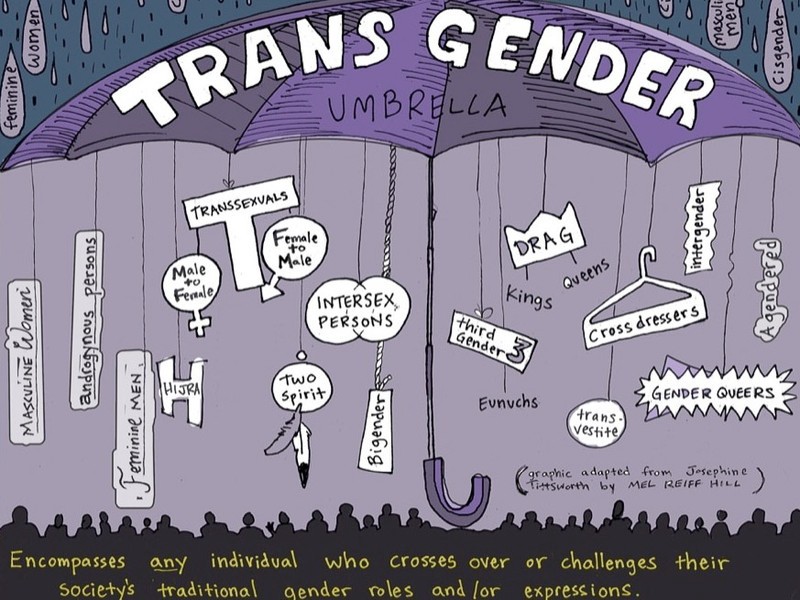
The first problem I have with the discourse from pro-trans advocates is that they seem to muddle sex and gender as much as their advocates do. Although when experts are explicitly making a difference between transsexual and transgender people, they more or less uphold the sex/gender distinction correctly, it is also very common for advocates and critics alike to call both simply "trans," which leads to all kinds of confusion. (I've often used "trans" in the same way in this essay, when I'm talking about the public face of trans rights.) This confusion leaks into almost everything anyone says, to where I can't even tell whether I agree or disagree with a statement. I believe the correct distinction is that transsexuals are those who have had sex reassignment surgery, while transgendered people are a large umbrella of those who challenge traditional notions of gender. Calling both "trans" muddies the waters greatly, and even when keeping a distinction, I'm not entirely sure that people consistently differentiate between biological and cultural concepts. So one huge problem I have is that the language all over is so imprecise, I don't even know what statement I'm being asked to agree or disagree with. 


As I understand it, transsexuals, those who have undergone sex reassignment surgery, are a subset of transgendered people, those who behave counter to cultural gender expectations for their given sex. 


Second, to take Cooney's description of Anne, is that Anne isn't really interested in queering gender. She's a rather gender normative man trapped in a woman's body. Her anguish comes about because her outward presentation of self to society doesn't match how she feels inside. She wants to change her voice, she wants to change her biceps. She spends a lot of time learning the "layers and layers of how to re-gender" herself: "It's not just new clothes and a new name. Not just wide stance and strong shoulders, nor just taking up space and talking loudly. For many transmen it's about how a guy props the door with his foot, that imperceptible difference in the kick of leg and tilt of hip." 

Anne isn't queer at all. She's not gender non-conforming. She's very gender conforming, just not to the social gender that's paired with her current biological sex. She's happy to accept gender normative standards, but not the ones that would be easier for her to pull off without drawing attention. She is, in a sense, transsexual but not transgender, as impossible as that sounds. If she were only a biological man, there would be no disagreement for her between how society expects her to act and how she feels.

This makes me wonder: do we need more men who take up space and talk loudly? More men who prop the door a certain way with their feet? Isn't this reinforcing traditional gender performance among men, albeit in a different package? Or is the project of queering gender more in need of biological women like Anne whose gender performance doesn't match what we expect? 

Cooney, a lesbian who had to fight to be seen, faces a loss with Anne's change. When she is seen with someone who passes for a man, she will no longer be seen as queer. Her identity, gained at great cost, will be taken from her. Anne's gain is Cooney's loss, although Cooney loves Anne enough that she is willing to support her.

Their decision how to balance their own gains and losses is personal, and I'm not here to question it. At the end of reading, I wished them only the best. But socially, I wonder if the eagerness to pass as a man by doing everything society expects a man to do and look like isn't undoing the project of queering gender. 

Ideally, it seems to me that society would accept that Anne's internal landscape aligns more with what we consider "masculine" than with "feminine," and that sometimes psychological masculinity can come in unexpected physical packages. Sometimes, the "masculine"--which is not a real thing, but something we culturally create--will have breasts and a vagina. Insisting on the importance of linking sex to gender seems like it's treating gender like it is a real thing. Anne seems to be saying, "I feel masculine, so naturally, I must need a male body to go with that." 

A biologist like Serano might suggest I'm making a body/mind dualism fallacy, because I think a masculine mind can exist in a female body, while Serano would say no, if someone is psychologically a man, he should also physically be one, since the mind is part of the body. I don't find that particularly compelling. If a body can demonstrate hermaphroditic qualities in two organs, such as body with both a penis and a vagina, why couldn't it also manifest a hermaphroditism that includes the brain as one of those organs? 

So my second misgiving is whether using medical remedies to make sex and gender match isn't an undoing of the whole project of queering gender. If everyone did this, there would be no gender rebels.

Third, it seems like a lot of Anne's concerns have to do with how she is perceived by random people in society, people she doesn't even know. She is happy when she is perceived as a man and called "sir," and then upset when someone hears her voice and stammers through an apology. She avoids going out in public a lot because of how people might view her. She hates being stared at. "She won't hold hands in public or walk by a group of men at night because no matter how much the queer community and academia discuss gender spectrum, the average American wants the binary boxes on forms to make sense and be absolute reality." (This sentence seems to me to be another muddling of sex and gender. When forms ask male or female, they want biological sex, not gender identity. This kind of thing happens all the time.) 

I'm sympathetic to Anne concerns for her own personal welfare. I hope everyone is. I especially felt for Anne going to the bathroom in public, where she lives her life "one safe pee at a time." 

It would be absurd for me to wish Anne would be braver, when I'm not half as brave as she is now. But I feel like Anne is taking T and considering surgery just to avoid dealing with the blowback from people she has no reason to care about. Her current spouse likes the way Anne is now, is ambivalent about the change. Cooney is willing to support Anne, because she knows how nerve-wracking it is for Anne to present herself authentically in accord with her self-identity in public. (Cooney, meanwhile, chides herself a bit too harshly for retreating into her privilege as an easily distinguishable woman.) But it's going to be hard on Cooney. She concludes her story with the words, "This is not what I signed on for." 

Cooney asserts that taking T or getting surgery do not change what Anne is. Those things "just let other people recognize her intentions when she walks down the street." 

I feel very torn about this. On the one hand, I genuinely sympathize with Anne. I hate going to public bathrooms now, and I have a beard and some lingering traces of biceps. I can't imagine what it's like for her. And nobody wants to feel unsafe. It's hard enough to go to a park for a walk and feel safe if you're an ugly bald guy. I'm sure it's a constant struggle for Anne. 

But doesn't this mean she's doing all this for other people? Just to get them to quit hassling her by making them more comfortable with how they read her? Wouldn't a more optimum state of society--not that it's Anne's responsibility to achieve this--be greater understanding that people like Anne exist and are entitled to space? All this altering of her body seems like a lot to require of Anne just to keep the peace in society. Her safety and freedom to move around unhassled shouldn't require her to have a beard and remove her breasts. 

Fourth, the subject that is most likely to be taken for bigotry. The surgery. The second I read something about Anne having "her hips shaved straight," I nearly quit reading. (One of the non-gender-conforming things about me is that I am squeamish. I also don't like snakes or spiders or rodents. Oh, and I have no interest in cars.)

Andrea Long-Chu wrote a thought-provoking article last year ((now many years ago--current Jake)) as she looked forward to her sex reassignment surgery. She wrote that she realized it was quite possible her new vagina wouldn't make her happy, but that this wasn't the point. "Left to their own devices, people will rarely pursue what makes them feel good in the long term. Desire and happiness are independent agents.” She's right. There must be some reason I keep writing, and it sure as hell isn't happiness.
 
She argued that the medical code of "first do no harm" actually turned doctors into gatekeepers of who should get surgery. Therefore, happiness shouldn't be the criterion for being able to get the surgery:
  
As long as transgender medicine retains the alleviation of pain as its benchmark of success, it will reserve for itself, with a dictator’s benevolence, the right to withhold care from those who want it.
But I also believe that surgery’s only prerequisite should be a simple demonstration of want. Beyond this, no amount of pain, anticipated or continuing, justifies its withholding.

That's a fascinating idea. It makes transsexual surgeries into something more like plastic surgery, something that doesn't require a justification beyond wanting it. If we take Anne as an example, the comparison to plastic surgery holds up fairly well. Anne wants surgery for many of the same reasons people who get plastic surgery want it: increased confidence and less social stigma. Those aren't frivolous goals, especially if you are thinking of plastic surgery less in terms of movie star nose jobs and more like burn victims getting restorative work. 

But society has justifiably mixed feelings about plastic surgery. Is it self-affirming or self-hating? A little of both? Feminists have criticized plastic surgery and the way unrealistic expectations about beauty for women have caused women to fork out money and endure pain to meet those standards. The practice is sometimes viewed by feminists as self-mutilation. 

Transsexuals see it as the opposite: self-revelation, a bringing forth of who they truly are. But I can't get past how much it must hurt. Yes, there's also the instinctive wince when I think of removing a penis, the thing many of the "pseudo-critics" Buckley talked about make a big deal out of. But beyond the shock factor, I just think surgery sounds terrible. At the very least, it has all the attendant risks of infection and pain cycles all surgeries involve.

If sex reassignment surgery resembles plastic surgery in some ways, then there seems to me to be a risk of the plastic surgery treadmill: always wanting just one more thing that will make you feel good enough. I can assure Anne, as a man who never, ever will be mistaken for anything other than what I am, that just passing won't be enough. There will always be something else you'll wish you had to make you feel more like a man. I wish I were taller. I wish I were more muscular. I wish I had a tougher sounding voice. I really wish I hadn't been born on the bottom end of average in the all-important organ size, and I really, really wish that organ hadn't started shrinking with age. I get that happiness shouldn't be the standard, and if someone is determined to get the surgery, I would stop trying to convince them otherwise. But I think it's important to be clear about how elusive contentment is no matter what body you're in. 

I'm not here to decide for others whether surgery is worse or living with present reality is worse. I will support anyone I know who makes the decision to get surgery. Once someone has crossed that line, it's stupid to question it, and from then on, the only sane thing to do is offer support for the person adapting to the new identity and new life. But I also don't want to gloss over questions about it. Without getting into the very contentious issue of how many people get the surgery and end up regretting it, because, as Long-Chu wrote, that's maybe not the point, I do think it's valid to raise similar objections that feminists raise to plastic surgery for people considering sex reassignment surgery. Yes, of course, do whatever you believe you must do to live a fulfilled life. If a woman knows what plastic surgery is and gets a giant boob job because she damn well wants to, more power to her. But at least consider that the problem isn't your body, it's how people look at your body. If society viewed a slender woman with breasts and a high voice wearing men's clothes as another embodiment of masculinity, there wouldn't be as acute a need to have a beard and biceps to match. 

Where there is actual disagreement

I think there is general agreement that trans people should not face violence. Even most conservatives agree with this. There is also general agreement that trans people should not face "discrimination," although I think there is a good deal of disagreement about what that means. Most people probably agree a trans person shouldn't be kept from a job, but there are things trans advocates want and claim would prevent discrimination that many find problematic. These include being able to use the public bathroom of their choice, allowing trans women to play women's sports, and forcing parents to provide gender-affirming care for their children under the age of eighteen. 

I'm at different places on some of these issues. The bathroom issue seems like the best argument, although it's going to take a long time for many cash-strapped organizations to refit everything to allow for single occupancy bathrooms. Nobody likes public bathrooms, although I doubt it's possible to put in 10,000 single-occupancy bathrooms at a football stadium, and I'm likely to bear the awkwardness of a public men's room rather than wait for a single occupancy room. Hopefully, most people will feel the same, so that will leave the few single occupancy rooms open to the people who really need them. 

I'm not sure how the other issues should play out or will play out. I would only offer the advice to trans advocates that playing down the issues isn't a good strategy. When someone objects to the advantage a trans woman who went through puberty as a boy has over other women in sports, or when someone points out how drastic a step removing a sexual organ is, these people shouldn't be gaslighted or shamed for even bringing up the objection. I've seen many arguments that the trans women in sports issue isn't really an issue, or that we only object to the extreme parts of sexual reassignment surgery because we are immature little children. I don't think talking past the sale is going to win long term. 

Sloppiness in use of language doesn't help, either. I know advocates can't control every person who posts on TwitterX, but part of their advocacy should be advocacy to their own ranks to use language correctly. 

Public and private


Whatever ends up happening with these issues, trans-gendered people have the unenviable fate of living a life that can never be truly private. Their very existence is being debated in the public sphere, so everything they do, no matter how private, can be used as fodder to feed one argument or another. Cooney's honesty, which I admire so much, could be used to say, "See! Sex reassignment is bad for the loved ones of those who get it!" I'm not saying that, and I hope Cooney doesn't live to regret the openness she wrote with.  

In political discourse, there is almost always an unfortunate shrinking of the truth. You've got some policy proposal, and it's got a lot of plusses and minuses, but overall, you think it's a marginal change for the good. So you pitch the proposal to the public, only when you pitch it, you don't talk about the negatives, or you downplay them, and you oversell the potential positives. You're not doing it to be dishonest, you just realize that honesty isn't going to get the proposal passed. 

Cooney's essay is so moving because it's unfailingly personal, not political, which means she's open to talking about the negatives as well as the positives. Because of this honesty, I was open to her reality in a way I haven't been before about the stories of trans-gendered people. 

Most of the decisions trans-gendered people make ought to be private ones. Whether someone takes T (or E) or gets something added or taken off isn't my concern. But somehow, it's an issue in public discourse now. Rather than attempting to immediately jump into legal remedies, I'd like to see society try first to focus on cultural ones. 

For example, one of Anne's chief concerns is how to use the bathroom safely and without harassment.  

A few of the things she's suffered in bathrooms:
-What are you?
-Prove it. (from a pack of hellish six-graders when Anne was in second grade)
-What the hell are you doing? You're in the wrong place.

Cooney says, "I've watched women enter the bathroom, see Anne at the sink, and step back to check the sign on the door." That actually sounds quite normal. That would be my reaction if I went into the men's room and saw someone in a dress at the sink. Going into the wrong bathroom by mistake sounds like something I'd do, because I'm an idiot. 

It would be nice if society could work on a system of signifiers to alleviate these situations. Something whereby one party could indicate that yes, I realize this isn't what you're used to, but this isn't a threat to you, and the other one could signal back, "Okay, carry on, then."

It would be nice if we had a language for Anne's experience. If we did, and she still wanted to live life as transsexual, not just transgendered, that would be fine. At least she could be sure that's what she wanted for herself, not wonder if she had been driven to the choice because it's so difficult living in society as something other than a zero or a one that she has to pick the one that will cause her the least trouble.  

Saturday, July 27, 2024

The Olympics is a world too much for me

Mrs. Heretic and I had plans for today, but after she watched the opening ceremonies yesterday of the 2024 Paris Olympics, she wanted to cancel our plans so she could watch. She's a sucker for three-minute documentaries of personal stories that crescendo toward an emotional climax. The swimmer whose dad died in a car crash because he was exhausted from taking his Olympian to early practice. The boxer whose aunt stepped in when everything fell apart. The volleyball player whose miscarriage nearly ended her career. The basketball player from Ivory Coast who just loves America so much. Mrs. Heretic's not the only one who loves this stuff. Melissa Kirsch wrote this morning in the Times about her love for picking an event and getting up to speed quickly to learn the what and the who and the so what. She admitted to being a "total sucker for a hyperemotional documentary featurette on that gymnast whose family sacrificed everything for her Olympic dreams." 

I understand this feeling, but for many Olympics now, I've passed on it. There are so many events and so many athletes, and each athlete has a story worth hearing. We tend to only get to hear about those who stand a chance of medaling. Part of the story-building is to pick an athlete, give the audience a reason to care, and then give them an event with stakes. The easiest stakes are a chance at a medal. Even if I watched every possible second of coverage, I would miss so many stories. And think of all the international stories I can't even access because I don't have that nation's coverage, and I couldn't speak the language even if I did. 

But what if I somehow could get the story of every athlete competing? How could I possibly do emotional justice to each of them? If the point of getting their stories before they compete is to appreciate that there's more at stake than just who wins, could I ever appreciate what's at stake enough? It's too many stories, and many of those stories end up pitting one person to root for against another. How to decide?

It's been years now since I rooted, I mean really rooted, for a team in sports. Not being able to love one side and hate the other robs me of the joy a lot of people feel in being fans, because it really is kind of fun to hate someone. But at some point, maybe during one of those "hyperemotional documentary featurettes" before a Super Bowl, I stopped being able to do it. Everyone--or maybe nearly everyone--is worth rooting for, and the universe doesn't have enough happy results to give out for all of them. 

The narrator of Elizabeth McCracken's The Hero of This Book speculates, "Maybe it's necessary to hate categories of people, because it's too much to assume that everyone has a soul." When I try to watch the Olympics, especially the opening ceremony with its flood of people and countries I'll lie and tell Mrs. Heretic I've heard of, I'm overcome with an acute version of sonder, the realization that everyone else has an interior life as rich as my own. It is too much to take. So much hope, so much striving, so few medals. I'll catch the highlights after the fact.   

Sunday, March 31, 2024

Removing blind submissions is a terrible idea, but so is keeping them

Let’s start by acknowledging that writing literary fiction is a bad deal financially for almost everyone right now. It’s bad for privileged cis, white, male writers like me, and it’s bad for nonbinary, poor writers of color. It's bad for writers and it's bad for journals. The economics of the literary journals we need to get to accept our work in order to progress as writers are, to be blunt, a scam. If that seems harsh, consider the similarities between how the average lit mag operates and those kiosks at the mall that grab passersby, telling them they have the face for modeling, and if only they’ll invest a mere $300 in a portfolio, they might be on their way to superstardom. The only thing that differentiates literary magazines is that they typically charge a lot less than $300. However, since you have to apply to many of them to have a hope of getting published, the total cost to the victim of the scam is about the same.

The modeling scam takes advantage of people’s natural tendency to overestimate their own value. Of course someone thinks I should be a model, the victims of the scam believe, so nothing seems out of place when someone suggests that the world sees a similar value in the victims.

For literary magazines, the exploitation of the Dunning-Kruger effect is even more invidious, because most of the people submitting actually do have some talent. The last few decades of MFA programs have generated tens of thousands of graduates, each of whom has, presumably, at least some ability. To go along with all of these, there are the hundreds of thousands more whose teachers or professors recognized they had some skill and encouraged them to make use of it. So the writers submitting their stories aren’t just fooled by their own vanity. They really can write at least passably. Do they write well enough to beat the 50-to-1, 100-to-1, or a million to one odds that some journals put in front of them? Likely not. But it’s three bucks to try, kind of the same as a lottery ticket, and you can’t win if don’t play, so in the three bucks goes. Maybe once in a while, you risk the big money and enter a $20 or $30 contest.


I assume my writing is as sexy as this woman's silhouette.


The people who run literary journals aren’t greedy like the scammers at the mall. In fact, most aren’t getting paid at all. There’s not much money in selling literary fiction these days, which is why they have to resort to squeezing writers to get even the few dollars needed to keep up a website or print a few copies. Stephen March, in a piece in Lithub in 2021 on Sally Rooney, compared literature as a business to the game musical chairs: “There is less and less room. There is less nature, there is less humanism, there is less capacity for argument, there are fewer places to publish, there is less attention to go around. There is less space, generally, from which to affirm life.” There are far too many writers relative to readers, so the only money literary journals can get is from the supply side, rather than demand, giving it its scammy appearance.

It’s important to keep this in mind when discussing the idea of blind submissions, or, more accurately, ending the practice of blind submissions. If the literary ecosystem currently favors certain demographics, it doesn’t favor them that much, because the system is bad for nearly everybody. And if certain proposals might shift the balance of favor in ways that might harm the potential for success of some writers, well, it’s not like the people benefitting are going to find themselves in all that enviable a situation, either. Writers should be kind to one another and try to preserve what dignity they can, rather than let the fight for the remaining scraps get ugly. There isn't much hope for any of us, so let's die with class. 

 The argument against blind submissions

I first became aware of the trend to end blind submissions a few weeks ago when I entered a short story contest. The decision surprised me, as I suppose it has a lot of people, mostly because I thought the research on blind submissions had showed it to be effective. I thought of the success of blind auditions in orchestras, which has been proven to improve the representation of women in orchestras.  

In explaining its decision, the journal cited three articles. Since becoming aware of the practice and looking into it a little further, I've seen these same three articles quoted quite a bit by other journals moving to similar practices. They are:


Below, I'm going to try to summarize the main arguments they make. Just in case it's not already clear, what we're talking about is the idea that when a story or poem or essay is submitted, it should either have information identifying the author or it should not. The three essays above all argue that it should include identifying information. 

1. There is a difference between orchestra auditions and literature


Two of the three essays explicitly mention those orchestra studies, and they acknowledge them as a reason why it might seem like a good idea to do the same thing in publishing. However, they argue that there are important differences between playing music and a writing/submitting a piece of literature. One important difference is that musicians typically do not play their own, original pieces in auditions. They are playing someone else's music, and there is, perhaps, while not perfect objectivity, at least relatively more of an objective standard as to how they are to perform. Chen writes: "Blind submissions do not actually have the same effect as, say, blind auditions, which suppose that the strength of a voice or an instrumental skill is more important than the identity of the singer or musician (also, the performed piece is not always an original piece). When it comes to writing, however, acknowledging the totality of the person behind the piece is arguably just as important as the piece itself." 

Gabbert probably explains the argument a little more precisely with: "Two cellists, a man and a woman, might audition with the same Bach piece; they won’t be playing their own music. And there seem to be nearly universally agreed upon standards of what constitutes good playing of Bach, which don’t vary much by gender. If they were each playing music of their own composition, we might run into a problem of bias again: namely, that we have been trained to perceive music written by men as great music. You glimpse this thinking in the common question, “Why are there no great female composers?” (Who says there aren’t?)"


2. The illusion of objectivity within the blind submission allows editors to indulge their conscious and unconscious biases

If writing has historically favored white, cis-male, heteronormative writing, and editors either fit those categories themselves or have been heavily influenced by an academic system that emphasized them, then they will struggle to avoid bringing assumptions fed by that system into their editing about what constitutes good literature. As the editors of Apogee put it, "the problem is that white/male/cis is the assumed standard."  Chen's version of the same idea was: "...in many corners of the literary world, quality has long been judged through a largely white, male, cis, heteronormative lens, and the practice of reading submissions blind perpetuates that standard of excellence and allows it to go unchecked." 

These assumptions might mean that an editor will fail to recognize another mode of storytelling, one that doesn't follow the narrative arc brought down from Aristotle. Or editors might discount diction that doesn't meet their expectations. In short, taking names off manuscripts doesn't mean that editors don't still bring biases with that into reading that can prevent greater inclusivity. Two of the articles cite statistics that show how literary magazines are still not (or as of 2017 were still not) as diverse as they ought to be. They reason from these statistics that editors continue to hold on to biases 


Problems with their arguments


The three articles use somewhat different logic to arrive at these claims, and cite different examples in places, but those two main arguments hold. Furthermore, all three acknowledge that blind submissions are not total evils. They can serve to fight against nepotism and favoritism. The Apogee article wrote" "There are valid reasons for doing blind submissions. Our friends at The James Franco Revieware all about blind submissions in order to stop the cult of celebrity." However, they also feel that in general, the good that blind submissions can do is outweighed by the negatives. Above all, all three alike argue that whether a journal chooses blind or identity-revealing submissions, what is really important is the makeup of the editorial staff. 

Overall, I think their arguments hold a reasonable amount of weight and are hard to dismiss completely. In practical terms, I think most literary journals have never really been blind. Other than in contests, which cost more money to enter, most do want identifying information on the piece being submitted, and it's been that way for a long time. If journals are going to do this, they ought to be all-in about it. Doing it halfway--by, say, asking for the name of the author but not looking at the biography--then they're asking for trouble. They might, in the quest to be inclusive, rule out someone who actually is Chinese or Guatemalan because they were adopted or took a married name or have a white father and now don't "sound" Chinese or Guatemalan. Also, some white writers might be able to present a very convincing world set within a non-white setting. I speak three foreign languages well enough to professionally translate in them. Much of my life has been in the company of non-white people, so I end up writing stories about non-white characters. Because I've been pretty deep in their culture, down to being able to speak the language, I can write a story that will make an editor think it was written by someone sharing the identity of those characters. I might even win a blind contest this way. In fact, I know that I've done this, because one editor told me so. So if a journal wants to avoid mistakenly picking a story by a white author, they need to go all-in. I'd recommend doing what Gordon Square Review has done. Their submission practices, the last time I submitted to them, said this: "We request that no cover letter or author bio be included in your submission. Instead, please share with Gordon Square Review what the story is about, the writing process of the story, and any context you believe is important to know while reading story." That seems to split the difference between not allowing for nepotism by allowing a writer to state how successful they already are, but also allowing a writer to explain how their background contributed to the story. 

Nonetheless, I do think there are some problems with ending blind submissions, and also with the philosophy of putting the author's identity front and center when selecting stories. Because that's really what all three articles are calling for. 

1. The lack of perfect objectivity in literature doesn't mean there are no standards at all. 

All three articles demonstrated what I would consider to be a troubling casualness in dismissing the notion of objective standards in literature. Chen wrote that "there is no such thing as objective quality." Apogee put it less extremely: "However, artistic and literary aesthetics are not an algorithm, and “literary excellence” is not an infallible mathematics." Gabbert, though, echoed Chen's absolute rejection of objectivity: "There is no universal standard of goodness." 

Rejecting the notion of objective aesthetic standards has become so commonplace, it seems many critics don't feel any sense of sorrow pronouncing that there is no such thing as "good" literature. They accept that literature can be reduced to a dialectical struggle between competing political interests and don't seem to feel any sense of loss. I've never been able to understand how. "No objectivity" would seem to mean you could just randomly pick stories for a magazine and do no worse than having a team of supposedly expert editors. Ask a computer to account for identities, pick the mix you want, and ignore the stories altogether. 

I'm sure Chen and Gabbert would reject this idea, if for no other reason than because it would diminish the political power of editors, which presumably they would like to keep in order to allow their kind of editors to fight for political ends they agree with. But they'd also likely agree that just because literary standards are not based on perfect objectivity doesn't mean there is no objectivity at all. It doesn't mean that 50 Shades of Grey is as "good"--yes, I think we can use that word--as Their Eyes Were Watching God. 

In aesthetics and ethics both, we might never be able, absent the decree of the gods, to determine with perfect accuracy where "good" lies, but we can create something like a plot graph, and we will find, over time and across cultures, that most of the dots for "good" are near one another. It can be hard to describe the area they inhabit, but that's really the job of literary and cultural criticism--to try to adduce something close to objectivity in a realm where there will never be absolute standards. 

Kim Yong Ha, a Korean writer I much admire, has written much about his admiration for Aristotle's Poetics. In spite of Kim's different cultural assumptions and identity, he finds a universal applicability in many of Aristotle's principles: "Thanks to (a movie director he heard about who always carried a copy of the Poetics in his pocket), I also started reading it, and that reading had an influence on novels I wrote afterwards...of course, my novels can't be compared to (the great classics Kim had been discussing earlier) but many writers the world over have gone through a similar process and ended up writing "work that seems new, but in reality is old." (From "Reading Dangerous Books," appearing in the collection See, Read, Speak. Translation mine.) 

Speaking three foreign languages may not make me the most globally aware reader, but it does mean I can to a small degree balance Western writing against some other traditions. And those other traditions show a nearly universal preference for a standard of "good" that even a fusty white professor from the 1950s would at least somewhat recognize. Even within Western culture, there have been eras where very different assumptions went into the production of literary work, and therefore those times yielded quite different work from other times. "Western literature" of the last 3,000 years is far from homogenous, but that doesn't mean we can't find something we can call "good" in any of the surviving records. 

2. The level of diversity needed to ensure the goal is impossible 


In this year's Best American Short Stories collection, one of the entries was "Do You Belong to Anybody" by Maya Binyam. As I pointed out in my critique of the story, it included a lot of veiled references to the last sixty years of Ethiopian history that would have been lost on most readers. At least some critics of the story ignored it, figuring one African country is the same as another. But I recognized the references, because, as fate would have it, I spent about five years studying modern Ethiopia rather deeply. So the story read quite differently to me than it would have to other readers. 

America is the most culturally diverse country on Earth. That means a journal can and will get submissions from writers who fully qualify as "American" but who are also writing from deep within other cultural contexts. Can any board of editors be diverse enough to recognize the political bent of a Nepalese-American, how that writer might be coming down on a variety of political issues well known to Nepalese diasporic readers but invisible to others? Can they do this for all the diasporas that might be represented within the submission pool? 

If we followed the recommendations of these three editorials, we might have picked a black, female editor over someone like me in order to achieve the needed diversity to judge a story like Maya's. But white, cis-male, middle-aged, balding, upper-middle-class me would have been a better judge of Maya's story.  (I say "Maya," rather than "Binyam," because Ethiopians use their given names to identify themselves. Did you know that? I do, but some critics of her story did not.) 

All three articles hoped that they could make up for weaknesses in identity-revealed submissions by first ensuring a properly diverse team of editors. But how on Earth is the average journal supposed to do this? How would they know if they are being blown away by something that seems novel to them, when in fact the writer is simply picking some very common item from another culture, one that wouldn't impress readers from that culture at all, the way Yoon Choi did in "The Art of Losing"? (For that matter, isn't it politically problematic that so much of the literary understanding of Americans about other countries comes from diasporic writers, rather than truly foreign writers in either the original language or in translation?) 

3. The statistics cited don't always support the arguments made


All three articles used similar statistics to prove that literary journals are still in thrall to white, cis-male, straight guys. They all seem to have ignored what is very clear from one of the very studies they cite: employees in the publishing industry are about 75% female. This has been an open secret in the literary community for as long as anyone can remember. Personally, as a writer who often creates what I've termed "bro lit," I feel that it's had an effect on what kinds of male stories get published. They are often either over-the-top tales of toxic masculinity, or they feature male characters I don't really recognize. 

One might also note other anomalies in the data. A whopping 19% identify as something other than straight, although the percentage of people in the general population identifying themselves as LGBT is around 7%. As in music and film, if anything, there is an over-representation of non-straight voices, at least in terms of raw numbers. This might be because there is something about literature that tends to attract LGBT people. Indeed, I've taken personality inventories that suggested I was gay, largely based on nothing more than my self-identified love of poetry. So there's likely nothing invidious in it, but it would be hard to claim that if there's an under-representation in publishing of non-straight voices, it's owing to a lack of representation among decision makers. 

That same study from Lee & Low Books identified a number of improvements within publishing that have taken place since the first survey they took. All in all, the assumed dire situation all three share seems overstated. We are in the middle of a shift, and if the slow and steady approach hasn't yielded all the results we'd like right away, that's no reason to suddenly switch to the nuclear option.

You keep on citing those statistics. I do not think they mean what you think they mean.


4. Putting the author back in the center of literary study will undo a century of important critical work


In his essay "Authorship in Contemporary American Literature," Anis Shivani traces the history of the place of the author in critical theory over the last 100 years. Once, critics viewed the mind of the author, or the author's true intent, as the transcendental signified it was the critic's duty to discover. However, after first the New Critics and then Roland Barthes and Jacques Derrida in the late 1960s, not only did the author cease to be the central foucs of literary study, but actually, in the more extreme versions, the author disappeared entirely. The author was "dead," to use the title of Barthes' essay. 

However, Shivani observes that, counter to the critical preference for the decentralizing of the author, the publishing industry prefers to have the author at the center of literarture. "From technology to economics to culture, the tendency today ought to be for the supremacy of ecriture (writing), the reduction of the author to scriptor, whereas in fact the literary industry pushes hard for exactly the opposite, the transcendence of the author and the negation of the reader."

Criticism sees the death of the author as an important part of dismantling authoritarianism in general, because of the way it gives freedom to the reader, whereas authors "actively excluding creative readers from interpretation" is exactly what publishers want. The author's "own authenticity deriving in large part from the academic discourse of diversity, authors must blend into this discourse if they are to have any authority in the marketplace of texts. Authority is extracted ultimately from the community of novice writers, rather than freestanding critics, again evoking medieval conditions. Active readership, which may take interpretation in such stray directions, becomes a hindrance to the author's establishment of authenticity, which rests on constraining the possible range of interpretations."

Criticism of all sorts viewed author-centered readings with suspicion. To use one example from feminist theory, Toril Moi's criticism of Gilbert and Gubar's The Madwoman in the Attic undermines the way the book assumed a unitary and whole female author throughout its history of literature, a move that ironically reified the entire patriarchal structure it was meant to attack: "For the patriarchal critic, the author is the source, origin, and meaning of the text. If we are to undo this patriarchal practice of authority, we must take one further step and proclaim with Roland Barthes the death of the author." 

Chen claimed that "When it comes to writing... acknowledging the totality of the person behind the piece is arguably just as important as the piece itself."  What is this if not putting the author's identity at the forefront in a way even the pre-New Critical world would not have? 

My own biases and interests 


I conclude by acknowledging that I, like everyone trying to publish fiction, have my own interests that are affected by the philosophies of editing staffs. If they are to actively, rather than wistfully, push for greater diversity of story tellers--and they should--then this likely makes the odds longer for me. I don't want to write this, because it sounds like "reverse racism" nonsense, but I don't see how the math works out any other way. The majority of writers submitting to any mainstream journal are probably white. Let's say a staff makes a decision to actively pursue diversity by considering the identity of the writer, and says that of the four stories it will chose to publish in its next edition, at least two must be by writers of color. If 80% of the 500 submissions are from white writers, my odds of getting published are now 200 to 1. The odds of a writer of color are 50 to 1. Those odds are still terrible for both of us. The point is not to claim some kind of reverse racism, but I think it's dishonest gasligthing not to admit that at least in the short term, the odds for a non-established white, cis-male, straight author of breaking in through a journal are going to be longer than those of a lesbian Chinese-American woman. 

Of course, the writers of these essays would argue that the practice isn't unfair, because the writer of color had to overcome more obstacles just to get to a place where she could submit a story to a journal at all. There's certainly merit to that argument, and in the big picture of what's good for society, the practice is likely beneficial. But when I get rejections and feel like I'm worthless for a day, I may not care about what's good for society as a whole. I'm not going to argue that my feelings are a reason to keep the old policies, but editors should at least be aware that those feelings will exist. 

The big difference between what I'm saying and what a "reverse racism" proponent would say is that I'm not really arguing that it should be different. Harold Bloom complained about literary awards given out based more on the identity of the writer than on the quality, but I've found, as a close reader of short fiction award winners for the past decade, that the quality of writing of stories hasn't gone down. I would guess that what's more likely happening is that editors are getting an abundance of stories good enough--and here, I'll use "good" unproblematically--to be published. With more good stories than they can publish, they look to authorial identity as a sort of tie-breaker. It's much the way affirmative action college decisions were supposed to be made. This is a fine way to pick stories, and probably as good a way to decide between stories of relatively equal merit as there could be. 

The biggest award I've received as a writer was winning New Letters' Robert Day Award for fiction. I won a contest that was read blind. The judge was a female writer of color. I wonder if she read my story, about a North Korean defector working at a hotel in Seoul, and found it "felt" authentic enough that it likely came from an ethnically Korean writer. I wonder if that helped me win. Nobody ever said anything to me about it, and the magazine still runs this contest without identifying information on entries. That story had been a near-miss at many journals before winning the contest, and I do wonder if it would have ever been published in such a high-quality journal if it hadn't been for a blind contest. If there are no blind contests again, I might never get into such a high quality magazine again. 

If that's true, it's okay. Proponents argue that in the long run, this activist approach might actually help writers like me, because it will grow the community of readers. Ideally, it would make journals less financially strapped in the future as the literary world becomes less moribund. I'm skeptical this will happen, but I do think that of all the attempts to actively improve our society's assumptions about race, the most effective one has been the proliferation of narrative platforms to new and diverse voices. If I have to be a part of the generation of white writers whose prospects shrank for the first time in history in order to get there, then I accept that, based on utilitarian "greatest good for the greatest number" reasoning. I'd only ask that in return, I not be given assurances that things are still easier for white, male writers than they are for everyone else. This might be true for established writers, but I don't think it's true for people trying to break in. The math just doesn't support that.