Showing posts with label gender and writing. Show all posts

Tuesday, November 4, 2025

Persian Paradise Lost that gets, um, lost: "Mornings at the Ministry" by Ehsaneh Sadr (O.Henry 2025)

I was pretty sure during my first read-through of "Mornings at the Ministry" by Ehsaneh Sadr that I was dealing with an unreliable narrator. Dr. Amir Musavi insists during his account of his dealings with the other, female Dr. Musavi, that he wishes her well at every turn until she becomes his supervisor, and even then that he only turns against her because of her unkind and dishonorable behavior. He explains that he never actually intends to turn over the incriminating evidence he finds against her--that she went without her chador and allowed men close to her while studying abroad--to anyone who could have used it to damage her. At the very end, we find that Amir is unable to hit his daughter in order to teach her not to be like the other Dr. Musavi, but that he does try to hurt her with words. Maybe Amir lacks the killer instinct needed to have really tried to do Ms. Musavi harm, and therefore, perhaps we can believe some of his claims to have not meant to hurt her. 

My guess was that if I looked at it more carefully, though, I would find that Amir is overlooking his own misogyny, his own complicity with Iran's patriarchal and highly sexually repressive society, and that because of this, he misses his own culpability in Ms. Musavi's undoing. On a second reading, I did find some evidence for this, but I would argue that Amir's moral position is more complicated than that of a sexist, Iranian version of Iago. 

Types of unreliable narrator


In considering whether Amir should be considered an unreliable narrator, it might be a good idea to consider some of the ways in which a narrator might be unreliable.

  • They might simply be in a bad position to have reliable knowledge. They might have heard a story second-hand, or have incomplete materials to draw from.
  • They might know they are lying, and the narrative is a deliberate attempt to deceive.
  • They might have an inkling that they are being less than fully true, but they are deceiving themselves as much as the reader. This is probably the most common type of unreliable narrator in contemporary fiction. It's also probably the most common type of lie you'll hear in real life.
It suddenly hit me while reading through the second time that Amir isn't the narrator. This should have been pretty obvious, since it's a third-person narrative, but because it was so closely told from Amir's point of view, I nearly didn't pick up on it. The third-person narrator was revealing Amir's own self-justifications in Amir's own language, exactly as Amir's own thoughts would have run. Above all, the narrator was logging Amir's many examples of protesting too much that he had goodwill toward Ms. Musavi. For example:

  • Amir expresses sincere regret that he and his wife Seema had not "gotten around" to inviting Ms. Musavi over for dinner when both Amri and Ms. Musavi were studying abroad in Australia. The justification is that Amir and Seema were too busy with their children. 
  • Amir claims it wasn't just a surprise when Ms. Musavi joined his team back in Iran years later, but a pleasant surprise. 
  • Amir records having done his best to get Ms. Musavi acclimated to the team, including getting her a better chair than she otherwise might have gotten.
  • Amir, in an unexpected show of quasi-feminist enlightenment, scolds his wife for assuming that Ms. Musavi's high rank upon getting hired was a result of connections, a notion he derides as "sexist." 
  • Amir supposedly admires Ms. Musavi at first, but does not sexualize her, in spite of the extraordinary amount of time he spends observing her eyebrows from within her chador.
Because I can never remember which is which, here's a helpful visual from the Montreal Gazette.


Everybody's nice until somebody gets promoted over you


Up until Ms. Musavi's promotion, Amir's claims (or the narrator's claims about Amir) to have largely congenial feelings toward Ms. Musavi seem plausible, perhaps even believable. But when she gets promoted over him, his feelings go off the rails. There are a few sources of his newfound hostility to her: she rebuffs his attempts to suggest she be more genial at work, she is tough on junior researchers, but mostly, he finds her sycophantic attitude toward senior officials at work repulsive--especially when contrasted to her bullying attitude toward junior members.

And here, I have to admit to having feelings a little like those that many people have when reading Milton's Paradise Lost. Milton did such a good job of imagining the motivations of Satan in his poem that many people--myself included--report feeling more sympathy toward Lucifer than with God when reading the poem. I knew that Amir's motives were suspect, and that I wasn't supposed to trust his account of Ms. Musavi, and yet I found myself rooting for him and against Ms. Musavi anyway. This is true even though I highly suspected while reading that Amir--or the third person voice reporting on behalf of Amir-was not reliable. Perhaps because the voice was in third person, I felt it was at least somewhat objective when it recorded events and attitudes. This was reinforced because of occasional admissions, such as Amir admitting to jealousy. Sure, maybe she wasn't as bad as Amir said, but still, she was bad enough to root against. 

Who is at fault?


I'm not going to do my "literary court" schtick here, but if I were to do it, this would be a good story for it. 

It is easy to sympathize with Ms. Musavi because of the pervasive patriarchal oppression she finds herself in. It's an oppression in which refusal to meet with expectations can be met with draconian punishments such as acid thrown into a woman's face. It's an oppression where the word "khanoom," a respectful title for a lady like "Miss," can also mean simply "wife of," such that the title that Ms. Musavi is given to disambiguate her from Amir, the other Dr. Musavi, makes her sound like she is his wife, rather than a PhD of her own accord. 

Even though it's easy to feel compassion for Ms. Musavi for being a highly educated woman in a society where she has to hide behind her chador all day in the presence of men, I still found myself not liking her, and agreeing with Amir when he dislikes her. Just like when reading Paradise Lost, even though I know that this isn't what I'm supposed to feel, I felt it anyway. Ms. Musavi strikes me as the type of woman I've come across in professional circles who was given bad advice about how to act like a man as an act of defiance and also as a way to insist on being taken seriously and get ahead. Most women I've known who adopt this philosophy act either like no man I've ever known, or like the kind of man nobody likes. Maybe a hard-edged, opportunistic shark of man does occasionally rise to the top, but in my experience, the one personality type that does well everywhere is the go-along-to-get-along kind. I'm not saying that's a good thing, but it does seem to be a truth. Amir's advice to Ms. Musavi was essentially that: chill out, get along better with your colleagues. 

Amir has the good sense and tact to give her this advice one morning at the ministry when he and Ms. Musavi are the only ones there, so he isn't putting her on the spot. Up to that point, he had helped her out in her career and noticed her many strengths. The only drawback he has seen is her "inability or unwillingness to make friends at the ministry." He recognizes that as a woman, it is difficult for her to join in some of the banter with men that allows Amir to make friends. He isn't, perhaps, aware enough of the difficult she has as a woman, though, and as a result, he makes a mess of his advice. 

To my mind, though Ms. Musavi is unduly harsh with Amir. His advice is undoubtedly good, at least in spirit, although she was quick to point out the pitfalls in Iranian society of "making friends with all the men" in the office. Had she tried to respond more charitably, though, she might have learned something. If she came off as cold to Amir, she likely came off as cold to others, and it doesn't really even matter if that is just or not. There is a "perception is reality" predicament at work, and Amir, for all his tone-deafness, is trying to help her with it. 

How it turns out


In spite of being perceived as cold, Ms. Musavi advances to division leader over Amir. Her hard work and ability won out over her perceived aloofness. But I'm not sure Amir's feeling that she became unduly harsh can totally be written off as jealousy. I might be misreading the situation. Possibly, it's more normal in Iran for a senior boss to be very harsh, as Ms. Musavi seemingly was, and so she was just acting like any other male boss would have. But it's hard for me to think that, since so many of the workers in Amir's office seem to have been Western educated and to have picked up at least a little bit of the vibe to mellow out their conservativeness. I would guess the ministry isn't a place where her no-excuses toughness approach would succeed.  

The scene in which Amir goes to do the right thing and give Ms. Musavi the photos which were accidentally delivered to him, of her not wearing her chador and being casual in mixed company while in Australia, but then he is derailed from his good intentions by Ms. Musavi's own brusqueness, is pure Greek tragedy. Perhaps it's best to read the scene in that spirit, where Ms. Musavi's own strengths--her independence and her determination to be taken seriously--end up being her downfall. Had she not started the conversation with belittling Amir, he would have given her the photos and that would have been the end of it.

I think many Western readers--who, let's face it, if they're reading this story, are by and large liberals--will come to the conclusion that Amir was largely that ubiquitous boogeyman of online feminism, the insecure man afraid of a strong woman. That may be part of it, but to me, the story is better and far less obvious than this caricature of men that feminist activism often draws 

Rather than being a cartoonishly evil man who masks his evil through culturally accepted ideas of propriety, Amir is a good man who isn't quite good enough. He's been exposed to some modern ideas about women's roles, and to some extent, he agrees with them and is happy to comply. In a less unjust society, his casual willingness to be thoughtful when it isn't too hard for him would probably be all that is morally required of him. But in the context of an Iran that will put the feet of the non-compliant woman into a bed of cockroaches, it isn't enough. Amir is a man of average moral makeup when the situation requires moral greatness. 

Amir has good intentions but is irresolute. He has too much of a tendency to assume what has been passed on to him is good. He accepts most of the cultural conservatism as necessary, although he is willing to "be reasonable" about small sins. When confronted with his own daughter's laxity, his initial response, because he fears for his own daughter's safety, is to hit her for her own protection, in order to prevent her from ever ending up in the same compromising position as Ms. Musavi. He can't bring himself to do it, so he opts instead to call her a jendeh whore, which is kind of like calling her a whore twice. Even with that, though, he doubts himself: "Had he gone too far, saying words that might cause her to doubt her worth? All he wanted was to protect her." The story is a recognition of how difficult it can be for a person of ordinary moral judgment and strength to make sound moral decisions in a society where values are so wrong. 

Symbolism


Speaking of protecting, the story makes wonderful use of symbolism, particularly in the chador. When Amir and his wife were overseas, they tried to explain the virtues of the chador to skeptical Westerners. However, "Amir wasn't sure they were ever able to convince Westerners that the chador actually elevated and empowered women by protecting their delicate and yielding parts behind an impenetrable, iron curtain."

Amir believes that on an intelligent woman like Ms. Musavi, the chador served to both make her even more intimidating compared to unveiled men (maybe with a similar effect to mirrored sunglasses) and also to deaden sexual desire. And with this second claim, I do feel with a greater degree of certainty than with others that Amir really is protesting too much. The chador really does nothing to deaden his erotic feelings for her. He simply redirects them. Given only her eyebrows to work with, he manages to make them erotic and to fetishize them, to obsess about them until the mere suggestion of a similarity in his own daughter, another Ms. Musavi, drives him to act in a way he is himself ashamed of. 

The title of the story is "Mornings at the Ministry." There is only one morning at the ministry that is covered in any great detail in the story, and that's the morning when Amir tries to counsel Ms. Musavi. Yet the story is called "Mornings," plural, at the ministry. This title, perhaps, reveals what Amir has carefully tried to cover through the chador of a third-person narrator, which is that he sexualizes Ms. Musavi, in spite of himself, and that these feelings make him unable to keep his other feelings in balance enough to do the right thing. To the narrator naming the story, the thing that stands out most are the moments when Amir was alone with Ms. Musavi before anyone else came in to work.

It's possible that the erotic attraction is partly about more than sex. It might be that Ms. Musavi represents a greater cultural freedom that attracts Amir even while he fears it. Whatever the feeling is, Amir is eventually unable to reconcile his commitments to public rectitude with the private, undeveloped intuitions of his conscience. 

Sunday, August 4, 2024

Hoping I know the difference between a skeptic and an asshole: a personal reaction to Molly Cooney's "Transition: The Renaming of Hope"

Note: I first wrote this more than four years ago. Since then, I've been too afraid to publish it, partly because I thought it might invoke an angry response and partly because I wasn't sure I knew what I was talking about. By now, I think I'm reasonably sure nobody cares what I write enough to get angry about it, and while I'm still not sure I really know what I'm talking about, it seems that there is enough uncertainty, even among liberals, about some points advanced by pro-trans rights groups that it might be worth this effort to explain, even imperfectly, what some of those doubts are. The NYT's decision recently to publish an op-ed questioning gender-affirming care made me decide to go back in and dust this off. I may be wrong about everything, but at least this might serve as an expression of what the doubts of a thoughtful liberal might be. For those advocating trans rights, it might help them to refine their message to address these kinds of doubts. 

I've left most of the anachronisms below in place. Where I thought it necessary, I've added notes to make it clear that the statement was written years ago. For some reason, when I wrote this, I cited a bunch of articles from Medium as statements of what trans advocates claim. I've read better articles since, but I'll leave what I have in place. I feel like I should say that the reason I've revived this oft-abandoned project isn't because of the furor over Olympic boxer Imane Khelif, who I realize is not a trans woman. Imane is an example of many things, including how the public struggles to see differences between one issue that makes it uncomfortable and another, and also how TwitterX is poison, but she isn't a trans woman. It was mostly the NYT article, as well as another article I can't find now about how Democrats are split on trans issues, that made me think it might be worth putting this out.

I still feel the same empathy for Cooney's partner I did when I wrote this piece. I want a world where they can be safe and pursue happiness. That's more what I remember four years later than the questions I wrote about below. 

Here's the piece..

---


When I blogged my way through the 2019 Pushcart Anthology last year, I only looked at the fiction. It's the only thing I can claim enough skill in to critique with some authority, so I passed over everything else. But my blogging pal Karen Carlson wrote about one of the non-fiction pieces from Pushcart in a way that intrigued me. I went in and read it, and was glad I did. I then wrote about it, sat on what I wrote for over a year, and am putting it out now in spite of strong doubts about the wisdom of publishing this. ((Note from present day Jake: I must have added that last sentence in 2021, a year after I originally wrote this, when I was considering publishing it belatedly before deciding not to. Obviously, I've been unsure about publishing this since the minute I wrote it.)) 

You see, I have a confession. I'm a bad liberal. I'm secretly not orthodox with some of the things all liberals are supposed to believe. I used to be; there was a time when most of the things you'd expect a liberal to believe were also things I believed. But the "T" in LGBTQIA+ has been a stumbling block for me. I mostly keep it to myself, because skepticism on certain points is just not something the people I hang around are expected to express. Curt Buckley wrote a piece on how skeptics of mainstream conclusions by the medical community about trans-gendered people are often just the same old bigotry masquerading as healthy skepticism. I'll try to be as acutely aware of Buckley's criticism as I can and to keep the line between skeptic and asshole clear.

I'd have continued keeping quiet about my reservations if not for two things. One is how moved I was by the piece that appeared in Puschart. Called "Transition: The Renaming of Hope," it is Molly Cooney's description of what it's like living with a partner who is about to transition from biological female to male. Her partner, Anne, is already taking testosterone, or "T" as Cooney calls it throughout the article. What makes Cooney's story so compelling is that there isn't a trace of sentimentalism, politicking, or whitewashing of the experience. It's uncomfortable. Cooney has profound misgivings about it. Although she loves her partner and wants what's best for her, her partner's transition poses challenges to Cooney's own identity. (I would ordinarily call Anne "him" to fit his identity, but Cooney is fluid about the pronouns she uses for Anne, mostly using "her" to speak of the person she has known so far, so I will do the same. "She/her" is the person Anne has been, and "he/him" is the person she will become, although I realize trans-advocates will say Anne has always been a man.)

I found myself genuinely pulling for this family. Cooney's story is almost magical in its ability to make me feel what her family is like. Not only is she a good writer, but she seems like an absolute gem of a spouse, because of how well she understands Anne. It was possible, in a way I've never experienced before, to understand the psyche of a person considering sex reassignment surgery, as well as the people around them.

The second reason is the current fuss about comments J.K. Rowling has made. ((Note from current Jake: Who knows which iteration of Rowling comments I was thinking of when I wrote that? There have been so many. God, I hate TwitterX.)) I'm not posting this  now to agree with Rowling. I simply want to say that there are some people like me, people who are generally on the same side of the political spectrum as trans-advocates, but still have questions. I believe trans-advocates should work to answer these questions without just trotting out "transphobia" as an attack. Before this is a political issue, it's an intellectual issue, and I'd like to be able to discuss it neutrally, outside the political implications, before making up my mind on how I'd like to align myself with those fighting for trans rights.

I felt such respect for the family in Cooney's essay, I've decided to make my long-held doubts public. When you respect someone, you're honest with them, the way Cooney was honest in her story. Before I launch into this, I want to reiterate that what motivated me to do this was how moved I was by what Cooney wrote.

I'm not any kind of expert on this subject. It's off-brand for me, you might say, to even talk about it. But maybe that's why it's worth thinking about what people like me might be thinking. I'm a reasonably intelligent, reasonably well educated non-specialist who has to make up his mind on an issue where much of the evidence is technical beyond his ken. I'm someone who's done a reasonable amount of research on this and who just can't get himself to come around to the view people in my normal political camp seem to want me to arrive at.

The doubts

Part One: Some history, both personal and cultural 

Back in the late 90s and early aughts, as an undergraduate and then graduate student in the humanities, I thought I understood the relationship between sex and gender. Sex was something nobody had control over. You got one or the other at birth. Yes, there were some exceptions, some people born with disorders of sex development, where the chromosomes said one thing, but the gonads said another. But at most, that was not quite 1% of people. For most of the world, sex was, I thought, a zero or a one. 

Gender, or the outward expression of sex-based characteristics, was once believed to be tied infallibly to sex. Men were "supposed" to hunt and try to have sex with women and fight. Women were "supposed" to be nurturing and supportive and knit. But we now know better: gender is not completely biological. It is a cultural construct. Men don't behave "like men" just because of testosterone and a Y chromosome. We're taught how to act like men. And what can be taught can be untaught, what can be learned can be unlearned. 

"Man" and "woman" referred to sex, as did "male" and "female." The terms "masculine" and "feminine" referred to gender. To quote Toril Moi, "It has long been an established practice among most feminists to use "feminine" (and "masculine") to represent social constructs (patterns of sexuality and behaviour imposed by cultural and social norms), and to reserve "female" and "male" for the purely biological aspects of sexual difference. Thus "feminine" represents nurture and "female" nature in this usage. "Femininity" is a cultural construct: one isn't born a woman, one becomes one, as Simone de Beauvoir puts it. Seen in this perspective, patriarchal oppression consists of imposing certain social standards of femininity on all biological women, in order precisely to make use believe that the chosen standards for "femininity" are natural."  

According to how I saw it back in grad school, challenging the cultural expression of man/woman and its necessary link to masculine/feminine--a process known as queering gender--was the project of those committed to re-thinking gender and society. It seemed to me back then that one of the most important projects of gender studies was to take the Venn diagram of what constituted male and female behavior, make both circles much larger, and then make the intersection between them so unpredictable and weird it would need the same math used in quantum calculations to figure out. Or, as Moi put it, to "disentangle this confusion (of femininity and femaleness)." I was on board with that. By that point, I'd experienced two versions of male culture out of control: high school football and the Marine Corps. Redefining what being a man and a woman meant seemed like a needed social project. 

A bit of an aside

Since I was in graduate school in the early 2000s, there has been some work in biology that questions whether the "purely biological" part of the sex/gender distinction is as clear as it seemed. That is to say, even "man" and "woman" aren't as simple as we once thought. Julia Serano, a transwoman biologist, has written a few articles and a book in which she tries to dismantle the idea that biological sex is as clear as we think it is. I don't have time to get into this fascinating idea. Serano is writing within a political environment in which some feminists do not accept transwomen as real women--the so-called "TERFs." Her arguments are often directed at those feminists. I will only say here that while Serano has some valid points, I think she makes too much of exceptions in nature and tries to use those to prove points in too general a sense. Sex might be more complicated than we thought, and nature always has surprises for us, but for now, I think these arguments lead more to a refinement of the definition of sex and not a revolutionary upturn. Arguments against Serano are here and here. ((Note from current Jake: Sorry I used Medium so much here. I'm sure you can find easier-to-access articles that will say the same things.)) 

Part Two: My doubts, as succinctly as I can put them

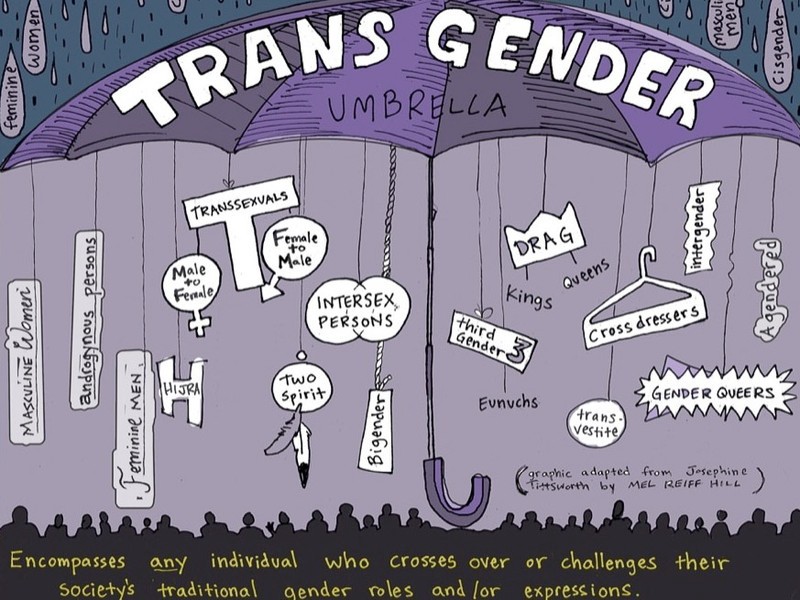
The first problem I have with the discourse from pro-trans advocates is that they seem to muddle sex and gender as much as their advocates do. Although when experts are explicitly making a difference between transsexual and transgender people, they more or less uphold the sex/gender distinction correctly, it is also very common for advocates and critics alike to call both simply "trans," which leads to all kinds of confusion. (I've often used "trans" in the same way in this essay, when I'm talking about the public face of trans rights.) This confusion leaks into almost everything anyone says, to where I can't even tell whether I agree or disagree with a statement. I believe the correct distinction is that transsexuals are those who have had sex reassignment surgery, while transgendered people are a large umbrella of those who challenge traditional notions of gender. Calling both "trans" muddies the waters greatly, and even when keeping a distinction, I'm not entirely sure that people consistently differentiate between biological and cultural concepts. So one huge problem I have is that the language all over is so imprecise, I don't even know what statement I'm being asked to agree or disagree with. 


As I understand it, transsexuals, those who have undergone sex reassignment surgery, are a subset of transgendered people, those who behave counter to cultural gender expectations for their given sex. 


Second, to take Cooney's description of Anne, is that Anne isn't really interested in queering gender. She's a rather gender normative man trapped in a woman's body. Her anguish comes about because her outward presentation of self to society doesn't match how she feels inside. She wants to change her voice, she wants to change her biceps. She spends a lot of time learning the "layers and layers of how to re-gender" herself: "It's not just new clothes and a new name. Not just wide stance and strong shoulders, nor just taking up space and talking loudly. For many transmen it's about how a guy props the door with his foot, that imperceptible difference in the kick of leg and tilt of hip." 

Anne isn't queer at all. She's not gender non-conforming. She's very gender conforming, just not to the social gender that's paired with her current biological sex. She's happy to accept gender normative standards, but not the ones that would be easier for her to pull off without drawing attention. She is, in a sense, transsexual but not transgender, as impossible as that sounds. If she were only a biological man, there would be no disagreement for her between how society expects her to act and how she feels.

This makes me wonder: do we need more men who take up space and talk loudly? More men who prop the door a certain way with their feet? Isn't this reinforcing traditional gender performance among men, albeit in a different package? Or is the project of queering gender more in need of biological women like Anne whose gender performance doesn't match what we expect? 

Cooney, a lesbian who had to fight to be seen, faces a loss with Anne's change. When she is seen with someone who passes for a man, she will no longer be seen as queer. Her identity, gained at great cost, will be taken from her. Anne's gain is Cooney's loss, although Cooney loves Anne enough that she is willing to support her.

Their decision how to balance their own gains and losses is personal, and I'm not here to question it. At the end of reading, I wished them only the best. But socially, I wonder if the eagerness to pass as a man by doing everything society expects a man to do and look like isn't undoing the project of queering gender. 

Ideally, it seems to me that society would accept that Anne's internal landscape aligns more with what we consider "masculine" than with "feminine," and that sometimes psychological masculinity can come in unexpected physical packages. Sometimes, the "masculine"--which is not a real thing, but something we culturally create--will have breasts and a vagina. Insisting on the importance of linking sex to gender seems like it's treating gender like it is a real thing. Anne seems to be saying, "I feel masculine, so naturally, I must need a male body to go with that." 

A biologist like Serano might suggest I'm making a body/mind dualism fallacy, because I think a masculine mind can exist in a female body, while Serano would say no, if someone is psychologically a man, he should also physically be one, since the mind is part of the body. I don't find that particularly compelling. If a body can demonstrate hermaphroditic qualities in two organs, such as body with both a penis and a vagina, why couldn't it also manifest a hermaphroditism that includes the brain as one of those organs? 

So my second misgiving is whether using medical remedies to make sex and gender match isn't an undoing of the whole project of queering gender. If everyone did this, there would be no gender rebels.

Third, it seems like a lot of Anne's concerns have to do with how she is perceived by random people in society, people she doesn't even know. She is happy when she is perceived as a man and called "sir," and then upset when someone hears her voice and stammers through an apology. She avoids going out in public a lot because of how people might view her. She hates being stared at. "She won't hold hands in public or walk by a group of men at night because no matter how much the queer community and academia discuss gender spectrum, the average American wants the binary boxes on forms to make sense and be absolute reality." (This sentence seems to me to be another muddling of sex and gender. When forms ask male or female, they want biological sex, not gender identity. This kind of thing happens all the time.) 

I'm sympathetic to Anne concerns for her own personal welfare. I hope everyone is. I especially felt for Anne going to the bathroom in public, where she lives her life "one safe pee at a time." 

It would be absurd for me to wish Anne would be braver, when I'm not half as brave as she is now. But I feel like Anne is taking T and considering surgery just to avoid dealing with the blowback from people she has no reason to care about. Her current spouse likes the way Anne is now, is ambivalent about the change. Cooney is willing to support Anne, because she knows how nerve-wracking it is for Anne to present herself authentically in accord with her self-identity in public. (Cooney, meanwhile, chides herself a bit too harshly for retreating into her privilege as an easily distinguishable woman.) But it's going to be hard on Cooney. She concludes her story with the words, "This is not what I signed on for." 

Cooney asserts that taking T or getting surgery do not change what Anne is. Those things "just let other people recognize her intentions when she walks down the street." 

I feel very torn about this. On the one hand, I genuinely sympathize with Anne. I hate going to public bathrooms now, and I have a beard and some lingering traces of biceps. I can't imagine what it's like for her. And nobody wants to feel unsafe. It's hard enough to go to a park for a walk and feel safe if you're an ugly bald guy. I'm sure it's a constant struggle for Anne. 

But doesn't this mean she's doing all this for other people? Just to get them to quit hassling her by making them more comfortable with how they read her? Wouldn't a more optimum state of society--not that it's Anne's responsibility to achieve this--be greater understanding that people like Anne exist and are entitled to space? All this altering of her body seems like a lot to require of Anne just to keep the peace in society. Her safety and freedom to move around unhassled shouldn't require her to have a beard and remove her breasts. 

Fourth, the subject that is most likely to be taken for bigotry. The surgery. The second I read something about Anne having "her hips shaved straight," I nearly quit reading. (One of the non-gender-conforming things about me is that I am squeamish. I also don't like snakes or spiders or rodents. Oh, and I have no interest in cars.)

Andrea Long-Chu wrote a thought-provoking article last year ((now many years ago--current Jake)) as she looked forward to her sex reassignment surgery. She wrote that she realized it was quite possible her new vagina wouldn't make her happy, but that this wasn't the point. "Left to their own devices, people will rarely pursue what makes them feel good in the long term. Desire and happiness are independent agents.She's right. There must be some reason I keep writing, and it sure as hell isn't happiness.
 
She argued that the medical code of "first do no harm" actually turned doctors into gatekeepers of who should get surgery. Therefore, happiness shouldn't be the criterion for being able to get the surgery:
  
As long as transgender medicine retains the alleviation of pain as its benchmark of success, it will reserve for itself, with a dictator’s benevolence, the right to withhold care from those who want it.
But I also believe that surgery’s only prerequisite should be a simple demonstration of want. Beyond this, no amount of pain, anticipated or continuing, justifies its withholding.

That's a fascinating idea. It makes transsexual surgeries into something more like plastic surgery, something that doesn't require a justification beyond wanting it. If we take Anne as an example, the comparison to plastic surgery holds up fairly well. Anne wants surgery for many of the same reasons people who get plastic surgery want it: increased confidence and less social stigma. Those aren't frivolous goals, especially if you are thinking of plastic surgery less in terms of movie star nose jobs and more like burn victims getting restorative work. 

But society has justifiably mixed feelings about plastic surgery. Is it self-affirming or self-hating? A little of both? Feminists have criticized plastic surgery and the way unrealistic expectations about beauty for women have caused women to fork out money and endure pain to meet those standards. The practice is sometimes viewed by feminists as self-mutilation. 

Transsexuals see it as the opposite: self-revelation, a bringing forth of who they truly are. But I can't get past how much it must hurt. Yes, there's also the instinctive wince when I think of removing a penis, the thing many of the "pseudo-critics" Buckley talked about make a big deal out of. But beyond the shock factor, I just think surgery sounds terrible. At the very least, it has all the attendant risks of infection and pain cycles all surgeries involve.

If sex reassignment surgery resembles plastic surgery in some ways, then there seems to me to be a risk of the plastic surgery treadmill: always wanting just one more thing that will make you feel good enough. I can assure Anne, as a man who never, ever will be mistaken for anything other than what I am, that just passing won't be enough. There will always be something else you'll wish you had to make you feel more like a man. I wish I were taller. I wish I were more muscular. I wish I had a tougher sounding voice. I really wish I hadn't been born on the bottom end of average in the all-important organ size, and I really, really wish that organ hadn't started shrinking with age. I get that happiness shouldn't be the standard, and if someone is determined to get the surgery, I would stop trying to convince them otherwise. But I think it's important to be clear about how elusive contentment is no matter what body you're in. 

I'm not here to decide for others whether surgery is worse or living with present reality is worse. I will support anyone I know who makes the decision to get surgery. Once someone has crossed that line, it's stupid to question it, and from then on, the only sane thing to do is offer support for the person adapting to the new identity and new life. But I also don't want to gloss over questions about it. Without getting into the very contentious issue of how many people get the surgery and end up regretting it, because, as Long-Chu wrote, that's maybe not the point, I do think it's valid to raise similar objections that feminists raise to plastic surgery for people considering sex reassignment surgery. Yes, of course, do whatever you believe you must do to live a fulfilled life. If a woman knows what plastic surgery is and gets a giant boob job because she damn well wants to, more power to her. But at least consider that the problem isn't your body, it's how people look at your body. If society viewed a slender woman with breasts and a high voice wearing men's clothes as another embodiment of masculinity, there wouldn't be as acute a need to have a beard and biceps to match. 

Where there is actual disagreement

I think there is general agreement that trans people should not face violence. Even most conservatives agree with this. There is also general agreement that trans people should not face "discrimination," although I think there is a good deal of disagreement about what that means. Most people probably agree a trans person shouldn't be kept from a job, but there are things trans advocates want and claim would prevent discrimination that many find problematic. These include being able to use the public bathroom of their choice, allowing trans women to play women's sports, and forcing parents to provide gender-affirming care for their children under the age of eighteen. 

I'm at different places on some of these issues. The bathroom issue seems like the best argument, although it's going to take a long time for many cash-strapped organizations to refit everything to allow for single occupancy bathrooms. Nobody likes public bathrooms, although I doubt it's possible to put in 10,000 single-occupancy bathrooms at a football stadium, and I'm likely to bear the awkwardness of a public men's room rather than wait for a single occupancy room. Hopefully, most people will feel the same, so that will leave the few single occupancy rooms open to the people who really need them. 

I'm not sure how the other issues should play out or will play out. I would only offer the advice to trans advocates that playing down the issues isn't a good strategy. When someone objects to the advantage a trans woman who went through puberty as a boy has over other women in sports, or when someone points out how drastic a step removing a sexual organ is, these people shouldn't be gaslighted or shamed for even bringing up the objection. I've seen many arguments that the trans women in sports issue isn't really an issue, or that we only object to the extreme parts of sexual reassignment surgery because we are immature little children. I don't think talking past the sale is going to win long term. 

Sloppiness in use of language doesn't help, either. I know advocates can't control every person who posts on TwitterX, but part of their advocacy should be advocacy to their own ranks to use language correctly. 

Public and private


Whatever ends up happening with these issues, trans-gendered people have the unenviable fate of living a life that can never be truly private. Their very existence is being debated in the public sphere, so everything they do, no matter how private, can be used as fodder to feed one argument or another. Cooney's honesty, which I admire so much, could be used to say, "See! Sex reassignment is bad for the loved ones of those who get it!" I'm not saying that, and I hope Cooney doesn't live to regret the openness she wrote with.  

In political discourse, there is almost always an unfortunate shrinking of the truth. You've got some policy proposal, and it's got a lot of plusses and minuses, but overall, you think it's a marginal change for the good. So you pitch the proposal to the public, only when you pitch it, you don't talk about the negatives, or you downplay them, and you oversell the potential positives. You're not doing it to be dishonest, you just realize that honesty isn't going to get the proposal passed. 

Cooney's essay is so moving because it's unfailingly personal, not political, which means she's open to talking about the negatives as well as the positives. Because of this honesty, I was open to her reality in a way I haven't been before about the stories of trans-gendered people. 

Most of the decisions trans-gendered people make ought to be private ones. Whether someone takes T (or E) or gets something added or taken off isn't my concern. But somehow, it's an issue in public discourse now. Rather than attempting to immediately jump into legal remedies, I'd like to see society try first to focus on cultural ones. 

For example, one of Anne's chief concerns is how to use the bathroom safely and without harassment.  

A few of the things she's suffered in bathrooms:
-What are you?
-Prove it. (from a pack of hellish six-graders when Anne was in second grade)
-What the hell are you doing? You're in the wrong place.

Cooney says, "I've watched women enter the bathroom, see Anne at the sink, and step back to check the sign on the door." That actually sounds quite normal. That would be my reaction if I went into the men's room and saw someone in a dress at the sink. Going into the wrong bathroom by mistake sounds like something I'd do, because I'm an idiot. 

It would be nice if society could work on a system of signifiers to alleviate these situations. Something whereby one party could indicate that yes, I realize this isn't what you're used to, but this isn't a threat to you, and the other one could signal back, "Okay, carry on, then."

It would be nice if we had a language for Anne's experience. If we did, and she still wanted to live life as transsexual, not just transgendered, that would be fine. At least she could be sure that's what she wanted for herself, not wonder if she had been driven to the choice because it's so difficult living in society as something other than a zero or a one that she has to pick the one that will cause her the least trouble.  

Monday, November 23, 2020

The return of literary court: "This is Pleasure" by Mary Gaitskill

For the second time in the first eight entries of the 2020 Best American Short Stories, the reader might be tempted to forget that BASS orders its stories alphabetically based on the last names of authors. "This is Pleasure" by Mary Gaitskill might seem to be chosen to go after "Something Street" by Carolynn Ferrell based on similar themes, since both involve bad sexual behavior of men, but that's just a coincidence.

**College BASS students looking to plagiarize your way to a C on a compare-and-contrast assignment, begin copy-and-paste now**

Furthermore, beyond a surface level, the two stories are pretty different. In "Something Street," comedian Craw Daddy has definitely done bad things, up to and including rape. In "This is Pleasure," though, the entire story isn't about a character's need to recognize the obviously criminal behavior of someone close to her, it's about how agonizing it can be to determine, in some cases of alleged sexual misconduct, not just whether the person charged is guilty, but how guilty, and whether the degree of guilt ought to matter when it comes to consequences. As Margot, friend to Quin the accused says, "Rape is one thing, but it's not like (Quin's accuser) can go to the media to report some weird thing (Quin) said years ago." 

Quin isn't a rapist. He hasn't, in fact, had sex with any of the women accusing him of misconduct. It's very hard to pin down exactly what his crime is, because, as Margot points out, he's not like any other man. Quin does enjoy shocking and inappropriate behavior. He likes "going up to the very line of acceptability and not crossing it." He loves flirting, because it makes him feel alive, although he never seems to have intended or expected the flirting to lead to sex, especially after meeting his wife Carolina, whom he does genuinely seem to love. 

He's a very rare case in the annals of #metoo incidents, just as "This is Pleasure" is a rare story in what will one day, I'm sure, be some type of #metoo anthology. What makes the story rare is the way Gaitskill has shown a willingness to be fair to the accused, maybe even too fair. Gaitskill makes use of the novella-pushing nearly 14,000 words in her story to not just allow Quin to tell his side of the story, but to allow nearly every argument the "not-so-fast-with-the-#metoo" critics have levelled to be considered duly. There's the "infantilization of women" argument, the "the whole fun of flirting is that it's transgressive" argument, the "we used to have crazy sex in the sixties, and nobody was crying foul then" argument, even the "women enjoy painting themselves as victims" argument. It's all there, and not just as a strawman to beat up on. 

Much of the tension in "This is Pleasure" comes from the sometimes razor-thin line between pleasure and pain, a line many regularly enjoy crossing. 

I'm sure there will be critics who will say Gaitskill was too fair, that she is, in writing this story, being something of a traitor to women, much as Margot's younger colleagues look upon her as a traitor for defending Quin. Worse, there will likely be critics of #metoo (pretending #metoo is a somewhat monolithic philosophy) who will treat the story as though they have, at last, been heard and championed by someone who "gets it." Both Quin and Margot, the only two narrators in the story, have some shots to take at the women who accuse Quin and at the propensity to too quickly make accusations rather than simply establish boundaries. 

One problem writers always risk when writing from the point-of-view of the perpetrator of a wrong is that the audience will think they are supposed to identify with the perpetrator. Call it the Archie Bunker Phenomenon, if you will, although you could also possibly call it the Lucifer Phenomenon for the way many people read Paradise Lost as though Satan were the hero. 

"This is Pleasure" isn't ultimately trying to argue for a return to the bad old days when men were men and women let them be men. Rather, by granting that some criticisms of the modern sexual climate are valid, the story is able to make a stronger moral claim that men really do need to change. 

By arguing from the perspective of the one committing the wrong, "This is Pleasure" reminded me of two other stories from recent BASS collections. One is "Wrong Object" by Mona Simpson, which may have been my favorite from last year's collection. By focusing on the struggle of a pedophile to not abuse children, it called into question America's "kill or castrate all pedophiles" culture while also maintaining an absolute line on the need to protect the innocent. The other is "Boys Go to Jupiter" by Danielle Evans, which was told from the point-of-view of a girl who started racial angst on her college campus when she wore a confederate flag bikini to irritate her stepmother. 

So let's steal an idea for a second time

When I looked at Evans's story a few years ago, I stole an idea from my son's middle school teacher, that of the trial of a literary character. It's appropriate to re-use this idea for Quin, partly because Quin really is about to face trial from at least one of his accusers. The question, though, is what kind of a trial? Are we the jury in his (likely civil) case, the one Quin thinks might be thrown out? Or are we the executives of the publishing house, charged with deciding whether we should fire him? Or are we the court of public opinion, in charge with deciding whether Quin remains a pariah, and if so, for how long and under what terms? 

Maybe rather than any of these three, it might be more appropriate to pretend we are the execs at a publishing company in New York, one that is considering hiring Quin two years after his civil case is dismissed. Although a number of women threatened to boycott any company that hired him, let's say it's now 2020, that we do most of our business virtually, meaning Quin's interaction with others, especially women, would be necessarily limited. Our business is in trouble, and we could desperately use Quin's proven ability to pick a winner. We're talking about hiring him to sit in the background and give his opinion on books quietly, for a bargain salary, given his ability. We are reasonably sure nobody will notice we have done this, as long as Quin can stay out of trouble. 

Our company lawyer has obtained the complete text of "This is Pleasure," which reads like the diary entries of Quin and his long-time friend Margot. Using this text as evidence, what do we decide to do?


The affirmative case: we should hire him

Quin's perversity and his acute perception, the perception that allowed him to pick literary winners, were always intricately linked. Quin took pride in his ability to "perceive people's most essential nature just by looking at them." It was this pride in his ability that often led Quin to test boundaries early on in a relationship through what could be described as a series of breaching experiments, behaving badly in order to see how people would react. Nearly every human being's best qualities are somehow directly linked to their worst, and Quin is no exception. He wasn't seeking sexual gratification when he raised sexual topics with women; he was seeking amusement and possibly intimacy by learning about the people he spoke with. Nobody has charged him with sexual assault. Other than one woman--a novelist who did not even join in the charges against him--nobody said publicly that he even touched them inappropriately.  

Nearly every woman who signed the petition against Quin can be shown to have carried on a long relationship with him, in many cases for years, in which they at least seemed to be willing participants in his eccentric behavior. Margot has testified in her diary that she personally witnessed many of those who signed the complaint willingly listening to Quin's romantic advice--which was often good advice, no less. 

Moreover, Quin is a good friend and a good person whose friendliness has obviously been misunderstood. He is someone who "imbibes people," who is overly friendly, "comical and strangely lewd," but as Margot has explained, he also cares deeply about those around him, wants to ease their suffering, even their minor suffering. His ability to assuage pain is, in a strange way, linked to his lewdness. Margot has explained that it was not just Quin's kindness that made her feel better many times when dealing with pain, it was his "silliness, his humor, his dirtiness that rekindled (her) spirit."

Quin has shown himself to be a good person to more than just women; he has even, for reasons that involved no personal gain to himself, helped a troubled young boy. 

The woman who started all the accusations against Quin once used words to describe him that suggest he seemed to her almost like a homosexual: "straight fairy," "fop," and "buttercup." Indeed, Quin's relationship with most women seems to be similar to a stereotypical gay man-straight woman relationship, down to the advice Quin gave on men, the makeovers Quin initiated, and the free touching of women, as if Quin represented no threat, so that gave him license. Caitlin's long-term relationship with Quin, a relationship with ample evidence she enjoyed having him as a friend, only ended when Quin did not invite her to his parties, suggesting her accusations came from manufactured, post-facto jealousy.  

Quin seems to have been a victim of the times, the bycatch of too wide a net. One woman who signed the petition apparently did not even mean to include him in her accusations, was in fact horrified to realize his name had been included in the list. He has many, many defenders, including those who know about his worst actions. 

His friend Margot has compared women to horses in that they need to be both led and respected, but it is Quin who has proven himself to be like a horse. When Margot laid down firm boundaries with him at the beginning of their relationship, she even alluded to horses stopping at a hand in the face, a gesture she used to stop Quin from an inappropriate action. From that moment on, Quin never seems to have stepped over a line with her. Other women showed the same ability to set boundaries, and it was these women whose company Quin seems to have enjoyed most of all. Quin can, in other words, be trained, and as long as we as a company train him, he will likely not cause us problems.

I should be made a judge of more things.

The negative case: we shouldn't touch this guy with a ten-foot pole, and we also shouldn't mention a "ten-foot pole" around him, because he's liable to make that into something sexual

Okay, granted, he's got a lot of women defending him, but isn't that number in itself troubling? I understand office flirting as much as the next guy. It's just like Quin described it--a way to feel alive without actually cheating on anyone. But does anyone need to flirt with a hundred different women? Who needs to feel that alive? The sheer volume of women Quin flirted with--assuming we can actually write off his behavior as just flirting--is extremely troubling. It tells the story not of a man from a different era with a different way of thinking about being true and open, but a man with a pathology that will require years of therapy to correct. That he has done this while it apparently has caused pain for a wife he seems to genuinely love only deepens the suspicion that he has a very deep-seated issue to work out. 

More to the point, although some of his worst offenses were kept out of the public view, we now know that he touched the breast of at least one female employee with a junior position at the company. She did not, apparently, take offense to the gesture, and seems to have considered it "sacred," just as Quin did. But the sheer recklessness of the action represents a risk this company cannot afford to take. Quin's wife Carolina hit the nail on the head with Quin when she said he's "not even a predator" but "a fool...a pinching, creeping fool." Perhaps his friends can afford to forgive him his foolishness, but this company cannot. A fool is a liability. 

One is tempted to wonder, as Margot's own friends did, why he had so many friends willing to forgive him. Reading over Quin's behavior over many decades, one has to ask the same question Margot's friends did: "Why would you want to have a friendship with someone like that?" Clearly, Quin was personally compelling, which was why so many people overlooked their warnings about him. This charisma is what makes him dangerous, though, as it allows him to take advantage of people in ways the less charismatic cannot. 

Perhaps Quin's own perceptiveness is what makes him so dangerous. He understands people, which gives him a strange ability to sense how far he can push them. This leads to multiple relationships with people whose friendship to Quin causes them a mixture of pleasure and pain, a mixture just pleasant enough they continue it, all the while slowly becoming angrier and angrier at him. Quin apparently uses his high emotional intelligence and ability to read people for evil purposes, even just to torture them for his own amusement--Quin is, apparently, one who enjoys spanking more than being spanked. (Strike that last comment from the record; the company should not seem to be trivializing this by comparing it to BDSM-type sexual preferences.) 

To sum up, Quin has: 1) touched the breast of a junior company employee without expressed consent, 2) reached for the inner thigh of another woman at a lunch without being invited to, 3) apparently done enough to be slapped by several other women 4) commented on the physical appearance of a number of other women. Whether these things make him a bad person is outside the concern of this company. He's simply a risk we can't take. 

But okay, let's us as readers take a second to consider what the story is saying about good and bad behavior

I think literary court, under the terms I described, would have to decide not to hire Quin. It doesn't matter if he's guilty, or, more to the point, HOW guilty, and if he deserves to meet the same fate as, say, Louis C.K., which Quin effectively has by being run out of his profession. (In fact, Louis C.K. doesn't seem to be totally dead in comedy, which means that maybe Quin got screwed by comparison.) As a company, we only care about what's good for our bottom line, and hiring Quin would too greatly risk running afoul of public opinion to justify.

But what if we interrogate that public opinion for a moment, as "This is Pleasure" does so well? Although I'm sure Gaitskill will occasionally be mortified to find some people using her story as an illustration of "how #metoo goes too far" or something like that, I think the very strength of the story is in how well it does take seriously some criticisms of #metoo. Modern political rhetoric, especially on forums like Twitter, seems to have abandoned the ancient practice of granting when your opponent has a strong point in order to be seen yourself as more reasonable when you go to make your own point. But that's exactly what "This is Pleasure" does. It allows us to inhabit, for a long time, the minds of one partially-but-not-by-any-means-totally innocent man accused of sexual misconduct and another, older woman, one somewhat impatient with younger women's complaints. Quin's friend Margot would likely have agreed with this editorial in The Atlantic from back when Aziz Ansari was first called into question for a date that was close to the line between "bad date" and "assault." The writer's basic take is, "This woman acted like an idiot." The writer of that editorial was then attacked for "blaming the victim," much like Margot.

But Margot isn't totally on Quin's side, and we need not be, either. The wonder of a novella this long is that it has a chance to interrogate #metoo in a way nothing else does. It admits to some oversteps, but it also has a core that I (as a guy who sometimes wonders about the rectitude of #metoo things) found pretty compelling.

The story understands--in wonderful detail, often explaining the "con" argument better than most #metoo enemies themselves could ever do--that there is a complex line between pleasure and pain, that the two often go hand-in-hand. It also understands the life-giving joy of flirting, and how often it is mutually beneficial to helping those who do the flirting when it comes to getting by in life. 

By admitting to all of this, the story can be taken much more seriously when it posits, slyly, a sort of heuristic for navigating our way through this. The three-part heuristic is something like this: 

1) When there is transgression of social norms going on, priority should be placed on the perceptions of the person facing the transgression. When trying to explain to Quin why some of what he did was actually wrong, Margot's husband, Todd, asks Quin, "But would they say they were hurt?" 

2) The rules of experimentation should be much stricter when the power relationship is unbalanced.

3) If someone has been hurt by a transgression, start with an apology. Quin never looks as bad in this story as he does when he thinks he is being inspired to write his explanation of everything that went down. Right away, we can see it's going in entirely the wrong, self-justifying direction: "I come from a generation that values freedom and honesty above politeness..." Oh, boy. 

Again, it's Todd who suggests a better way, a way Quin ignores: "I think you should start with an apology." Quin doesn't see why he should apologize, and maybe that's to be expected. Apologizing would mean having to change everything about Quin, at least as he sees it. Quin believes his own licentiousness is what makes life worth living, and he doesn't believe the licentiousness can be reformed with a little change here and there without making life entirely too little fun to be worth living. 


I think Quin is wrong. It is possible to make small but significant changes that could allow most of the fun of flirting to remain while still reducing the number of times people end up feeling pain. And it could be as simple as a "first do no harm" rule when transgression is involved. While it would ruin the fun to have to ask for permission before trying anything, there are certain things you should never try out without talking them over first. If you have a spanking fetish, for example, you don't just start by spanking your partner to see how they react.  

Is it too didactic of me to turn literary analysis into rules for flirting in 2020? Is that too narrow a purpose, too pedestrian a use to make of art? I'd argue no, that in fact, one of literature's best uses is that it allows us to look at a difficult issue from the outside and analyze it. The best proof of this story's artfulness is how easily it can be turned to a non-artful use.  

Other takes:

Jim Harris at Auxiliary Memory, who offers the novel solution of women signing a "creepy friend agreement" as a way for people like Quin to remain themselves and not be constantly sued. 


Karen Carlson at A Just Recompense, who, thankfully was not as angered by Gaitskill as she's been in the past. 


Sunday, November 15, 2020

Introspective disorder: "The Nanny" by Emma Cline

Hillary Kelly from the Los Angeles Times, in a recent interview with Emma Cline about Cline's book of short stories "Daddy," observed that many of Cline's stories present "young women too often subject to — and sometimes complicit in — acts to which they don’t fully consent, or romance narratives they don’t create." That not only pretty aptly sums up "The Nanny," appearing in the 2020 Best American Short Stories, but also "Los Angeles," one of my favorite stories from the 2018 BASS

Both Alice from "Los Angeles" and Kayla from "The Nanny" make terrible decisions surrounding sex. Neither is very good at diagnosing their own dysfunctions that lead to those decisions, but the texts of the two stories allow for a pretty reliable literary examination that allows the reader to break down how Alice and Kayla are ruining themselves. For Alice, it was a willingness to readily buy into the philosophy of "it's important to make mistakes when you're young." 

Kayla, though, is a tougher nut to crack. She resists attempts from well-meaning acquaintances to help her self-analyze. Throughout the entire story, she has access to a credentialed counselor who is willing to help, but Kayla digs her heels in about accepting that help. 

We can see that Kayla really needs the help, though. She's just run in shame from the paparazzi to the house of a friend of her mom's after the press found out she was having an affair with the famous actor whose child she'd been hired to be the nanny for. The texts between Kayla and Rafe, the big dumb actor, were linked to the child's tablet, which allowed Jessica, the mother who had never showed Kayla anything but kindness, to find out. 

Cline's Nanny is, um, a little less bubbly and self-confident than this one. 

Kayla has gone from being completely unknown in the world to known widely, and only for one bad thing. Her refusal to accept help is understandable to some extent as a desire to not be pitied, but there's something deeper at play here, something fundamental that not only is keeping her from lessening the impact of the consequences of her bad decisions, but helped lead to those bad decisions in the first place.

Although Kayla is assuredly "a smart girl," she has a huge blind spot where her own value is concerned. She is able to be extremely attuned to others, to know the "level of precise, almost psychotic attunement to another person." It's why she's a good nanny. Or was a good nanny. 

She can see others clearly, but when it comes to seeing herself, she either refuses to look at all or is only able to see herself hyper-critically. Looking at herself in tabloid photos with Rafe, she sees that "she looked only okay," and that the jeans she was wearing were not "as flattering as she'd imagined." Kayla assumes she can guess what Mary, the friend of the mother she's staying with, is thinking about her: "A waste, she probably believed...Probably, Mary thought, this was just the result of an absent father, an overworked mother." Not only does Kayla assume others are judging her harshly, she accepts this imagined judgement as correct: "This felt correct, the correct scale of things." Kayla's run-in with shame has fulfilled her own self-prophecy, because "she had always expected something like this to happen to her."

What is it about Kayla that makes her see herself in such negative terms, terms she's bound and determined to make sure she lives down to?

Princess and nurse

As Kayla hides out, she stays in the room of Mary's teenage son, who is away. She looks through his things, which include a yearbook. Only girls have written in it. One teacher took up a whole page in the back with encouraging words, words Kayla finds moving. She is unable to accept encouragement directed at her, but finds it appropriate when given to others. Only girls have written in the yearbook because only girls are able to write something encouraging, only girls are raised to know the "level of precise, almost psychotic attunement to another person." 

Girls, in other words, are raised to be keenly aware of the feelings and wellbeing of others, especially boys, but not to themselves. Their social development prevents many girls, when they become women, from being able to perform introspection, or worse, only able to handle introspection that is unrealistically self-critical. 

This is born out when Kayla goes to a party and decides to abscond to the room of the younger daughter of the hosts. The girl has made an elaborate house for her dolls. When Kayla seems tired, the girl attends to Kayla's needs, giving her pretend medicine. "I'm actually a princess, but I was forced to be a nurse," the girl informs her. One imagines Kayla is living a similar life. One imagines many women are.

The only time Kayla is able to accept any kind of compliment is when she is in a fever dream talking to Bugs Bunny. Bugs, in the dream, is something like a therapist, reflecting her questions back to her without judgment. He calls her "beautiful" in the dream, and for once, she doesn't correct him. Kayla's secret desire sneaking out in the dream isn't just to be seen as beautiful, it's to be able to hold a discourse with her own psyche that's as rational as the thinking she applies to the needs of others. She has an introspective disorder, one that keeps her from looking inside with the same care and attentiveness she applies to others. 

At the end of the story, Kayla is not cured of her affliction. The medicine given her by the young girl has not worked. Dennis, Mary's husband, is still trying to feed her encouragement, but she's not accepting it. Dennis tells her she's "a good person" and "more than just this one thing," but she is just as sure as ever that she is a "vain, silly girl" who "wasn't good at anything." 

She assures Dennis that she's "not ashamed," but she's done nothing through the entire story but act ashamed. Ultimately, there is no cure for Kayla by the end of the story. She's still looking outside herself for someone else to find her rather than working to find herself. If there is redemption Cline provides, it's only for readers who might suffer from a similar affliction to Kayla's. 


Oh, by the way, Cline is a genius

I didn't mean to learn anything about Emma Cline or her life. I usually try to avoid learning about the lives of authors. However, I accidentally learned about her when researching for this post. She's been hailed as a prodigy, someone who demonstrated an incredibly mature voice and powerful gift for language at a young age. 

On Goodreads, some people criticized her first novel "The Girls" for being over-written. I have to imagine those are people who don't usually read literary fiction. Cline's first novel got a lot of hype, meaning it probably got readers who normally stick to general commercial fiction, people who would find any attempt to write gleaming-white prose as "over-written." 

I don't usually focus much on whether the works I look at are excellent on a frame-by-frame basis; I don't generally analyze the technical quality of the writing. But with Cline, it's very hard to not realize I'm dealing with a genius among geniuses. My chief problem reading literary fiction is that sometimes, I just think the level of detail is boring. I realize it's necessary to setting tone, atmosphere, and even the very themes I do like to look at in my analysis, but my nature is such that sometimes, I really just want to find out what happens. I never feel that way with Cline. Every digression, every observation not strictly necessary, is so enjoyable, so considerate of the reader's need to be stimulated, is pulled off with such skill, I do not feel myself constantly looking to see how much longer the story is. She does this with nothing but her own virtuosity. Like a film maker whose every frame is rich with compositions that throw a viewer off enough to make the viewer instinctively look closer, Cline engages at the sentence level in a way few can. She's utterly deserving of her status as a rock star. 

For Karen Carlson's take, which includes a good observation about the scene with where Kayla gets in Rafe's eyeline, go here

Tuesday, February 18, 2020

The artlessness is the point: "Kim Ji-Young, Born 1982," by Cho Nam-joo

Where is the line between art that is polemical and art that is political? A similar question might be, "Where is the line between art that is didactic and art that holds a particular thematic position on a question concerning ethics or morality?" Nowadays, "didactic" is almost always a pejorative; we don't trust art when its main purpose seems to have been to teach us a lesson. But we don't have the same reservations about polemical art.

By polemical art--more specifically, by a polemical work of fiction--I mean this: a work that follows the Western courtroom model of disclosing the truth, rather than an objective, dispassionate recorder of truth. In a polemical narrative, it isn't the narrator's job to try to tell a balanced story. It's to tell the side of the story you're on with as much force as you can, and if someone wants to refute it, they can write their own story.

One problem with a polemical narrative like this is that it can be hard to differentiate between what is polemical and what is propaganda. This will likely come down to whether you as a reviewer happen to agree with the stance taken by the narrator.

Kim Ji-Young, Born 1982, by Korean author Cho Nam-joo, is without doubt a polemical work of fiction. It's possible the movie based on her book will be the next South Korean film to get the attention of the West, after Parasite swept the Academy Awards this month. The book has already had years of attention in Korea, where it seems to have landed at the exact right place at the exact right time to become a key cultural touchstone in South Korea's #metoo movement.


And did South Korea ever need it. Life is not good for women in South Korea. The gender pay gap is greater there than it is in any advanced nation. An astounding number of women face domestic violence, and it is still customary to try to convince women not to press charges. Confucianism, which influenced Korea for centuries, was openly misogynistic, and even though South Korea has done an amazing great leap in the last 70 years, there are some ideas that just won't die. A South Korean awakening to these problems was necessary and good for the country's future.

What's the book about?


I haven't seen the movie Kim Ji-Young. What I have to say here is about the book. There is an English translation of the novel, but I've only read Cho's original Korean, and any passages here are my own translations.

Kim Ji-young was the most common name for girls in South Korea in 1982, the year the novel's main character was born. The name is indicative of how very ordinary she is. "Compared to her peers, she was neither late nor early" to get her period, and "neither ahead nor behind" describes KJY in every way. KJY is meant to be an everywoman. Her struggles are the struggles of every Korean woman. There is an analysis of the novel in the back of my e-book version, written by Korean author Kim Ko Yeon-ju. Kim Ko titled her analysis, "We are All Kim Ji-Young." That KJY was meant to represent the struggles of all Korean women was not a subtle point.

KJY doesn't face any especially dramatic traumas in her life. As a Financial Times interviewer of Cho put it, the book doesn't have a villain. But KJY is still troubled. As the book opens, she is seemingly being possessed by older Korean women, who are speaking through her. (This is almost the only comical part of the book, as the young KJY is suddenly speaking like a grandma from the sticks.) At this point, I was reminded immediately of The Vegetarian by Han Kang, which I've talked about before. In Han's novel, a woman responds to the difficulties of being a woman in Korea by choosing to fade away, becoming more and more spiritual and less rooted to the world. The story begins with her behavior vexing her husband, who had always counted on her ordinariness. It ends with the main character in a mental institution, on the brink of death.

But Kim Ji-Young doesn't match the drama of The Vegetarian. After an intriguing opening, one in which it seemed that generations of women close to the main character were literally forcing her to find her voice by talking through her, the book slows down into a straightforward chronological grind through a series of microaggressions against Kim from the moment she is born to the birth of her own child. The most serious thing that happens in the book is a hidden camera in the bathroom at KJY's office that was responsible for sending nude videos of her's office mates to a room on the Internet. But KJY herself is not one of the people who was revealed in those videos; she had left work to have her child just before it happened. The second worst event is possibly when Kim was almost attacked by someone who followed her home on a bus when she was in high school. She was saved by a random old woman on the bus who got off to help her. The worst part of that affair was the way her father blamed her for it: "Why do you go to a tutoring office so far away from home? Why do you talk to random people? Why is your skirt so short?"

There isn't any one major traumatizing event. That would destroy the point, because it would make the main character extraordinary. The point is that her experiences should all be something every woman in Korea can relate to, and that the cumulative effect of these experiences, along with a culture that abhors women in a million spoken and unspoken ways, are enough to cause mental illness.

Intentional dullness


The narrative style, such as it is, stands out mainly for being entirely non-literary. It neither ascribes to nor achieves any aesthetic achievement. It is the most basic prose, reading often more like a rough draft full of ideas for a novel rather than the painstaking result of dreaming people into life. It's easy for me to believe Cho wrote it in a few months, as she says she did. It reads like that. One of the most arresting characteristics of the prose is the way it intersperses non-fictional facts about South Korean women's lives, complete with footnotes, at nearly two dozen points in the narrative. Having dropped a fact, the narrative then motors on, like we're watching a historical reenactment of an overtly fictional woman's life in Korea rather than watching the development of a fictionally "real" woman's life unfolding behind the suspension of doubt a good story brings. "In 1999, the year Kim Eun-Young (my note: the older sister of the main character) was twenty, a bill outlawing sexual discrimination was passed, and in 2001 when Kim Ji-Young turned twenty, the Ministry of Gender Equality and Family was founded." An endnote follows, along with some commentary on the mixed results of these laws, and then the narrative just picks back up in the next paragraph.

The story drones on and on like this, because the objective isn't to bring the reader into the story by making it feel real, thereby making us ultimately sympathize with Kim Ji-Young. It's to bludgeon the reader, to wear the reader down into accepting the point-of-view of the story. In a way, this is really effective, because it's similar to how the story argues women in Korea have been worn down. They're aware they're being treated unfairly, but the costs of standing up for oneself and finding one's voice always seem to outweigh the benefits. So women are silent, until the weight of oppression piles up and they buckle under it.

The novel isn't so much a story with a beginning, middle, and end as it is an extended essay which uses a running series of vignettes about "Jane Doe" to illustrate points.

The effectiveness of a non-aesthetic aesthetic


I can't really argue the novel wasn't effective, given how culturally relevant the book became. Since I'm always wringing my hands about whether fiction can even do any good, maybe this approach is a good one, one that should be used more often. Maybe people don't need a cerebral, spiritual meditation full of heartbreaking beauty like The Vegetarian or Easy Woman, another novel I liked about the struggles of Korean women in the modern world. Kim Ji-Young, unlike most literary novels, certainly had an observable impact.

The Financial Times article I linked above mentioned in passing that some commenters have remarked on the "artless" style of Cho's prose. It then argues that the ordinariness is the point. But this is sleight of hand, substituting "ordinariness" for "artlessness." There are thousands of excellent novels about ordinary people. Whether this is a great novel is up for debate not because Kim is so ordinary, but because there is no apparent effort to even try to forge the raw material of the novel using the skill of a novelist. It's one thing for every woman, no matter how ordinary, to see herself in Kim Ji-Young. It's another thing for every writer, no matter how ordinary, to see herself in Cho.

An essay by Jon Baskin has been making the rounds a lot lately. It's called "On the Hatred of Literature." He argues that the prevailing ideology surrounding literature of the last fifty years--one that held sway when I was a student--was suspicious of emotional attachments to literature because we as readers thought works said true and/or beautiful things. Rather, we were to hold ourselves in a cool, aloof detachment from the work, seeing it as always produced by, and therefore bound to perpetuate, a certain political power hierarchy. This has ended up weakening literature, Baskin argues, by making it impossible for anyone who loves it for the reasons all people have ever loved it do to study it seriously. To quote Baskin at length:

There is nothing wrong with literature participating in—or being used as material for—social and political debates: from Ulysses to The Golden Notebook to Beloved, many of the great works of twentieth-century fiction have served as touchstones in cultural conversations. Surely, though, we lose something when this is all we can figure out to do with literature—as any of the authors of those novels would passionately attest. To their credit, Lerner’s novels at least recollect the possibility of aesthetic enchantment, even if they do so from a remote distance. The viral success of two recent short stories published in magazines, Kristen Roupenian’s “Cat Person” and Tony Tulathimutte’s “The Feminist,” gives a more straightforward sense of the way the hatred of literature often manifests itself, in our public discourse, in the simple conflation of fiction and social commentary. (The lack of literary sensibility in these millennial morality tales was a feature rather than a bug: it was what allowed them to generate takes in the same register as the newest fragment of cultural testimony in The Cut.) That language, style and perspective clearly matter to Lerner, however, only makes his distrust of literary experience all the more telling. Not only his turn from aesthetics to politics, but also the suspicious theoretical commentary he embeds at the very heart of his narratives—as one critic has put it, a Lerner novel arrives already armed with “its own critique, and its own defense”—give evidence of just how far the hatred of literature has advanced. No wonder the haters were “cancelling dinner dates” (Joanna Biggs, London Review of Books) when the review copies arrived in the mail; Lerner is their man on the inside.

I did not personally find "Cat Person" as flat a morality tale as Baskin did; at the very least, I found it an interesting kind of experiment, because the story was a kind of Rorshach Test, designed nicely to get everyone who read it to see what they assume to be true about sexual violence as reflected in the story. But her follow-up was far less interesting, and it begins with a line I think shows the limits of the female imagination to see sex through a man's eyes. And I think "the simple conflation of fiction and social commentary" about describes Kim Ji-Young perfectly. There are limits to what polemical fiction can accomplish. Although it may get a lot of clicks or sales, as much from hate as from love, it won't convince many people to change their minds. Polemics aren't meant to do that. They're meant to win a formal debate according to the terms laid down. They're meant to get those who agree with you involved. They're meant to stir up latent convictions. But they aren't meant to convince. Those who don't share the right politics in the view of the polemicist are swine, and if they trample the pearl of wisdom offered, that's just what pigs do. 


When Kim Ji-Young almost wanted to be more


I happen to agree with a lot of the politics of the novel. But that doesn't mean I found reading the novel interesting or even, to use a Christian word, edifying for my political beliefs. I found the novel all the more boring because I agreed with it. Cho said she thought many women who have reacted to the book are braver than she is, and that the book is braver than she is. But the book isn't really all that brave. It could have been much more provocative if it had even the slightest bit of aesthetic merit. I've heard this all before, and the novel didn't really make me feel the urgency of anything it wanted to say.

But at times, it wanted to be more. There is a really nice moment when Kim's friend from her job she has quit to raise her child comes to see KJY and the baby. The friend gives the baby a few gifts, but also gives KJY a tube of lip gloss:


"What's with this lip gloss?" Ji-Young asked."I'm wearing it now. Isn't the color nice? It matches our skin tone."Maybe because she was a woman, she knew not to say, "Don't just sit around the house; get dressed up" or something like that. It was nice. She just said the color seemed like it suited her. That was it. Nice and simple. Kim Ji-Young felt better, and she opened up the lip gloss there on the spot and put it on. It really did look good on her, and she started to feel better still. 

There was an opportunity for more moments like these. The old woman who saves Kim from her stalker tells her it wasn't her fault, and KJY cries, she is so happy to be understood. The best feminist fiction has strong bonds between women. But the bonds in the story are all relatively transitory. They're the kind of thing that happen when you write a novel in eight weeks and don't bother to build a world or backstories for anyone besides the main character. We completely lose sight of Kim Ji-Young's older sister halfway through the novel. No female character stays for long besides Ji-Young. 


The effect of polemical fiction 


I hate when I find myself making statements that sound like conservative talking points, but here I go. The problem with polemical fiction is that in a democracy, winning an argument often means showing there is a more critical need to fix your problem than to fix some other problem. That means you have to show how terrible it is, and if it doesn't seem terrible enough, then you need to find ways to make is sound worse. The end result can be the fetishization of suffering. Women aren't just still struggling to get the equality they deserve and getting fed up with the catch-22 they're in, they're actually dying from psychological trauma. 

There is a lot of space given to how awful child birth is in the novel. There's a story to this. Part of the battle of the sexes in Korea right now (a battle that is far more vitriolic than anything going on in the U.S. right now) goes like this: Men say that if women want real equality, they should also be required to serve mandatory terms in the armed forces, like South Korean men are. Women often respond by saying that their patriotic duty comes from having children. Which isn't really the same thing, but you can make it seem like more the same thing if you really play up the horrors of it.

I'm not about to mansplain to women about why childbirth isn't bad. Mrs. Heretic's childbirth was terrible, and I had a front row seat for all twenty-two hours of it. It's nasty and barbaric, and I can't believe humans come into the world like that.

But nobody is making women have children. Yes, there is social pressure to have children, but having a child isn't mandatory like going into the military is for men. Presumably, women have children because they want to most of the time. And if you're going to do that, it's important not to focus on how horrible it can be, because that's just not a good life strategy for dealing with things that are hard. If you want to be a dancer, you can't focus on how hard it is training. You have to find ways to get past the hard parts so you can get the rewards you want.

Polemical stories--and a polemical approach to life in general--reduce resiliency, because we focus on how bad the situation is for us. We need to in order to make our complaint count for maximum points in the zero-sum game of wrangling for public dollars and attention. In Kim Ko Yeon-ju's analysis after the novel, she goes so far as to say that the current generation of 30-something women in South Korea actually have it worse in some ways than their mothers did. This is laughable. Their mothers lived in a military dictatorship. Their mothers came from crushing poverty. Their mothers had children they had to raise without help from husbands, while still having to hold grueling part-time jobs themselves just to survive.

What is true is that women today are psychologically troubled in ways their mothers weren't, and that they might in some ways be less happy. But we always knew that would be part of throwing off tradition and trying to find a new path. The old ways stuck around so long because they were comforting. Sartre introduced us to the notion that when we stop relying on tradition to tell us how to live our lives and take responsibility for our own happiness, we can experience a kind of nausea when we realize that our own happiness really is up to us. It can be miserable being a woman in a culture that legally considers women less equal, but there can be assurances in making yourself believe it's all part of God's plan. Taking responsibility as an equal member of society, and all that means, comes with challenges the history of the world hasn't prepared us for.

For women of Kim Ji-Young's generation, who were told they could have it all, only to find how hard it is to try to have it all, many of them might really be less happy than their mothers. Their mothers weren't equal, but nobody told them they were. Having been told their happiness wasn't that important, they set aside political goals for the moment and set about to find what happiness was allowed to them. But Kim Ji-Young's generation was told both that they were equal and that they weren't. They spend their energies struggling with the cognitive dissonance of this more than trying to find ways to be happy. Political struggle is noble, but it comes with a cost. We shouldn't act like the struggle can be fought for free.

The need for solidarity and consensus-building


One thing that strikes me in this book is how little women seem to help one another to be happy. Kim Ji-Young has no lasting female relationships that matter, other than her mother. Women do not share their burdens. There is no community of shared concerns. I do not think this was true of the generation before them. The atomization and individualization of culture in South Korea has come along at the same time as the semi-modernization of women's legal standing, and it is wreaking havoc on women who suddenly feel lost trying to find what their freedom/not freedom means.

The book is a long complaint. It offers no solutions. There is little female solidarity to overcome lingering inequality and seek to chart a new path in the absence of traditional rules to guide the way. There are no male allies to work with, only men relatively more or less guilty of being complicit with the patriarchy.

Complaint is necessary. Complaint is de rigeur. I would never tell any oppressed group to just be grateful for what they have and to try to be happy. But it is important to realize that complaint has psychological costs. So does independence. Real stories that sustain us for the long haul don't hide this from us. They don't leave us, like KJY was when she faced the realities of motherhood, bitter that nobody told us the truth. The truth is that you should absolutely fight for your freedom, but that when you get it, you are absolutely going to be overwhelmed with the responsibilities freedom brings.

There is a scene in the book where Kim Ji-Young is accused by passing men of being a "momasite" (Korean: momchoong/맘충). That's a portmanteau of the English word "Mom" and the Korean word for "insect" or "worm." The "choong" part of the word can also mean "parasite," and that is the sense here. The men saw her drinking a coffee with her child in the park, and think she is living the easy life off her husband's money. Speaking of Parasite, there is something Bong Joon Ho's movie has in common with Kim Ji-Young. In Parasite, the poor people down below fail to realize they have common cause. They could all have lived off the rich family if they had just worked together. But they couldn't, and so they ruined a golden opportunity for all of them to improve their lives. Kim Ji-Young's main character is in the same place. South Korea isn't just a rat race for women. There are men struggling with high real estate prices and slow growth of wages. Many are just giving up. The "3-quit generation" and the "7-quit generation" refer to how many young South Koreans are just choosing not to have families.

That means that women aren't alone in their struggle. Men are able to understand many of the things women in South Korea are going through, because they're going through the same things. Women are right to call out behavior in men that unfairly blames women or criticizes them. They are right to demand to be free from violence. But although the book didn't attack men, as some of its critics claim it did, it also didn't seek to find any common cause with people who are suffering from many of the same things described in the book.

A good story will bring others into a movement. It will do that by creating empathy, but also by being so damn beautiful, it's hard to fight it. An argument in the form of a notional story won't do those things.