Showing posts with label reading and culture. Show all posts

Sunday, August 4, 2024

Hoping I know the difference between a skeptic and an asshole: a personal reaction to Molly Cooney's "Transition: The Renaming of Hope"

Note: I first wrote this more than four years ago. Since then, I've been too afraid to publish it, partly because I thought it might invoke an angry response and partly because I wasn't sure I knew what I was talking about. By now, I think I'm reasonably sure nobody cares what I write enough to get angry about it, and while I'm still not sure I really know what I'm talking about, it seems that there is enough uncertainty, even among liberals, about some points advanced by pro-trans rights groups that it might be worth this effort to explain, even imperfectly, what some of those doubts are. The NYT's decision recently to publish an op-ed questioning gender-affirming care made me decide to go back in and dust this off. I may be wrong about everything, but at least this might serve as an expression of what the doubts of a thoughtful liberal might be. For those advocating trans rights, it might help them to refine their message to address these kinds of doubts. 

I've left most of the anachronisms below in place. Where I thought it necessary, I've added notes to make it clear that the statement was written years ago. For some reason, when I wrote this, I cited a bunch of articles from Medium as statements of what trans advocates claim. I've read better articles since, but I'll leave what I have in place. I feel like I should say that the reason I've revived this oft-abandoned project isn't because of the furor over Olympic boxer Imane Khelif, who I realize is not a trans woman. Imane is an example of many things, including how the public struggles to see differences between one issue that makes it uncomfortable and another, and also how TwitterX is poison, but she isn't a trans woman. It was mostly the NYT article, as well as another article I can't find now about how Democrats are split on trans issues, that made me think it might be worth putting this out.

I still feel the same empathy for Cooney's partner I did when I wrote this piece. I want a world where they can be safe and pursue happiness. That's more what I remember four years later than the questions I wrote about below. 

Here's the piece..

---


When I blogged my way through the 2019 Pushcart Anthology last year, I only looked at the fiction. It's the only thing I can claim enough skill in to critique with some authority, so I passed over everything else. But my blogging pal Karen Carlson wrote about one of the non-fiction pieces from Pushcart in a way that intrigued me. I went in and read it, and was glad I did. I then wrote about it, sat on what I wrote for over a year, and am putting it out now in spite of strong doubts about the wisdom of publishing this. ((Note from present day Jake: I must have added that last sentence in 2021, a year after I originally wrote this, when I was considering publishing it belatedly before deciding not to. Obviously, I've been unsure about publishing this since the minute I wrote it.)) 

You see, I have a confession. I'm a bad liberal. I'm secretly not orthodox with some of the things all liberals are supposed to believe. I used to be; there was a time when most of the things you'd expect a liberal to believe were also things I believed. But the "T" in LGBTQIA+ has been a stumbling block for me. I mostly keep it to myself, because skepticism on certain points is just not something the people I hang around are expected to express. Curt Buckley wrote a piece on how skeptics of mainstream conclusions by the medical community about trans-gendered people are often just the same old bigotry masquerading as healthy skepticism. I'll try to be as acutely aware of Buckley's criticism as I can and to keep the line between skeptic and asshole clear.

I'd have continued keeping quiet about my reservations if not for two things. One is how moved I was by the piece that appeared in Puschart. Called "Transition: The Renaming of Hope," it is Molly Cooney's description of what it's like living with a partner who is about to transition from biological female to male. Her partner, Anne, is already taking testosterone, or "T" as Cooney calls it throughout the article. What makes Cooney's story so compelling is that there isn't a trace of sentimentalism, politicking, or whitewashing of the experience. It's uncomfortable. Cooney has profound misgivings about it. Although she loves her partner and wants what's best for her, her partner's transition poses challenges to Cooney's own identity. (I would ordinarily call Anne "him" to fit his identity, but Cooney is fluid about the pronouns she uses for Anne, mostly using "her" to speak of the person she has known so far, so I will do the same. "She/her" is the person Anne has been, and "he/him" is the person she will become, although I realize trans-advocates will say Anne has always been a man.)

I found myself genuinely pulling for this family. Cooney's story is almost magical in its ability to make me feel what her family is like. Not only is she a good writer, but she seems like an absolute gem of a spouse, because of how well she understands Anne. It was possible, in a way I've never experienced before, to understand the psyche of a person considering sex reassignment surgery, as well as the people around them.

The second reason is the current fuss about comments J.K. Rowling has made. ((Note from current Jake: Who knows which iteration of Rowling comments I was thinking of when I wrote that? There have been so many. God, I hate TwitterX.)) I'm not posting this  now to agree with Rowling. I simply want to say that there are some people like me, people who are generally on the same side of the political spectrum as trans-advocates, but still have questions. I believe trans-advocates should work to answer these questions without just trotting out "transphobia" as an attack. Before this is a political issue, it's an intellectual issue, and I'd like to be able to discuss it neutrally, outside the political implications, before making up my mind on how I'd like to align myself with those fighting for trans rights.

I felt such respect for the family in Cooney's essay, I've decided to make my long-held doubts public. When you respect someone, you're honest with them, the way Cooney was honest in her story. Before I launch into this, I want to reiterate that what motivated me to do this was how moved I was by what Cooney wrote.

I'm not any kind of expert on this subject. It's off-brand for me, you might say, to even talk about it. But maybe that's why it's worth thinking about what people like me might be thinking. I'm a reasonably intelligent, reasonably well educated non-specialist who has to make up his mind on an issue where much of the evidence is technical beyond his ken. I'm someone who's done a reasonable amount of research on this and who just can't get himself to come around to the view people in my normal political camp seem to want me to arrive at.

The doubts

Part One: Some history, both personal and cultural 

Back in the late 90s and early aughts, as an undergraduate and then graduate student in the humanities, I thought I understood the relationship between sex and gender. Sex was something nobody had control over. You got one or the other at birth. Yes, there were some exceptions, some people born with disorders of sex development, where the chromosomes said one thing, but the gonads said another. But at most, that was not quite 1% of people. For most of the world, sex was, I thought, a zero or a one. 

Gender, or the outward expression of sex-based characteristics, was once believed to be tied infallibly to sex. Men were "supposed" to hunt and try to have sex with women and fight. Women were "supposed" to be nurturing and supportive and knit. But we now know better: gender is not completely biological. It is a cultural construct. Men don't behave "like men" just because of testosterone and a Y chromosome. We're taught how to act like men. And what can be taught can be untaught, what can be learned can be unlearned. 

"Man" and "woman" referred to sex, as did "male" and "female." The terms "masculine" and "feminine" referred to gender. To quote Toril Moi, "It has long been an established practice among most feminists to use "feminine" (and "masculine") to represent social constructs (patterns of sexuality and behaviour imposed by cultural and social norms), and to reserve "female" and "male" for the purely biological aspects of sexual difference. Thus "feminine" represents nurture and "female" nature in this usage. "Femininity" is a cultural construct: one isn't born a woman, one becomes one, as Simone de Beauvoir puts it. Seen in this perspective, patriarchal oppression consists of imposing certain social standards of femininity on all biological women, in order precisely to make use believe that the chosen standards for "femininity" are natural."  

According to how I saw it back in grad school, challenging the cultural expression of man/woman and its necessary link to masculine/feminine--a process known as queering gender--was the project of those committed to re-thinking gender and society. It seemed to me back then that one of the most important projects of gender studies was to take the Venn diagram of what constituted male and female behavior, make both circles much larger, and then make the intersection between them so unpredictable and weird it would need the same math used in quantum calculations to figure out. Or, as Moi put it, to "disentangle this confusion (of femininity and femaleness)." I was on board with that. By that point, I'd experienced two versions of male culture out of control: high school football and the Marine Corps. Redefining what being a man and a woman meant seemed like a needed social project. 

A bit of an aside

Since I was in graduate school in the early 2000s, there has been some work in biology that questions whether the "purely biological" part of the sex/gender distinction is as clear as it seemed. That is to say, even "man" and "woman" aren't as simple as we once thought. Julia Serano, a transwoman biologist, has written a few articles and a book in which she tries to dismantle the idea that biological sex is as clear as we think it is. I don't have time to get into this fascinating idea. Serano is writing within a political environment in which some feminists do not accept transwomen as real women--the so-called "TERFs." Her arguments are often directed at those feminists. I will only say here that while Serano has some valid points, I think she makes too much of exceptions in nature and tries to use those to prove points in too general a sense. Sex might be more complicated than we thought, and nature always has surprises for us, but for now, I think these arguments lead more to a refinement of the definition of sex and not a revolutionary upturn. Arguments against Serano are here and here. ((Note from current Jake: Sorry I used Medium so much here. I'm sure you can find easier-to-access articles that will say the same things.)) 

Part Two: My doubts, as succinctly as I can put them

The first problem I have with the discourse from pro-trans advocates is that they seem to muddle sex and gender as much as their advocates do. Although when experts are explicitly making a difference between transsexual and transgender people, they more or less uphold the sex/gender distinction correctly, it is also very common for advocates and critics alike to call both simply "trans," which leads to all kinds of confusion. (I've often used "trans" in the same way in this essay, when I'm talking about the public face of trans rights.) This confusion leaks into almost everything anyone says, to where I can't even tell whether I agree or disagree with a statement. I believe the correct distinction is that transsexuals are those who have had sex reassignment surgery, while transgendered people are a large umbrella of those who challenge traditional notions of gender. Calling both "trans" muddies the waters greatly, and even when keeping a distinction, I'm not entirely sure that people consistently differentiate between biological and cultural concepts. So one huge problem I have is that the language all over is so imprecise, I don't even know what statement I'm being asked to agree or disagree with. 
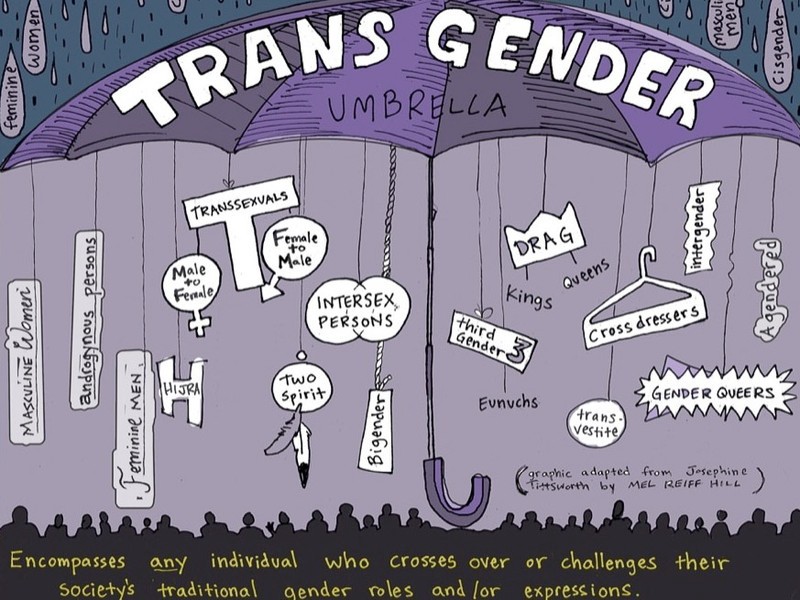

As I understand it, transsexuals, those who have undergone sex reassignment surgery, are a subset of transgendered people, those who behave counter to cultural gender expectations for their given sex. 


Second, to take Cooney's description of Anne, is that Anne isn't really interested in queering gender. She's a rather gender normative man trapped in a woman's body. Her anguish comes about because her outward presentation of self to society doesn't match how she feels inside. She wants to change her voice, she wants to change her biceps. She spends a lot of time learning the "layers and layers of how to re-gender" herself: "It's not just new clothes and a new name. Not just wide stance and strong shoulders, nor just taking up space and talking loudly. For many transmen it's about how a guy props the door with his foot, that imperceptible difference in the kick of leg and tilt of hip." 

Anne isn't queer at all. She's not gender non-conforming. She's very gender conforming, just not to the social gender that's paired with her current biological sex. She's happy to accept gender normative standards, but not the ones that would be easier for her to pull off without drawing attention. She is, in a sense, transsexual but not transgender, as impossible as that sounds. If she were only a biological man, there would be no disagreement for her between how society expects her to act and how she feels.

This makes me wonder: do we need more men who take up space and talk loudly? More men who prop the door a certain way with their feet? Isn't this reinforcing traditional gender performance among men, albeit in a different package? Or is the project of queering gender more in need of biological women like Anne whose gender performance doesn't match what we expect? 

Cooney, a lesbian who had to fight to be seen, faces a loss with Anne's change. When she is seen with someone who passes for a man, she will no longer be seen as queer. Her identity, gained at great cost, will be taken from her. Anne's gain is Cooney's loss, although Cooney loves Anne enough that she is willing to support her.

Their decision how to balance their own gains and losses is personal, and I'm not here to question it. At the end of reading, I wished them only the best. But socially, I wonder if the eagerness to pass as a man by doing everything society expects a man to do and look like isn't undoing the project of queering gender. 

Ideally, it seems to me that society would accept that Anne's internal landscape aligns more with what we consider "masculine" than with "feminine," and that sometimes psychological masculinity can come in unexpected physical packages. Sometimes, the "masculine"--which is not a real thing, but something we culturally create--will have breasts and a vagina. Insisting on the importance of linking sex to gender seems like it's treating gender like it is a real thing. Anne seems to be saying, "I feel masculine, so naturally, I must need a male body to go with that." 

A biologist like Serano might suggest I'm making a body/mind dualism fallacy, because I think a masculine mind can exist in a female body, while Serano would say no, if someone is psychologically a man, he should also physically be one, since the mind is part of the body. I don't find that particularly compelling. If a body can demonstrate hermaphroditic qualities in two organs, such as body with both a penis and a vagina, why couldn't it also manifest a hermaphroditism that includes the brain as one of those organs? 

So my second misgiving is whether using medical remedies to make sex and gender match isn't an undoing of the whole project of queering gender. If everyone did this, there would be no gender rebels.

Third, it seems like a lot of Anne's concerns have to do with how she is perceived by random people in society, people she doesn't even know. She is happy when she is perceived as a man and called "sir," and then upset when someone hears her voice and stammers through an apology. She avoids going out in public a lot because of how people might view her. She hates being stared at. "She won't hold hands in public or walk by a group of men at night because no matter how much the queer community and academia discuss gender spectrum, the average American wants the binary boxes on forms to make sense and be absolute reality." (This sentence seems to me to be another muddling of sex and gender. When forms ask male or female, they want biological sex, not gender identity. This kind of thing happens all the time.) 

I'm sympathetic to Anne concerns for her own personal welfare. I hope everyone is. I especially felt for Anne going to the bathroom in public, where she lives her life "one safe pee at a time." 

It would be absurd for me to wish Anne would be braver, when I'm not half as brave as she is now. But I feel like Anne is taking T and considering surgery just to avoid dealing with the blowback from people she has no reason to care about. Her current spouse likes the way Anne is now, is ambivalent about the change. Cooney is willing to support Anne, because she knows how nerve-wracking it is for Anne to present herself authentically in accord with her self-identity in public. (Cooney, meanwhile, chides herself a bit too harshly for retreating into her privilege as an easily distinguishable woman.) But it's going to be hard on Cooney. She concludes her story with the words, "This is not what I signed on for." 

Cooney asserts that taking T or getting surgery do not change what Anne is. Those things "just let other people recognize her intentions when she walks down the street." 

I feel very torn about this. On the one hand, I genuinely sympathize with Anne. I hate going to public bathrooms now, and I have a beard and some lingering traces of biceps. I can't imagine what it's like for her. And nobody wants to feel unsafe. It's hard enough to go to a park for a walk and feel safe if you're an ugly bald guy. I'm sure it's a constant struggle for Anne. 

But doesn't this mean she's doing all this for other people? Just to get them to quit hassling her by making them more comfortable with how they read her? Wouldn't a more optimum state of society--not that it's Anne's responsibility to achieve this--be greater understanding that people like Anne exist and are entitled to space? All this altering of her body seems like a lot to require of Anne just to keep the peace in society. Her safety and freedom to move around unhassled shouldn't require her to have a beard and remove her breasts. 

Fourth, the subject that is most likely to be taken for bigotry. The surgery. The second I read something about Anne having "her hips shaved straight," I nearly quit reading. (One of the non-gender-conforming things about me is that I am squeamish. I also don't like snakes or spiders or rodents. Oh, and I have no interest in cars.)

Andrea Long-Chu wrote a thought-provoking article last year ((now many years ago--current Jake)) as she looked forward to her sex reassignment surgery. She wrote that she realized it was quite possible her new vagina wouldn't make her happy, but that this wasn't the point. "Left to their own devices, people will rarely pursue what makes them feel good in the long term. Desire and happiness are independent agents.She's right. There must be some reason I keep writing, and it sure as hell isn't happiness.
 
She argued that the medical code of "first do no harm" actually turned doctors into gatekeepers of who should get surgery. Therefore, happiness shouldn't be the criterion for being able to get the surgery:
  
As long as transgender medicine retains the alleviation of pain as its benchmark of success, it will reserve for itself, with a dictator’s benevolence, the right to withhold care from those who want it.
But I also believe that surgery’s only prerequisite should be a simple demonstration of want. Beyond this, no amount of pain, anticipated or continuing, justifies its withholding.

That's a fascinating idea. It makes transsexual surgeries into something more like plastic surgery, something that doesn't require a justification beyond wanting it. If we take Anne as an example, the comparison to plastic surgery holds up fairly well. Anne wants surgery for many of the same reasons people who get plastic surgery want it: increased confidence and less social stigma. Those aren't frivolous goals, especially if you are thinking of plastic surgery less in terms of movie star nose jobs and more like burn victims getting restorative work. 

But society has justifiably mixed feelings about plastic surgery. Is it self-affirming or self-hating? A little of both? Feminists have criticized plastic surgery and the way unrealistic expectations about beauty for women have caused women to fork out money and endure pain to meet those standards. The practice is sometimes viewed by feminists as self-mutilation. 

Transsexuals see it as the opposite: self-revelation, a bringing forth of who they truly are. But I can't get past how much it must hurt. Yes, there's also the instinctive wince when I think of removing a penis, the thing many of the "pseudo-critics" Buckley talked about make a big deal out of. But beyond the shock factor, I just think surgery sounds terrible. At the very least, it has all the attendant risks of infection and pain cycles all surgeries involve.

If sex reassignment surgery resembles plastic surgery in some ways, then there seems to me to be a risk of the plastic surgery treadmill: always wanting just one more thing that will make you feel good enough. I can assure Anne, as a man who never, ever will be mistaken for anything other than what I am, that just passing won't be enough. There will always be something else you'll wish you had to make you feel more like a man. I wish I were taller. I wish I were more muscular. I wish I had a tougher sounding voice. I really wish I hadn't been born on the bottom end of average in the all-important organ size, and I really, really wish that organ hadn't started shrinking with age. I get that happiness shouldn't be the standard, and if someone is determined to get the surgery, I would stop trying to convince them otherwise. But I think it's important to be clear about how elusive contentment is no matter what body you're in. 

I'm not here to decide for others whether surgery is worse or living with present reality is worse. I will support anyone I know who makes the decision to get surgery. Once someone has crossed that line, it's stupid to question it, and from then on, the only sane thing to do is offer support for the person adapting to the new identity and new life. But I also don't want to gloss over questions about it. Without getting into the very contentious issue of how many people get the surgery and end up regretting it, because, as Long-Chu wrote, that's maybe not the point, I do think it's valid to raise similar objections that feminists raise to plastic surgery for people considering sex reassignment surgery. Yes, of course, do whatever you believe you must do to live a fulfilled life. If a woman knows what plastic surgery is and gets a giant boob job because she damn well wants to, more power to her. But at least consider that the problem isn't your body, it's how people look at your body. If society viewed a slender woman with breasts and a high voice wearing men's clothes as another embodiment of masculinity, there wouldn't be as acute a need to have a beard and biceps to match. 

Where there is actual disagreement

I think there is general agreement that trans people should not face violence. Even most conservatives agree with this. There is also general agreement that trans people should not face "discrimination," although I think there is a good deal of disagreement about what that means. Most people probably agree a trans person shouldn't be kept from a job, but there are things trans advocates want and claim would prevent discrimination that many find problematic. These include being able to use the public bathroom of their choice, allowing trans women to play women's sports, and forcing parents to provide gender-affirming care for their children under the age of eighteen. 

I'm at different places on some of these issues. The bathroom issue seems like the best argument, although it's going to take a long time for many cash-strapped organizations to refit everything to allow for single occupancy bathrooms. Nobody likes public bathrooms, although I doubt it's possible to put in 10,000 single-occupancy bathrooms at a football stadium, and I'm likely to bear the awkwardness of a public men's room rather than wait for a single occupancy room. Hopefully, most people will feel the same, so that will leave the few single occupancy rooms open to the people who really need them. 

I'm not sure how the other issues should play out or will play out. I would only offer the advice to trans advocates that playing down the issues isn't a good strategy. When someone objects to the advantage a trans woman who went through puberty as a boy has over other women in sports, or when someone points out how drastic a step removing a sexual organ is, these people shouldn't be gaslighted or shamed for even bringing up the objection. I've seen many arguments that the trans women in sports issue isn't really an issue, or that we only object to the extreme parts of sexual reassignment surgery because we are immature little children. I don't think talking past the sale is going to win long term. 

Sloppiness in use of language doesn't help, either. I know advocates can't control every person who posts on TwitterX, but part of their advocacy should be advocacy to their own ranks to use language correctly. 

Public and private


Whatever ends up happening with these issues, trans-gendered people have the unenviable fate of living a life that can never be truly private. Their very existence is being debated in the public sphere, so everything they do, no matter how private, can be used as fodder to feed one argument or another. Cooney's honesty, which I admire so much, could be used to say, "See! Sex reassignment is bad for the loved ones of those who get it!" I'm not saying that, and I hope Cooney doesn't live to regret the openness she wrote with.  

In political discourse, there is almost always an unfortunate shrinking of the truth. You've got some policy proposal, and it's got a lot of plusses and minuses, but overall, you think it's a marginal change for the good. So you pitch the proposal to the public, only when you pitch it, you don't talk about the negatives, or you downplay them, and you oversell the potential positives. You're not doing it to be dishonest, you just realize that honesty isn't going to get the proposal passed. 

Cooney's essay is so moving because it's unfailingly personal, not political, which means she's open to talking about the negatives as well as the positives. Because of this honesty, I was open to her reality in a way I haven't been before about the stories of trans-gendered people. 

Most of the decisions trans-gendered people make ought to be private ones. Whether someone takes T (or E) or gets something added or taken off isn't my concern. But somehow, it's an issue in public discourse now. Rather than attempting to immediately jump into legal remedies, I'd like to see society try first to focus on cultural ones. 

For example, one of Anne's chief concerns is how to use the bathroom safely and without harassment.  

A few of the things she's suffered in bathrooms:
-What are you?
-Prove it. (from a pack of hellish six-graders when Anne was in second grade)
-What the hell are you doing? You're in the wrong place.

Cooney says, "I've watched women enter the bathroom, see Anne at the sink, and step back to check the sign on the door." That actually sounds quite normal. That would be my reaction if I went into the men's room and saw someone in a dress at the sink. Going into the wrong bathroom by mistake sounds like something I'd do, because I'm an idiot. 

It would be nice if society could work on a system of signifiers to alleviate these situations. Something whereby one party could indicate that yes, I realize this isn't what you're used to, but this isn't a threat to you, and the other one could signal back, "Okay, carry on, then."

It would be nice if we had a language for Anne's experience. If we did, and she still wanted to live life as transsexual, not just transgendered, that would be fine. At least she could be sure that's what she wanted for herself, not wonder if she had been driven to the choice because it's so difficult living in society as something other than a zero or a one that she has to pick the one that will cause her the least trouble.  

Friday, April 12, 2019

Unjustified optimism, necessary optimism: American attitudes about the future in the 2019 Pushcart Anthology

Millenarian beliefs that the deluge is nigh are not new, but it's not a stretch to say American culture is experiencing a high tide of fin-de-siecle sentiment. We've been drowning in post-apocalyptic stories for years. Perhaps somewhat differently from past concerns about the impending end of the world as we know it, today we can actually point to rational, scientific concerns. Superbugs, climate change, dwindling water to satisfy a growing population, an overdue supervolcano beneath Yellowstone--there are plenty of reasons to feel dread that don't require any religion at all.

Add to that the unusual nature of the current political cycle. While we've had dramatic swings in political philosophies before, we've never quite had this kind of politician whose entire appeal is that he has come to destroy politics. Trump's appeal to the far right--even if he doesn't have enough of a political philosophy to be far right himself-- is now engendering an almost equally radical swing from the left, and we may well end up with a choice between two highly unconventional candidates in 2020. This swing to the extremes seems to also be limiting the space Americans have for common understanding, making us more likely to hate the other side. There is stress on our institutions.

If we look for reflections of this stress in a literary anthology like the 2019 Pushcart--an anthology that, with its focus on smaller presses, can possibly boast to be somewhat more representative of the concerns of ordinary Americans than other anthologies with big names who occasionally make a living out of art--we can certainly see this angst informing narratives. Several stories reflect contemporary nervousness, such as Julie Hecht's "Taco Night," about an aimless woman experiencing a sort of fugue on the night of Trump's election. Or Poe Ballantine's "Secrets Deep in Tiger Forests," in which Vietnam is a stand-in for contemporary concerns about unending wars and the effects of those wars on those who fight them and those who don't. In the entire anthology, no story reflected a basic pessimism about the future as much as Julie Burnstein's "All Politics."

Western optimism in general and American optimism in particular owe their philosophical roots to humanism, an outcropping of the Renaissance that stresses the centrality of humanity and believes in the ability and duty of humanity to use reason to overcome its problems. Humanism gave us modern universities. But in Burnstein's story, the university--in particular, humanities departments, which have the specific task of propagating humanism's core tenets--are rotten to the core and utterly beyond redemption. Because humanities departments themselves are in thrall to their own perverse politics, they are unable to have any impact on politics in the general culture. Without the spirit of humanism to guide them, Western political bodies and the cultures they prop up don't have much hope.

Now this, THIS is a humanities department that can change the world.

But there's a lot of optimism in Pushcart 2019


Along with the pessimistic, though, and actually outweighing it, there are stories that reflect a fundamental optimism about the future, be it the future of humanity, of Western culture, or of basic cultural institutions like family.

I noted a similar swing from a renunciation of the values that have dominated Western culture for centuries to an attempt to restore those values in some way after reading through another anthology, the 2018 Best American Short Stories. This doesn't mean that we are going to see an upswing of writers of serious fiction calling for a genuine return to the values of yesterday, or to make Western culture great again, but it does mean I see modernity struggling to find what it can salvage of humanistic values from the ruins.

This is true from the opening story, Karen Russell's "Tornado Auction," about a man who is obsessed with selling baby tornadoes the way many people now sell prize animals at auctions. It's a world that's mostly like ours, but under a little more environmental stress: some people make a living creating rain or wind. The protagonist is alienated from everyone in his life, especially his children, who do not appreciate his dangerous and unprofitable passion. But we find in the story's most touching moment that his hobby, misanthropic as it seems, is actually what he clings to desperately in order to prevent him from becoming overwhelmed by how powerfully he feels the weight of human bonds, especially the family kind. It is his way of escaping suicidal feelings or the oppressive weight of "something worse than freedom" he feels when he realizes he is a father to children he loves more than he can handle.

Russell's hero, Bobby, faces a very modern conundrum. We fetishize individual freedom, but it is also what is killing us. Jonathan Franzen explored this at length in the novel Freedom, how in the name of freedom, we allow people to waste and consume to the detriment of all. Bobby doesn't give up his freedom. He tries to turn the power of the freedom he loves into an instrument to keep alive the very bonds he seeks to run from. It doesn't work out well for him, and in fact, the story itself is nearly destroyed by the power of the ideas it is working with. But it's clear in the end that the sentiment of the story is in favor of a belief in the family ties that bind.

Nothing is freer of human ideals of right and wrong than an act of God, but also, nothing is more destructive. 


The best two stories of the collection both exude a fundamental optimism, even while presenting a world that is basically doomed, either environmentally, as in David Naiman's "Acceptance Speech," or emotionally, as in Lisa Taddeo's "Suburban Weekend."

In "Acceptance Speech," a gardener expounds upon how the way of things in nature is self-destructive: bacteria in a petri dish will eat their food faster and faster until they choke themselves. She claims that man is headed in this direction, and the sooner we get our own destruction over with, the happier she will be. But the whole time she is weaving the thread of the futility of life in the natural world, she is knitting herself into that tapestry of life. She reveals at the end that she has become purposefully and happily pregnant.

It's not clear exactly how she progresses from misanthropic nihilist to born-again optimist, but it's clear she didn't do it by closing her eyes to all that is wrong in the world. She embraces the future while still realizing it is, almost without any doubt, doomed. Her award for which she is giving her speech was given for ripping out every beautiful plant from her garden and putting ugly things in their place. But when she got to the end of ripping the beautiful things out, she felt that her very honesty about how the ugliness of the world was, in fact, a kind of lie. She felt this when she juxtaposed her own honest pessimism to the self-blinding optimism of her husband: "I knew, from my husband's wounded puss that the garden, however glorious, was no reply to his infant questions unanswered, but a terrible lie."

Her pessimism does not disappear, but rather, she finds a way to merge it with her husband's optimism. Having torn out everything beautiful, she finds there is yet something in the garden left to love. But she is only able to find this out after tearing all the beautiful things out, much as our culture today is only able to find a remnant of humanism worth clinging to because it has so mercilessly attacked the foundations of humanism for so long. Nothing still left standing can possibly be the weak stuff.

In Taddeo's "Suburban Weekend," we have the familiar "love and family are a lie" theme challenged, however, timidly, by a bumbling hero who spends most of the story eclipsed by the person she is trying to save. It is interesting that the suicidal friend in need of saving is named "Fern," making her view of the world the more "natural" one. Liv--whose name is almost comically on-point, because it is her goal to help her friend to do just that--is a comedian who is nearly unable to deal with her own personal issues. This brought to mind Joseph Meeker's The Comedy of Survival, in which the theme is advanced that comic mindsets are better suited to survival than tragic ones. "Suburban Weekend" is sort of an exploration of whether that philosophy has an evangelical side to it, whether it can not just save those who follow it, but whether its followers can use it to save others.

In the end, it isn't clear that Liv can save Fern. (That is, in a sense, that she can save the natural world.) But the reader admires the love she shows when she tries to save her friend, and the reader ends up wanting to show that kind of love, too.

Liv can't have less luck at saving a Fern than I have had in my life. 


The not really exceptions

There are some stories that seem to possibly challenge the fundamental optimism of most of Pushcart, but they are actually just validating a humanistic view of progress and the future by way of pointing out exceptions. Gabriel Brownstein's "No Time Like the Present" is about the disasters that can happen when we fail to get a hold of our psychological disorders, the things that rob us of peace. But by critiquing the inability to fix the problem, the story is also asserting a classical humanist concept: that problems can be solved if the right solution is applied through hard work. Similarly, Victor Lavalle's "Spectral Evidence" sounds like it ends in a very dark place. When the narrator ends with the promise that "from now on whoever comes to see me is going to hear truth," it's not a comforting truth she's going to tell. It's that whatever comes after death is frightening and best not to think about. But again, this is the failure of reason showing that the solution is to apply reason correctly. It's an injunction against becoming obsessed with what one cannot control and focusing on the here and now. In its renunciation of the after-life and its recommendation to focus on the physical world, it is perhaps the most classically humanist story in all of Puschart 2019.

Even a cynical story like Sarah Resnick's "Kylie Wears Baliman" finds something to admire in the dying world of tabloid journalism it skewers.

The most interesting exception, although I found it to be not a very interesting story in its own right, is Robert Coover's "The Wall." Coover combines the ancient tale of two lovers separated by a wall with the modern political resonance of a wall--although the later is never overtly stated. Coover seems in this parable-like story to examine the idea that troubles tend to be mounted by the societies that face them, but that this just leaves society with another wall to get over. The wall might be psychological, and it might just be the realization that every freedom brings new chains, or that there is never any end to walls. Rather than being overtly pessimistic or optimistic, it is philosophical about the whole notion of pessimism and optimism, and, really, about the future. It's old-guy lit.

Because I make everything about Lord of the Rings


The point has been made many times that American optimism is unjustified and quite possibly dangerous. We don't take seriously the idea that we might destroy the world because we always think Elon Musk or John Wayne will be there to save it for us. I have often thought that America could use a good dose of reality to cure it of its confounded optimism and bring out the dour Calvinists we all might have been.

But then I'm reminded of something Frodo Baggins said about another group of foolishly optimistic and inward-looking fools: "...there have been times when I thought the inhabitants (of the Shire) too stupid and dull for words, and have felt that an earthquake or an invasion of dragons might be good for them." He says this just after Gandalf has revealed the truth about the one ring and the threat Frodo brings to everyone in the Shire by keeping the ring there, the moment when Frodo decides he must leave to save it. When the time comes to leave and he thinks about having once felt this way about his fellow hobbits, he concludes, "but I don't feel that way now." 

Frodo has to face terrors and truths and become wiser than any inhabitant of the Shire in order to save it. By doing so, he becomes unable to live in it any longer, but he is content to have saved it for his gardener friend Sam. Which brings me back again to "Acceptance Speech." The wisdom the gardener finds that makes her rejoin the world around her isn't a philosophical argument, it's the sadness in her husband's face. She's not unaware of the cold truths of the world in which cute otters rape baby seals. But when she returns from plumbing the depths of rot in the world, she doesn't leave the garden like Frodo left the Shire; she decides to return to it, a goth Eve with her fool of an Adam. 

The sense from Pushcart and from intelligent, liberal-minded folks in the world who have spent the last few decades tearing down pillars of classical humanism is that we need to find something left with which we can plant a new garden. 


Sunday, March 31, 2019

Thoughts on why there are so few critical assessments of short stories

The other day when I posted a very positive review about a short story by David Naiman, I tweeted about it and included a notice to David. In turn, he posted a very kind thank you, retweeted it, and then a couple of people following him started following me. (I have 37 Twitter followers now! Imagine!)

Yesterday, Lisa Taddeo "liked" my Tweet linking to a positive review about her story A few weeks ago, I got an email from Eli Barrett when I blogged about his story. While blogging through Best American Short Stories, I got a reply on Twitter from Amy Silverberg, and Jacob Guajardo was cool enough to even follow me.

Posting positive reviews about writers, even if you run a blog that gets maybe 3,000 views a month, is a good way to make writer friends. And if you run a blog and are also a writer struggling to get picked up by a more noticeable venue, writer friends are good to have. Which means when I'm reviewing a story, I have only motivations to post positive reviews and no reason to post negative ones. That doesn't really promote honesty and healthy, vigorous criticism.

Naiman, when he responded on Twitter, noted that almost nobody is doing serious criticism of short stories these days. He's right, and I think I can understand why. Almost all the people reading short stories are writers themselves, so who in their right mind would provide honest criticism? Instead, what you're likely to get--and what we actually have--is an endless back-scratching chain of positive "reviews" that don't really review much. I say good things about you so you'll say good things about me. That's good for networking, but it's not great for the ecosystem of short fiction.

If there's a movie you like and you want to talk about it, you can easily find people online to talk about it with. You can find a dozen Youtubers picking apart the movie at length. If there's a song you like, you can find an online community to talk about it. But if you read a short story, and you want to dig into what it means or what works and doesn't work about it, you're usually shit out of luck. There's a reason I get 3,000 views a month; they're almost all headed to the reviews I've done. Almost nobody cares what I write about my own writing process. My blogging buddy Karen Carlson gets a lot more hits than I do, and she mostly is doing the same thing: reading short stories and talking about them. In fact, if you Google one of the short stories from BASS or Pushcart, she's usually the number one result after the story itself, and I'm often #2.

That's not a great sign for the health of short fiction as a viable commercial and cultural activity. Which is an absolute shame, because there is great fiction being written in America today, but almost the only stories anyone talks about, if they talk about them at all, are the ones the New Yorker puts out. And even that is usually just a day or two of chat on Twitter.

I find writing reviews somewhere between exhilarating and as exhausting as writing fiction of my own. It's definitely a lot more fun to write a good review than a bad one. The bad ones, I don't Tweet about. I feel bad about them. But I feel I need to write them, because without honest criticism, the ecosystem collapses.

Saturday, January 26, 2019

Elegy without a ceremony: "Secrets Deep in Tiger Forests" by Poe Ballantine

Fiction often deals with tragedies and traumas, but there are a number of performative functions a story can play in framing a trauma. It can memorialize, lament, celebrate, heal, criticize, exhort, blame, excuse, or simply bear witness. None of these approaches is better than the others. For major traumas in human history, such as the Holocaust, it's important that culture produce art that plays all of these roles.

A culture can, perhaps, end up with an imbalance in the actions the stories of a particular generation perform. It can produce too many patriotic stories in response to trauma, for example. For 20 years after Eritrea gained independence from Ethiopia, its literature produced little else than stories lionizing the martyrs of the revolution and pointing to their suffering as a reason why Eritrea needed to go it alone.

I wonder if American literature hasn't produced too much literature of the lament or elegy form in response to the non-stop American wars of the last 17 years. The veteran with PTSD story is so ubiquitous nowadays, I wonder if it's partly responsible for the stereotype that all veterans suffer from it. If this is true, then the very act of creating stories meant to help veterans may be inadvertently hurting some of them.

Stories don't have to be about Iraq or Afghanistan to really be about Iraq or Afghanistan. Much like M*A*S*H used the Korean War to comment on the war in Vietnam, some writers are using Vietnam as a stand-in for talking about the Unending Wars. (I talked about a story like this in 2017.)


"Secrets Deep in Tiger Forests" by Poe Ballantine is also such a story. It's set in what appears to be a working-class neighborhood during the Vietnam War, at a time when young men are coming home in body bags or as shadows of their former selves. The unnamed first-person narrator is a teenager only a few years shy of the same age as the young men who went off to war from his neighborhood. He observes the effect of the war on those around him, especially Raja, the older son of the Carrs next door.

The Carrs have had a lot of bad luck, it seems. Mrs. Carr died a year before the story takes place, and her oldest son Raja "went off to war a serious boy in a uniform, but when he came back, he was no longer Raja." Raja can't even talk. He just laughs and smiles. Raja's younger brother Whitey is acting out, beating up on the narrator once a week, and then being nice sometimes in between beatings. Mavis, the older of two daughters, is pregnant, and gossip says her father is also the father of her baby, although the father has since also died of leukemia. The youngest daughter, Queenie, is starting to show signs of a budding sexuality herself, a sexuality the narrator notices, and it probably won't be long before she gets pregnant herself.

The narrator comes home one day to find Raja has been carted off to a mental health facility. He'd have gone to the facility sooner, but the wait to get in was too long. The family couldn't keep taking care of him. The story ends with a grief that can't find a voice: "...old peasant women with mangled teeth who yacked and yelled at me without a sound."

It's a very short story, and maybe best viewed as a sad bildungsroman in which the narrator learns about the world he's about to inherit and doesn't find much to look forward to. The kids in the neighborhood who've just gone the path he's about to go down came back mean or broken or dead. America is a place where young men are very often fed to whatever issue politicians believe cannot possibly be resolved without sending them to die. It still is. As much as America wanted to keep the Unending Wars from becoming Vietnam when they started, they became much more Vietnam than even Vietnam was. Even President Trump cannot find a way to end our never-ending commitments there, although he's certainly tried, above the complaints of his generals.

Yes, Colonel Potter, that sums up my thoughts on 18 years of war with no end in sight.


In addition to a bildungsroman, the story could also be seen as an elegy. It's meant to honor and remember Raja and those like him who came back a shadow of what they were when they left. As Lincoln said of another group of war dead, it is "altogether fitting and proper" that we should honor our casualties of war like this.

But the story doesn't really offer any kind of way out for young men touched by war. For those dealing with the after-effects of war, the narrative in this story and in our culture seems to be that you will be forever broken, and it's okay. Society can only commiserate with you in your brokenness, not try to find a way to make you whole.

Contrast this with another story of a war veteran who came back changed, the unforgettable  Ceremony by Leslie Marmon Silko.  It's about a WW-II vet, the mixed-race Tayo, who comes back from hell in the Pacific. He is at risk of following the route many native Americans who came back from the war did, losing himself in alcohol. But medicine men help Tayo to find his own ceremony in a world that is losing all sense of the sacred, his own way to repair the broken web of the world.

The reality of Ceremony is every bit as awful as that of "Secrets Deep." Silko wasn't ducking reality by having Tayo find a way back after hell. I'm not suggesting that stories should never end without redemption. Nor do I object to occasionally dwelling or even fetishizing our sadness. I am an artist, after all. But I wonder if our generation has too great a fondness for merely diagnosing our ills. If we can post on social media about our solidarity with troops struggling to overcome trauma, we feel we've done our job.

James Mattis has spoken before about how emphasizing the PTSD aspect of military service may not be helping military members to get better. Of course we should recognize and treat illness. But as folks used to say in church, that doesn't mean we need to spend so much time talking about the devil we end up praising him. It's okay to encourage people to put themselves back together. It doesn't all have to be appreciating how broken they are.

Maybe it's because when it comes to repairing spiritual wounds, our culture doesn't have much to offer. We have no ceremonies to cleanse ourselves, because we don't believe in anything sacred. Our view of psychological healing is a consumer one: we go to a professional who gives us drugs. We continue going forever, which means we consume forever.

I'm not saying nobody should see a psychiatrist, although I wish we were as skeptical about diagnoses of depression as we are about diagnosing too many kids with attention deficit disorder. But we need more than just a consumer doctor-patient model to make us well again. We need a spiritual life as a society. One of the sources of that healing spirituality is our mythology, our stories.

There's nothing wrong with Ballantine's story. Ballantine isn't to blame for the predilections of society. But the fact this story made it into a year's best anthology says something, I think, about how our culture views trauma and recovery. For us, a coming-of-age story about war and trauma is complete when we realize how psyche-rending the trauma is. The boy is a man when he is unmoored, confused, sexually frustrated, and unable to find a voice to express all that he now knows.

Saturday, December 8, 2018

Is there another color pill besides blue or red?

I've referred a lot on this site to my past as an evangelical. There are a lot of reasons I keep recalling those days. One is that even though I was only an evangelical for about seven years, it has continued to have a pretty profound psychological impact on me for decades since. Another reason is that there are a number of sociological phenomena I witnessed in evangelical churches that I've seen play out in other settings.

But are we sanctified enough?


The church I went to as a teenager had a schism where about one-fourth of the church left. The argument? How to correctly understand the roles free will and pre-destination play in salvation through faith. It is very common in evangelical churches for believers to segregate themselves from other believers based on what would seem to an outsider to be small differences in belief. Those segregating themselves justify their decision to do so based on the notion that God would rather have a small group of believers truly committed to the right set of principles than a large group of only half-correct believers.

If homo sapiens had evolved with more than two hands, would we have become less binary in our thinking? 


I see this attitude reflected in the politically liberal circles I tend to orbit these days. Liberals naturally see themselves as distinct from conservatives. I'd argue that there is a respectable form of conservatism that liberals could learn from and use to refine their own beliefs, but let's accept here that we as liberals ought to generally have beliefs that set us apart from conservatives. That being said, there is a kind of liberal that is becoming more ubiquitous, one for whom accepting the general principles of liberalism is not enough. One has to accept an ever-growing set of specific beliefs, and if you do not accept their highly refined version of what being a liberal is, then this person will not consider you fit for fellowship.

An incident in the literary world from this past summer helps to illustrate this point. Anders Carlson-Wee published a really good poem in the Nation. It was a short narrative poem in which one homeless panhandler teaches another homeless panhandler how to play on the emotions of people to get donations. It has some great lines in it: "It's the littlest shames they're likely/to comprehend." Or, "What they don't know is what opens/ a wallet, what stops em from counting what they drop." It's a smart look at what motivates people to give to those in need, and suggests people are often motivated by what giving says about them rather than love for the person in need.

The objections to the poem


As the poet said, he hoped the poem would help "address the invisibility of homelessness." So it might seem surprising that there was an outcry against the poem, mostly coming from people who likely identify as politically liberal and who would tell you they believe it's important to think of the less fortunate in society.

There were two reasons, basically. One was the "ableist" language in the poem. At one point, the adviser-narrator of the poem tells his protege, "if you're crippled don't flaunt it." This criticism is incredibly thin, and can be dispatched pretty easily. The presence of something in literature doesn't equate approval of that thing. This is something we all learn pretty early on. A poem that includes a homeless person using a word that he plausibly would have used in real life doesn't mean the reader is supposed to approve of the use of that word. Rather, the reader is supposed to imagine a person who would use such a word. Using the correct lexical terms for the situation is part of building the imaginative landscape necessary to seeing the world through the narrator's eyes. If you are writing about a racist, it's appropriate for that character to use the N-word. That doesn't mean the N-word is a good thing.

The bigger objection to the poem seemed to be that it used what has been termed "literary blackface," a white poet using AAVE, or African American Vernacular English.

Use of dialect--aesthetic and ethical considerations

Aesthetics

Can a writer borrow from a dialect that isn't the writer's own dialect? This isn't just an ethical question, it's also an aesthetic one. Over the last few decades, heavy use of dialect has fallen out of fashion. We don't get much Huck Finn anymore. It's not just that people find it untoward; it's also a little tedious. At some point, the reader is usually saying, "Okay, I get it, the character talks in dialect, and you know the rules of the dialect. Can I just read the story now?" Generally, the "rule" for using dialect now is to throw in enough to let the reader realize that the character speaks in dialect and that what is on the page is something of a translation of that dialect for the reader. That's what Colson Whitehead did in The Underground Railroad. He didn't kill the reader with 19th Century slave dialect, but there was enough "sampling" of the dialect that we were occasionally reminded that the characters were living in a different time and place. This keeps the story from being dull for the reader. It also keeps the author from having to spend years researching dialect in order to get it right. Whitehead is black, yes, but that doesn't mean he has any advantage over a white writer in knowing what a slave sounded like 175 years ago. So he picked a good compromise.

Aesthetically, Carlson-Wee seemed to follow this compromise fairly competently. His narrator speaks in dialect, but not obnoxiously so. A good taste of it is right in the opening two lines: "If you got hiv, say aids. If you a girl,/say you're pregnant." That's twice it says "you" where schoolboy American English would give you "you've," or "you're." Having done this, though, the poem then shifts to the use of "you're" where it could have justifiably said the dialect-derived "you" again. (One of the characteristics of AAVE is a reduction in the number of verb tenses.) But on that third "you," the narrator reverts to "standard" English, because we've already had enough AAVE to establish how the narrator is really talking without needing to keep hearing it over and over.

In fact, I wouldn't have even been certain this was AAVE. It shares characteristics with other English dialects. "You got" isn't just AAVE. Neither is "you is." It could have been someone other than a black narrator. 

Ethics

The ethical considerations of using a different dialect than the one the writer speaks in her daily life is a little trickier than the aesthetic one. We definitely consider it offensive for a white actor to wear makeup to look like another race. I'm not exactly sure why this is; we accept using makeup to look older or younger. Is it because it's creepy? Is it because the old minstrel shows were so insanely racist that anything with even a single point in common with them nowadays is too much to take?

Would anyone argue this is ageist? 

Whatever the reason, it seems a pretty commonly accepted point. Since ethics often comes down to common consent, let's accept that as a solid principle. The question then becomes, "Is using dialect from another community than the writer's own equivalent to blackface?" I am yet to hear a convincing explanation of how it could be. It's true that one can mimic an accent or a mannerism to be cruel and to mock. One can affect a Southern accent while saying something outrageous to make the point that one thinks Southerners are stupid. A racist might fake a "black English" dialect in order to mock that dialect. But there are clearly ways to use the accent that aren't cruel or mocking. One is simply to demonstrate it. For example, "Marylanders sometimes extend and round their long "o" sound, as in "I'd like to drink a Cohke and a Natty Boh while watching the Oehs."

For a white person who is not from an area of the country where he actually learned to speak AAVE as a "native language" to "try to talk black" in an everyday social setting is almost always offensive. To try to write a black character and let him talk in his own voice, however, is neutral. It works if it works. It doesn't if it doesn't. It has nothing to do with the race of the writer. I don't believe anyone would have objected to this poem if a black author had written it. Which is the same as saying there's nothing to object to.

Having a character speak a dialect so we can inhabit that character's psychological reality is more akin to the explanatory type of use than it is to mocking. For this reason, perhaps, we tend to accept an actor's use of an accent that isn't the actor's own accent much more readily than we accept manipulation of the actor's physical appearance.

Perhaps sensing there was something not quite right about calling Carlson-Wee's use of language inherently racist, those who objected to the poem didn't always take this route. They didn't all suggest that his use of AAVE was appropriation. For example, when Roxane Gay objected to this use of AAVE by a white writer, her objection was more pragmatic than ethical. She believed it was impossible to do it right:


To argue AAVE can't be used and learned like other languages is to deny its rightful status


I think "no white writer can ever write AAVE correctly" is a hard point to argue. We have an entire profession, employing millions of people in the world, that is built on the supposition that it is possible to take words in one language and render them in the words of another language. I'm one of those millions of people who make a living doing this. We have always accepted this as necessary and even useful. We often see translators and interpreters as necessary to achieving understanding between people. Nobody has ever suggested that there is a moral issue with translating from one language to another. We might wonder, on a philosophical level, how efficacious translation really can be, and whether it's really possible to fully translate from one language to another, but nobody questions that translation is, to the extent possible, a good thing to do.

If we believe that I can take a language like Korean, spoken by people on the other side of the world, and, after years of hard work, become skilled enough to sort of use it correctly, surely someone else can do the same for people who speak a version of the same language living ten miles away? Especially if they're not really trying, as in this poem, to fully reproduce AAVE, but just to give a flavor of it to help keep the reader in the character's point-of-view?

I include words in foreign languages all the time in my stories. They're right. I know they're right, because I've done the work to know they're right. That doesn't mean I'm going to give you the same insight into a Korean character that a Korean person might. But as a white person writing for an English-speaking audience, that's okay. I can offer a translation of that character. If I can do this for a character who thinks in a language where the syntax is all backwards from English, others can probably manage it for a dialect most white people can understand without ever taking a single class in it. If I can't do everying to AAVE I can do to French, then AAVE isn't a valid language (which it is).

No true Scotsman and why it's uncomfortable to be a Liberal


I return now to my days as an Evangelical. It is always possible to continually narrow the terms of what is necessary to be a part of your community. Doing so will help to prevent disagreement within your community, but it will also reduce your impact, because it will reduce your size. While it's true that a small but ideologically unified and motivated community can achieve a lot, this isn't typically what happens. Typically, the group becomes perpetually embroiled in the effort to achieve ideological unity, and it never gets around to the accomplishment phase of its existence.

When a church continues to require more orthodoxy of its members, when it requires that you not only believe that Jesus was the Son of God and that he died for our sins, but also that God created the world in seven days and that women are supposed to be subordinate to men because that's what Paul said, you are going to get objections.

"You can't be a Christian unless you believe in a literal seven days and a rest!"
"But I'm a Christian, and I don't believe in that."
"You're not a true Christian. No true Christian would doubt Genesis 1 is literally true."

It's the perfect example of the No True Scotsman fallacy. It seems to be more and more common among the community of people who identify as politically liberal. Something comes up like the controversy around Carlson-Wee's poem, and if I do not immediately declare that I found the poem terrible and ridiculous, I will be accused of being a Fox-quoting alt-right conservative. I will counter that of course I'm a liberal, because I support ideas X, Y, and Z that are textbook liberal issues. But because I do not agree with a position that isn't a core liberal belief, I am then met with an attitude that I must be a "red-pill" alt-right acolyte.

Isn't there something besides the red and the blue pill?


"Redpill" (which is now a verb somehow) refers to the realization some people believe they have when they awake to the lies they have been fed by a media in thrall to liberal ideals. It is "the beginning of a process of radicalization in which an individual becomes enculturated in an extreme, reactionary worldview," as Bharath Ganesh said. 

It very much feels to me like if I offer any critique of where I think liberal culture is headed, I will be seen as already on that path toward radicalization. This is true even if I go to great lengths to indicate that I am not trying to "redpill" anyone, nor have I redpilled myself. In fact, I'm not. I care about liberal ideas. I want those who fight for them to have their agendas as uncluttered by erroneous thinking as possible. So I express reservations when I think some movement is headed in the wrong direction. That's not equivalent to abandoning the basics of liberal political philosophy, and it certainly doesn't mean I'm a racist or a misogynist or anything that ends with -phobe. 

Taylor Swift recommended voting for Democrats this fall after years of being an ambiguous symbol of...something... for neo-Nazis (I still haven't figured all this out, and I don't want to...Google it yourself if you're interested). When this happened, instead of embracing her turn, a lot of liberals gave her a cold shoulder. This prompted one of the funnier Tweets I've seen lately (although I can't find it now). It said, in essence, that Liberalism is the only religion that punishes its own converts. I think that fits for what happened with Anders Carlson-Wee. He's a guy who obviously cares about things liberals care about. He fully apologized for his poem, although I believe he had nothing to apologize for. But if you Google the guy now, this story is what he's about. It will follow him around for the rest of his poetry life. 

You're never "saved" as a liberal. You always need to be purer, holier, more sanctified. You can't just agree to some broad, core beliefs and disagree about side issues. You have to keep accepting every non-essential belief. This seems to me to be especially true in writing circles. I'd do much in my quest to become better known if I uncritically co-signed and retweeted every statement from literary luminaries. Instead, I post long blog entries like this one about my own ambivalence, entries I'm sure get misread by the few literary editors out there energetic enough to read my blog before they decide to publish me. I wouldn't guess this blog has ever helped me get a story published. 

In the New York Times review of the Carlson-Wee story cited above, the NYT noted that the story was mostly covered by conservative outlets, who took a certain glee in pointing out the ridiculousness of liberal PC culture run amok. This doesn't do wonders for liberal outreach, or evangelism, to use the Christian term. Seeing us turn against one of our own over the application of a string of unexamined assumptions and logical fallacies isn't going to bring a lot of thinking people over to our camp. 

Beyond the liberal political camp, it's probably not great for serious poetry, either. Almost nobody reads serious poetry anymore. Folks have opted for easy-to-digest pop poetry, which now occasionally makes it onto the best sellers list, while top poetry journals pay contributors in copies of the journal. When the only press poetry gets is a spat over a man who obviously meant to do something good getting attacked for not doing good in the right way, I doubt that makes serious poetry seem attractive to anyone.

There's another lesson to draw, though, from the fact that conservative outlets are happy to pick up stories about liberals attacking each other. It's that when someone within the liberal camp is unhappy, he will have an easier time finding a voice in a conservative outlet than a liberal one. Unable to fix speak his doubts to the faithful, who will often be shocked to even hear the doubt exists, the wavering liberal ends up going underground and effectively redpilling himself. There is no alternative to the red and the blue pills. This is why we are becoming increasingly polarized. To belong to either camp is to fully take one or the other pills. There is no purple pill. You can't even argue for a better version of the blue pill.

When we force this kind of orthodoxy out of the people in our own communities, we make it impossible that there would ever be anything in common between completely different communities. If we are that suspicious of signs of unorthodoxy in our own members, we'll never find anything worth salvaging in the camps of those outside our tribes. 

Friday, December 7, 2018

Remember when you had to get news about celebrity bad behavior from magazines at the checkout counter?

Scrolling through Twitter this morning, I saw this post from Roxane Gay, the mega-star writer:


In what has become a routine, I read something on Twitter that made me go Google what the hell they were talking about. Turns out actor/comedian Kevin Hart tweeted a few years ago about not wanting his son to do "gay" stuff like play with dolls. He also called someone a "fat fag face" or something like that.

As I was figuring out what my opinion on this was, it occurred to me that people I look to for intellectual sustenance spend a lot of time these days on what used to be written off as celebrity gossip, brain candy. Just today, in addition to the Hart story line, there was something about Lena Dunham--whose name I've heard hundreds of times but whom I'm still not sure I've actually seen in anything--doing...I don't know...bad stuff about rape or something? I didn't look into that one.

A lot of the last two years has required me to do some fairly in-depth research into what bad thing a celebrity did, including exactly what way both the victim and the accused claim a certain touch went down. I know a lot about a date Aziz Ansari went on.

All of this involves a pretty significant shift in intellectual discourse. It's not necessarily wrong to talk about pop culture or sports or other light-hearted fare in a serious forum. I've offered serious analyses of a Star Wars movie and an Avengers movie. Just because something isn't aimed at intellectuals doesn't mean the intelligentsia can't treat it seriously. Pop culture may not be an intellectual product, but it does reflect the culture it was made by and for, and it's completely legitimate to study the artifacts of that culture in a serious way.

But I can't help thinking we're kind of taking that liberty a little far, and we're using it to indulge ourselves in stories that don't really concern us. I remember when I first realized I wanted to be smart, that I wanted to take learning seriously. I was a teenager, and one of the first things I did--perhaps needlessly--was to try very hard to avoid pop songs or celebrity news. I really thought just knowing the words to pop lyrics or knowing facts about celebrity lives would make me dumber. It was probably overly zealous of me, but I think we could do with a little of that zeal now.

It's hard to believe there are no consequences to intellectual life in America of a shift that now has intellectual figures talking about celebrity news on a routine basis as if that news were important. When key figures start to talk about a subject and others, under that influence, also rush to become informed about it so we can join in the discussion, that sets the intellectual agenda. Today, smart people who help shape what other smart people are talking about are in a deep conversation about Kevin Hart. He's a funny guy, but I don't know if he's as important to be talking about as, say, all the research on the coming climate disaster that's just emerged. There is almost no difference in subject matter between some "intellectual" discourse and what is probably being talked about today on The View. 

Tuesday, February 13, 2018

Sigh no more, singles. Valentine's Day is meant to make couples miserable, not you.

It's important for me to make it clear, before I say ought else, that I really love my wife. I'm happy with our marriage most of the time, which is, I believe, a lot more than most people can say. If you were to pick 100 women at random throughout the world and sample them for how well-suited to me they would be, Mrs. Heretic would be in the top three of group after group of those women time after time. Some dreamers think marriage is a bust unless you get the one perfect match out of all the billions of possibilities. That's stupid dreaming. In the real world, getting anyone in the 95th percentile is really good fortune in a wife.

But the assholes who bring you Valentine's Day every year will never let you just enjoy how much you've beaten the odds. They will not let you be content being content. It isn't enough you got a spouse well-suited to you at a statistically serendipitous rate. She must be THE PERFECT wife. She must be your other half, split from you before time and then surgically re-attached to you by God, Cupid, and Nicholas Sparks.

Valentines, Inc. doesn't want you to just be happy. You've got to be perpetually ecstatic, and you've got to prove how excrementally ecstatic you are each and every day. Moreover, you've got to leave tangible proof of your ecstasy in a form that can be shared on social media.


The Single's Lament 


Every year around this time, I see posts from my single friends about what the impending Dia del Amor means to them. Some take it as a joke, posting about how they're going to be drunk alone or masturbating or pondering suicide. Others post earnest or passive aggressive things about how couples should be considerate of those not fortunate enough to have someone special to love.

For the record, I'd file this one under passive-aggressive.  


As a person in my mid-forties who has not achieved many of the things on my to-do list in life, I'm certainly not going to be dismissive of your feelings of being let-down if you're single and hating it. And I realize that settling down and having a family isn't like my dream of publishing a successful novel. There's a clock on the family dream. If you're my age and a woman, then the window of opportunity is closing fast or has closed on having kids the old-fashioned way. I don't blame you for your sadness.

But you mustn't think that Valentine's Day is a day out to get you. It's out to get me. You aren't playing the game, and so you don't get judged on whether you're the perfect plus one to your mate.

My Valentine's Day this year


I hate crowds and traffic, and so I generally hate to go out on Valentine's Day. But I've been feeling pretty good about my marriage lately, and I wanted to go out and celebrate with Mrs. Heretic. Let me say that part again--I wanted to go out and celebrate with her. Nobody was forcing me. There was no perfunctory feeling to it. It was a genuine feeling on my part. I came up with my own idea because I wanted to.

I asked her if she wanted to go out the Friday before the holiday to avoid the crowds. We'd get a nice dinner, then go to the mall--the good one--and use some of our tax refund to buy the clothes we'd be needing to get for a while. She likes to shop, and I thought if I went with her in a good mood, that'd be a nice night for her. I offered to throw in a trip to pick up a charm for her Pandora's bracelet.

The night pretty much went as planned. We had a nice dinner, in which I gave up my share of the bottle of wine so she could be happy-drunk and I could drive home without worry. We got clothes in a stress-free mostly empty mall. The emptiness of the mall meant we were free to make out here and there. I suggested she get an impromptu ten-minute massage. I thought it was a fun night together.

Right at the beginning, though, as we were on our way to dinner, she said something about settling for an off-night instead of the actual night. She made it sound like she was sacrificing to make me happy, because I didn't want to go out on the actual February 14th. She suggested it would have been more romantic to make a reservation for the night itself instead of working around it. It wasn't a long or a constant harangue. It didn't ruin the evening. It hurt my feelings just the littlest bit. It was just a tiny blip in any otherwise fun night that made it not quite perfect. And not perfect on Valentine's Day is, of course, the worst fucking thing that could happen ever and you might as well call the divorce attorney right now.

I blame Jack Pearson

Why was our mostly-good-but-not-quite-perfect evening not enough? I blame a string of characters we've been made to compare ourselves to. This year, it's Jack Pearson.

This man is pretty much the worst person ever. I fucking hate this guy. 

On the show This is Us, Jack is a child of an abusive, alcoholic father and a depressed mother. His brother, who helped him survive his childhood, dies in Vietnam, where Jack also served. Jack nearly fell into a life of crime, but then he met Rebecca, and everything changed for him. He is romantic, given to grand gestures. He has just the teensiest bit of an alcohol problem, but not in a way that makes him mean to his wife or kids ever. His addiction mostly happens off-camera, and it's only there so the show doesn't get accused of making Jack too perfect. But he is too perfect. He's perfect in his adoration for Rebecca. Every mistake he makes is just a way for him to be more grandly romantic. Every man in 2018 will get graded on the Jack Pearson scale of sweetness and devotion, and we will all fall short. 

I could be more like Jack. I could plan picnics and surprise getaways. I could insist that Valentine's Day was meant to be overdone or not done at all. But that's a trap you can never get out of. Once you do one grand romantic gesture, it demands another, grander one, or else you're left feeling you've lost something. Something done once in a genuine fashion quickly becomes something you're a slave to. Moreover, the whole thing smells of artifice. It's as fake as the holiday itself. 

I never wanted to be a breadwinner. I feared that kind of responsibility, because I didn't think I was cut out for it. I've done it for fourteen years, though, because it kind of just happened that way. This is how I show how much I love the woman I'm with. I keep it together. I don't even complain that much about it most days. I do what I have to do so we can do what we want to do. I don't expect much more from Mrs. Heretic than that she try to keep it together, too. And most days of the year, we're very happy with one another keeping it together. 

Then this particular fucking holiday rolls around to make you feel that good enough is not good enough, although I've been around long enough to know that good enough is actually great. My day-to-day better than average is awesome. It's worth celebrating. Except Valentine's Day tells me that I need to be Jack Pearson when I really just want to go on being Jake Weber. 


Not comparing who has it harder day-to-day, but I am claiming February 14th

I don't want to get into some kind of who-has-it-worse competition with single folks. Loneliness can actually kill you. Some people love their single lives, others are bitter about it. You're welcome to either reaction, or anything in between. If you claim you've got it better than me, then you probably do. If you claim you've got it worse, then you probably do, too. 

But the fourteenth of February is tougher on me than it is on you, single folks. (I mean, unless, like, your husband died on Valentine's Day or some shit like that.) Let's leave aside the financial debacle of the thing, coming right after I've just had to pay the credit card bill from Christmas. Every year starts off with me feeling like I'm supposed to be hopeful for a better year, even though with each year that goes by, I give up a little more on certain key hopes I had for my life. But I adjust, and trudge through the cold and the sludge and try to focus on what is still within my reach. At the very top of the list of blessings I count is how much I enjoy my family. And the best part of my family is Mrs. Heretic, the one I started it with. My life is not what I hoped it would be, but on most days, I think about my wife and my family, and it seems like it is enough.

Then this stupid holiday comes along and makes me feel like neither my life, my marriage, nor I personally am nearly enough. It's a hurdle to get through that I dread. And I can't even rise above it just by knowing I'm being manipulated by a culture with asinine assumptions about love. I grew up with enough romantic comedies that I can never de-internalize some of those idiotic concepts. Part of me will always think of love in Lloyd Dobler terms, or some other sap. (I wonder if Lloyd Dobler ever figured out what to do for a job? When he did, did he become less sweet?) There will be a voice in my head that feels if I'm not literally melting Mrs. Heretic's face off with romance, then the end is nigh (or might as well be). 

The worst part about this is that it obscures the very good thing I do have. Valentine's Day makes it hard for me to see what I appreciate most other days of the year: that graded on terms of how love actually (another terrible movie) works in the real world, ours is pretty great, and I'm lucky to have what I have. Valentine's Day is my Tantalus punishment--where I am within arm's reach of the thing I want, and still unable to enjoy it. 

But feel free to start up the "being single sucks" memes again on February 15th. I'll give them a thumbs-up.