Showing posts with label small press. Show all posts

Sunday, October 2, 2022

Ruined orgasm aesthetic: Impossible Naked Life by Luke Rolfes

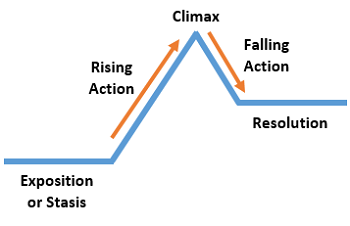
Very early in the literary education of most students in America, they learn about narrative arcs. The most typical model students come across uses a diagram that looks like a roller coaster, with a gradual climb upwards, followed by a sharp descent. In the most commonly taught model, we meet a character in their "before" life, witnessing what life is like just before the force that changes the status quo for the main character and gets the story moving enters the plot. In Bridge to Terebithia, for example, we watch Jesse wake up to his normal life on the first day of school, with his indifferent father, annoying sisters, and his dreams of being the fastest kid in school. Then we meet the new girl in school, who changes the trajectory of Jesse's life, which gets the story going. 

Once the story gets going, there is rising action. Eventually, the plot heats up enough that it boils over, giving us the climax, after which there is a change in the main character, leading to a falling action and a new reality, which is where the story ends. 
Shoutout to my 8th grade teacher, Mrs. Stutchel, whom I and everyone else hated. She taught this, but I didn't learn it from her.

The thirty-six stories in Luke Rolfe's "Impossible Naked Life" (Kallisto Gaia Press) aren't interested in any of that climax and change stuff you learned in middle school, though. Over and over, there is a chance in these stories to achieve a climax, but the climax is deferred or avoided. When there is a climax, it's almost invariably a bad one. If the climax in a story is like the orgasm in sex, then these stories are the ruined orgasm fetish of short story collections.

This isn't a criticism. The avoiding and maneuvering around climax is skillful and intentional. Most of us never experience true (non-sexual) climaxes in life, or epiphanies that lead to meaningful change. That's an artifice of literature, and while neither I nor any other reader will ever tire of the formula, that doesn't mean every story has to hold to it. When something interesting happens to most people, they either change only slightly or don't change at all. So Rolfes is playing with a different and interesting aesthetic here. The trick is whether he can be that close to real life and still delight the reader. 

Romantic realist

There are far more stories in this collection that feature a romantic relationship that never fully develops or that falls apart. My rough count yields eleven of these ("Crab," "Day Camp," "Plucked," "Fish Heart," "Siren," "Liar, Liar," "White Landscaping Rocks," "There, There," "Acai Bowl" (maybe), "Time Magazine Person of the Year," and "Common." There are only maybe two stories with romances that seem to be going anywhere at the end, and I wasn't even sure about those two.  

Romantic comedies are the best known genre for mixing the character overcoming conflict at the moment of climax with the fulfillment of the achievement of romance. They aren't the only types of stories that do this, though. Coupling the main character working through his main flaw in order to overcome adversity often is shown in the character's ability to achieve the love interest they've been chasing. 

These stories just don't work that way, though. Even stories that end on a note of sweetness seldom end with "boy meets girl" (or "girl meets girl," which is what we might have in one of the few exceptions in this collection). These stories reject both climaxes that change characters forever and romances that lead to happy-ever-after. It's a brutally honest collection in that sense. 

Anticlimactic climaxes 

"This story doesn't have an ending," the narrator of "White Landscaping Rocks" tells us, and that could be said to be true of many of the stories in the collection. Moreover, there is one story after another that seems to portend a big, climactic, orgasmic moment, but that moment never comes. "There, There" teases a storm that never materializes. "Karate Witch Teacher Kickass" has a narrative that build to a fight that never comes. "Showdown" brings up the notion of Mike Tyson fighting an alien to save the human race, but the scene fizzles out like a daydream interrupted. 

This aversion to climax is often literal. There are several sex scenes that begin but are then interrupted. In "Plucked," a struggling college student connects with an older woman on a train. They end up in her private sleeping room, but after kissing that seems to be leading to sex, the woman just runs out of libido:

"After a while, she says, "I'm too tired to keep going." 

 "We can do whatever you want to do," I say. 

 "Sleep. I want to fall asleep."

Similarly, "Fish Heart" has a scene in which a woman is making out but not enjoying it, while "Killer Saltwater Crocodile Killer" briefly alludes to a budding romance that died before going anywhere. A paperboy in "Paperboy" sees a couple naked in their front window, but rather than going at it, he sees that "they seemed to be just standing there, hugging each other as the sun rose across the neighborhood." 

As if aware of its own refusal to give readers the endings they're used to, one story in the collection has a character recall an old story he once wrote, only to have another character offer the critique, "That ending is terrible." The story-teller responds, "It's my story...I can end it any way I want."

Climax is dangerous 

These stories don't always avoid climax, but when there are fireworks (including one story where there are literal fireworks), they're almost always bad. There are two stories about crocodilians, "Killer Saltwater Crocodile Killer" and "Kingdom of Teeth and Scales." Unlike most of the stories in this anthology, the promised monster does not fail to appear. But when they appear, it's not so the hero can conquer them. In one story, a kid gets his arm ripped off. In the other, one person is killed and a macho high schooler gets his fake machismo exposed before someone kills the crocodile in a non-heroic accident. 

We may think as readers that we want Chekov's gun to go off, but the point in the real world is to keep guns from going off, because they tend to hurt people. This might drive readers, used to their normal narrative cycle, a little crazy, but isn't avoiding drama actually what most adults spend a lot of their time doing? 

In fact, there is one story, "Spectacular Regular," that starts with a gun going off, but it's a nightmarish piece of flash fiction that begins with a mass shooter on a bridge and then fades into imagery of spiders. The collection is trying to remind us that as much as we are conditioned to look for explosions, when we get them, we might not actually like them. In "Wendy's Eclipse Day," Wendy is so obsessed with seeing an eclipse that when fireworks (which ironically ruin the climax rather than signal it) keep her from being able to see it, she thinks that she could "kill everybody in the world." Climaxes don't necessarily lead to epiphanies that make us better, the collection is reminding us.


Sex is...bad?


This climax aversion is sometimes literal in the sex scenes. When sex actually does occur in these stories, it's often coupled with something ominous, too. In the opening story, "Crab," which sort of reads like a long dad joke, we do get a briefly alluded-to sex scene: "...she said, 'I can be terrible sometimes' and took off her shirt." The introduction of sex is how we get foreshadowing of her eventual harrowing bad behavior. "White Landscaping Rocks" sees a gay couple's happiness undone by their proximity to bourgeois sexual decadence. 

Sex is more often spiritualized, as in the scene on the train in "Plucked" or the two unlikely teammates huddling together for warmth in "Impossible Naked Life." 

Nature is...bad, too? 

It isn't just sex that these stories tend to eschew; it's also nature and natural impulses. In "Bubbleheads," Sunny wants her friend Jenny to close her eyes and drive by "instinct," but this ends as badly as you'd think it would. "Instinct," in fact, isn't human in these stories. It's animal, and not in a good way. A saltwater crocodile's instinct is to kill and eat: "That's all an animal lives for. The next day. The next meal. The chance to prolong its life."

Because nature's tendency is to kill and eat, much of the natural imagery in the anthology is a threat. There are crocodiles and alligators and spiders. In "Viper," there is a deadly snake at the head of a walking trail, which is perhaps the furthest point the natural world can be said to reach into the manicured world of human development. It's not the only snake that shows up in these stories. "Rubber Horsey Heads" is a story that's little more than a narrated nightmare, full of animals out to get humans.

The only "instinct" the text approves of in any story is the instinct for self-discipline Genevieve exhibits in the title story, which notes she has "a natural instinct at patience and holding still." Self-control is more important that self-expression. It's an anti-Romantic aesthetic.  

The Ego controlling the Id

It's not so much, maybe, that sex and natural urges are bad as it is that they're associated with what we've come to call the Id. These are the base, reptilian urges of the brain, the raw, animal urges connected with survival and maximizing pleasure. It's the caveman brain that tells us to murder our enemies and ravage their women.  

These stories are leery of following our natural urges to their climatic conclusions because the Id tends to lead to death and destruction. Instead, these stories--at least most of the happy ones--feature characters whose Egos (their socially aware brains) subsume their Ids.  In "Hold your Soul," we find a child urging her teacher to take care of his soul, a rather spiritualized suggestion of prioritizing the spiritual over the carnal.

Salvation isn't found in these stories through diving deep into the psyche to "find oneself." In "Ball Pit," two characters dive deep into a fantastically deep children's ball pit, which serves as a metaphor for the depth of the subconscious. What they find is terrifying, which suggests that perhaps there are some psychological depths better off not plumbed. Self-revelation doesn't lead to anything good, which is why, in spite of the evocation of nakedness in the title of the book, nakedness tends to be something to avoid in these stories. "Killer Saltwater Crocodile Killer" mentions characters and their "amount of nakedness they were ridiculous enough to endure on that particular weekend." Nakedness isn't part of self-discovery leading to wisdom. It's coupled, instead, with ridiculousness. 

In the title story, about a woman on a reality show where contestants try to survive while naked in the wild (similar, I think, to Naked and Afraid), we finally confront nudity head-on. The nakedness is portrayed, however, not as natural, but as artifice. Nothing is more fake than the "reality" show, and Genevieve comes to wonder what the point of all the nakedness is. While "impossible naked life" is a phrase only specifically applied to the last and title story (which might be the best in the book), it could also apply to the whole of the book (as we should think it would, given that this is the title of the collection). It's impossible to live life nakedly, or practicing extreme self-revelation or self-knowledge. A little repression is what separates us from crocodiles. 

The title story is interesting in that it seems to confirm the themes of many of the other stories, but in a reverse way. There is frank nakedness and introspection, and eventually, the two characters do share their inner selves and are emotionally vulnerable. This is only achieved, though, once the two characters come to a place where they are uninterested in nakedness, where it now seems too ridiculous to think of. It's a reverse story of Eden--the characters are no longer ashamed of their nakedness, not because they've decided to embrace their nudity like Romantics, but because they've demonstrated control enough to simply not find it that interesting. 

Manly men aren't the ideal

Perhaps because the Id is shown as something to be held in check in these stories, manly men are generally held up as objects of scorn. In "V Scale" (one of the two stories that might actually end with a romance that's going somewhere), the main character avoids gyms with men grunting as they strain to lift weights, which she is sure is something they only do to show off. There are other insults in the book thrown at weightlifters. In "Puffy Man," a weightlifter at an outdoor gym near the beach is seen as a monster by a young girl. "Man Show" is about two young men who are obsessed with their bodies and how self-centered and unaware this makes them. We are meant to sympathize more with the skinny runner in "Palestine Boy" than with the giant football player who tries, clumsily, to connect with him. The physical ideal isn't a strong man who can push obstacles out of the way, it's runners who endure or rock climbers who patiently work their way through puzzles. 

Living in the midst of our world means avoiding the fireworks

Perhaps the single best image in these stories of how to survive in a world full of death and sadness comes at the end of "The Birds of Joy." In a medical facility where patients are dropping like flies, one dying woman finds happiness in a bird that's snuck into the facility. But rather than fly to the heavens, like we'd expect in a normal narrative cycle, instead we see the bird choosing to "settle into the bedpan, uninterested in flight." 

The narrative arc in these stories could possibly be drawn as follows:

Verily, my MS Paint skills know no bounds


These stories are occasionally weird, but not terribly so, and most tend toward realism. Even the ones that bend realism, however, are still thematically grounded in reality, because they are trying to break the habit in readers of looking for vicarious catharsis. Even at their most fantastic, the point is that we shouldn't look to the fantastic to heal us, because the fantastic doesn't happen all that often. What does happen to change our lives for the better is our decision to control our worst impulses. That's not as fun as fireworks, but it's a lot more effective. This collection deserves praise for its ability to refuse the well-trod path of fireworks.  


Saturday, September 3, 2022

Two interpretations of the Taco Bell Quarterly (and its hate boner for The Paris Review)

If you're halfheartedly a part of literary Twitter like I am, you've probably come across The Taco Bell Quarterly at some point in the last few months. If you haven't, your first instinct might be to think it's a joke. Which it isn't, as much as it might disguise itself as one. It's definitely hard to explain exactly what TBQ is; even the magazine's founder, M.M. Carrigan, has offered differing and possibly contradictory explanations for the journal's raison d'etre, mostly through pithy and provocative Tweets. Although Carrigan is witty, the one thing TBQ is not is a joke. At 26,400 followers on Twitter and growing, they may not yet have made good on their boast to be "more relevant than The Paris Review" (which has a million followers), but they're certainly not a joke. Their following has grown to the size of a decent literary journal, and I've seen approving re-tweets from some very hip authors, if not yet many establishment darlings. 

There are two more assertions I can make with certainty about what TBQ isn't. The first is that it's not establishment. It's set up to poke and prod at the literary establishment, frequently taunting The Paris Review in particular. TBQ's Venmo/PayPal is @ParisReview, for example. The second is that it's unaffiliated--unaffiliated with Taco Bell, unaffiliated with The Paris Review, unaffiliated with everything. (At one point, Carrigan joked about asking Taco Bell for a million dollar literary grant, the result of which was that Taco Bell "continues not to sue" TBQ.) 

So that's what it's not, but what is it? TQB offers some explanations of its own, both in the journal itself and also through Carrigan's barrage of hilarious, come-and-get-me Tweets. I'd like to examine two different ways of looking at TBQ and its meaning--both what it hopes to signify as a literary artifact and also what it means as a product of its literary and economic time and place.  

I imagine Taco Bell isn't suing because it's realized that it has more to lose in public perception than it has to gain in suing the journal. It also isn't hurting Taco Bell to be associated with something hip and counter-culture, because that makes Taco Bell seem hip by association. Kind of like why Arby's changed its mind about suing Nihilist Arby's. 


But first, the meaning of TBQ in its own words

Here is how TBQ describes itself on its website: 


Taco Bell Quarterly is the literary magazine for the Taco Bell Arts and Letters. We’re a reaction against everything. The gatekeepers. The taste-makers. The hipsters. Health food. Artists Who Wear Cute Scarves. Bitch-ass Wendy’s. We seek to demystify what it means to be literary, artistic, important, and elite. We welcome writers and artists of all merit, whether you’re published in The Paris Review, rejected from The Paris Review, or DGAF what The Paris Review is. 

First and foremost, TBQ is about great writing. It’s about provoking and existing among the white noise of capitalism. We embrace the spectrum of trash to brilliance. Taco Bell Quarterly has tens of thousands of readers. We’ve been interviewed or mentioned in Vox, Salon, Food and Wine Magazine, Mental Floss, Yahoo, The Guardian, The New York Post, Publisher’s Weekly, Literary Hub, Bon Appetit and dozens more.

Is this real? A joke? A literary psy-op? We don’t fully know. We just decided to write about Taco Bell. We are absolutely not affiliated with Taco Bell and make no profits. We can’t even get extra sauce in the drive-thru. Employees treat that shit like unicorn blood.


That part-facetious, part-rebellious self-explanation holds within it all the seeds of the varied ways of looking at the magazine, both as a literary product and a social phenomenon. 

Meaning one: it's an outlet and a meeting place for the rejected


One unusual characteristic of the literary fiction community is that a significant percentage of its members frequently face rejection from the most powerful members of their own community. It's well known that a good percentage of the people who read literary magazines are those who hope to one day be published in them. Major literary conferences are largely attended by dreamers hoping to make connections with or soak up wisdom from the few who've made it. Most aspiring writers have found their way blocked by "gatekeepers" (who are often themselves just other struggling writers volunteering their time). Faced with rejection, there are three possible reactions: revolt, persistence, or giving up. TBQ represents a little of all three. 

The constant jabbing at The Paris Review is the revolt, of course. TBQ isn't the only journal to have been founded partly by people who were tired of being rejected by other journals, but it is one of the best at making its feelings about rejection known. The existence of a journal named for a fast-food restaurant perhaps best known to most people for being cheap and for being a great late-night post-drinking option also represents a kind of resignation. It's sort of like getting kicked out of a fancy, high-society restaurant for being underdressed, and rather than going home to get a coat and tie and going back to try again, you decide to just go to Taco Bell in your tank top and shorts, because who needs those snobs, anyhow? Carrigan once ran a string of Tweets about appearing at a literary conference with a trash can into which attendees were encouraged to throw their literary works, as if to say that at some point, continuing to struggle to "make it" is futile. 

Some examples of the revolt:
Revolt

Revolt
A Tweet very much on the fringe between giving up and persistence


There's plenty of anger in the revolt and the giving up. At times, TBQ accuses the establishment of not just being snobs, but fascists who hold onto authority and prevent the emergence of minority voices. Even when it's at its angriest, though, there's sometimes a note of sweetness mixed in and a call to persistence. A pinned Tweet that's been re-Tweeted nearly 7,000 times catches this vibe:


Not all of the Twitter followers of TBQ are the literary rejected, but nearly all of its followers are intimately familiar with rejection. TBQ lives in a world in which powers--some corporate, some of the elite cultural gatekeeper variety--are blocking the masses from publication and recognition as writers. Not just recognition, but money. TBQ recognizes our capitalistic backdrop and the need all artists have to make a living to sustain themselves. Which is what drives the second interpretation of TBQ.

Meaning Two: It's both a reaction against and a concession to art's commodification by capitalism


Taco Bell restaurants are faux southwestern missionary-style buildings with fake adobe exteriors. The cuisine is an unholy mix of Midwestern crockpot cuisine with other influences we might, if we take a wide view of things, call "Mexican." It's gauche and Philistine, like any culture is when it's dictated by commercial logic.

Naming the journal after a symbol of crassness is a call to storm the bell tower and take back real art. TBQ isn't about loving Taco Bell; it's about Taco Bell as a symbol of the ugliness of art run by gatekeepers in thrall to power. It's an aesthetic descendant of Dadaism, answering nonsense with nonsense.

Or so I thought. But while that might be lingering in the background, there is too much actual love for Taco Bell being professed by the journal for it all to be ironic or for Taco Bell to be purely a symbol of ugliness in art. In fact, much of the journal's actual literary output is more about how Taco Bell played a positive role in the lives of narrators than about how Taco Bell is a symbol of a dying and decaying society. Or perhaps the narrators do acknowledge that Taco Bell is a symbol of a sick society but still find room for elegies to that society's dying beauty. 

In "Un Espinella to a White Friend," J. Villanueva writes of a Mexican narrator talking about Taco Bell with an over-eager white friend. The white friend, perhaps motivated by wanting to show off to his Mexican friend how much he knows about "real" Mexican culture, has questioned why anyone would want to eat at Taco Bell when it's "not Mexican." The narrator responds that, "I know what's served at Taco Bell."  For the narrator, though, while he is well aware that Taco Bell isn't "real" like the Mexican food that is part of his "cultura," it's still "food for (him)." The poem seems to argue that if it tastes good, it is good, an argument that the millions of people who eat at Taco Bell would agree with. It's also a very democratic aesthetic when applied to art, like Duke Ellington's "if it sounds good, it is good." 

This hint of justification or apology for Taco Bell is all over editions four and five of the magazine (the two most recent). "Spondylolisthesis, or why I eat Taco Bell" has a narrator who finds comfort after an abusive relationship in the Crunchwrap Supreme, discovering "decency" in a meal that comes with napkins and straws. The short story "Crazy, Stupid, Tacos" features a protagonist who remains unhappy as long as she resists the crassness of a Taco Bell-themed hotel where she has gone unwillingly for a destination wedding. The character only finds happiness when she stops fighting the crassness and learns to make peace with it. 

The directions for writers submitting to TBQ are pretty much this: "Put Taco Bell in it somewhere." Carrigan advises that this can be as simple as "shoehorning a chalupa" in there somewhere. Most of the published works in TBQ 4 and 5, though, go the other route, highlighting Taco Bell front and center, either as a setting or as a symbol. About half make the connection to Taco Bell right in the title of the work. Rather than rejecting Taco Bell as a symbol of all that's bad in society and therefore art and therefore writing, most writers are celebrating it. 

The relationship to capitalism of TBQ, in fact, seems to be less, "It's all bad, let's burn it all down" than, "Okay, it's bad, but we can't change that, so let's at least try to get ours, too." No work demonstrates this more than Catherine Weiss's "Everyone at the KFC-Taco Bell drive-thru is on their way to the pro wrestling show." The narrator is watching fans of a garish, kayfabe, staged but still violent "sport" eat at a garish, fake establishment built on industrial violence toward animals. The narrator, who seems to have either decided not to have children or been unable to have children because of a disability, looks at all this absurdity and wonders if she, too, wants in. She wonders if she also wants to "order some small human a taco" and what her wrestling persona would have been. The narrator is, like so many rejected authors, looking at those who've managed to gain something she's hasn't, and rather than throw scorn on all of it, she decides to change herself slightly:

are there leagues for disabled people?
at 35      i have almost decided i will be happy

by staying happy i have almost decided      the sound
of a body percussing the mat would be enough


Many poems look on the surface like they take the whole TBQ project as a joke, offering comically mock-grandiose titles such as "Saturn Devouring His Crunchwrap Supreme" or "Six Modern Haiku for a Taco Bell Drive-thru" or "An Ode to the Taco Party Pack." While these begin as facetious, they often end up falling back into a tone that's mostly earnest. That's TBQ in general: a joke that seems to have become serious. 

There are some works in which Taco Bell holds negative connotations. In "Happy Birthday from Taco Bell," the restaurant is a continuing reminder for a young woman of the place where she was raped. No work, though, seems to confront the conflicting meanings of Taco Bell as a symbol and of a literary journal named for the restaurant as much as Cynthia Arrieu-King's "TBQH." 

The title itself is a reference both to the name of the journal itself and an introduction to the speaker's voice. Anyone not familiar with the abbreviation gets it immediately spelled out in the opening line, "To be quite honest." It is followed by an assertion that when art and capitalism mingle, art withers:

To be quite honest

If we want to make art, yet look for money to spring up in its place

Who will have extra lettuce but the bombers, artillery manufacturers, oat milk saboteurs?

Poems will have to remain garlands and garnish, the older ones our menu


Unlike most of the works in TBQ, "TBQH" never makes its peace with Taco Bell. It launches into a series of "Taco Bell questions," which are really questions about the sustainability and viability of society itself. It arrives, ultimately, at a "the party's nearly over and someone will have to be paid" attitude toward our society's unquestioning consumption. The narrator and an interlocutor pull up to the drive-thru window, the moment when, in most of the works in TBQ, a narrator would make peace with Taco Bell and enjoy what corrupt enjoyment is available to us. But "TBQH" is too honest for that. Instead, it keeps questioning right up to the very end, asking, ominously, whether the window they're approaching is the window for picking up their order or the window for paying. 

Unironic kitsch


Most of the work in TBQ, though, is much more forgiving of Taco Bell than that. Maybe that's because for most of us, Taco Bell is the kind of restaurant we've spent more of our lives in than fancy, high-brow restaurants. For most writers, the journals that have published us are more like Taco Bell than the five-star Paris Review. Taco Bell is a more realistic setting and symbol of our lives than other places. Nearly all of us have eaten there, have memories there. Most of the work in TBQ is nostalgic about Taco Bell, because most of us, when it comes down to it, are nostalgic about our lives, even though our lives are as far away from the high art we hoped they'd be as Taco Bell is from real Mexican food. 

TBQ is about surviving in the reality of an ugly, corporate-driven world where not even art is free from the ugliness. There are a number of ways to enact that survival. For TBQ, it means eating the Crunchwrap Supreme of capitalism with both hands, selling merch (I really like the "I survived the poetry discourse" coffee mug) and constantly hustling for donations. TBQ is a statement that if we live in a world with Taco Bells in every town, then an artist has a right to find a way to thrive in that world, even if it means embracing the madness. Embracing the madness that is itself an enemy of art can become an act of beauty in itself. 

I don't know how long TBQ is going to keep growing. One problem it's already running into is that its own success means the the journal that partly sprang up as a reaction against rejection is now having to reject an awful lot of writers seeking to be published by it. Carrigan recently Tweeted that less than half of a percent of people submitting would be published, but writers should "live más" anyway. The journal is perhaps less counter-literary-establishment than one would expect. It reads like a lot of other queer-focused literary journals might read, with the exception that every volume is a themed volume about Taco Bell. There are limits to how revolutionary a literary journal can be and still be a literary journal, just like there are limits to how anti-capitalist anyone can be and still survive in a capitalist society. 

TBQ doesn't ignore or deny these limitations, though. They're there, but that's not a reason to give up. The journal is always on the edge of saying fuck it, let's give up. It's always a breath away from becoming Nihilist Arby's, but it never quite goes there. TBQ may have adopted Taco Bell's "Live Más" slogan as part of the joke, but somewhere along the way, both its staff and its contributors have somehow mostly imbibed the message for real. If a term had to be applied to the journal and the Twitter community growing around it as a movement, the term might be unironic kitsch. It's an aesthetic of trying to make real art and real sentiment out of garishness, because garishness is the only raw material the world offers us to work with. 


Thursday, March 26, 2020

One of my stories about what life on Earth used to be like for some people gets published

It seems hard to believe now that I once wrote a short story that was a psychological profile of a husband cheating on his wife. Today, I wrote an email to someone that ended, more or less, with, "I really hope you aren't one of the people who dies." At some point, I more than half believe, normal life will continue, which means people will resume making the same hopeful, misguided, and doomed choices they hope will lead them to happiness they've always made. I look at this story as a reminder of the kinds of mistakes we'll hopefully one day be lucky enough to be making again.

This story is published in the Northern Virginia Review, making this the third local journal to publish my work: The Baltimore Review, The Potomac Review, and now this. I wonder if being local actually helped me get published in these journals. Do they look at my bio and weigh my home address in the balance when deciding what to publish?

In any event, NoVa Review does a really attractive hard copy that they put a lot of effort into. But they're not going to be able to do this one in hard copy, at least any time soon, since the journal is tied to a college and has university students who put it together. So all they've got now is the Adobe document for what would have been the spring 2020 edition. As online literary journals go, it's not the best, because you essentially have to just click all the way through it. I'm all the way on page 87. It looks like it would have been a really attractive magazine. The link is here:

https://indd.adobe.com/view/45d7be02-7abc-4c6a-b7f0-237aac053a78


Monday, December 9, 2019

The process of deciding what to publish never seems less legitimate than when I'm in charge of it

For the last few weeks, I've been part of a couple of processes to help pick the winners in writing contests. One was Sixfold's writing contest, which I've written about already and in which I only played a small role. (A very, very small role, since the winners were stories I didn't like.) But I have a much bigger role in the Washington Writers' Publishing House fiction contest. The deadline to enter was November 15th.

The publishing house is a co-op. We run a poetry contest and a fiction contest every year. Anyone within 75 miles of D.C. is eligible to enter. So it's aimed at giving a boost to local writers. And it has. A few of the past winners, like Melanie Hatter and Dave Ebenbach, have gone on to pretty big things after winning our contest. The way it's supposed to work is that after you win, you come give of your time to the publishing house for at least two years afterwards. This is my third year after my own win. I'm now in charge of running the fiction contest. That doesn't mean I have sole responsibility for picking the winner, but I am the one getting everyone else together to make the decision, and so I have a lot of influence over the eventual winner.

We got the most entries this year since I've been part of judging it. I've really put a lot of effort into trying to pick the best entry, but no matter what I do, I can't get past the feeling that what we're doing just isn't good enough. I always felt this way during my year I spent as an editor for the Baltimore Review, as well.

One reason our method for picking what to publish seems so inadequate has to do with the review/analysis I've been doing for the past few years on the Best American Short Stories or other anthologies. One of the important things I've learned from doing this is how often my impression of a story ends up being profoundly different after a second reading than it was after a first. That probably sounds a little bit obvious. Everyone knows a story is different the second time through. But I've been really surprised just how different the second reading sometimes leaves matters. Many stories I didn't like after one read became my favorites the second time through.

So really, the minimum I ought to do for the entries is to give them each two reads. But it's also impossible. I don't have time to read them all twice. Nobody helping to make the decision does. The fact is we don't read most entries all the way through once. The process is something like this: I read roughly the first 25 pages of each entry. I pick the five to seven most promising out of that. Everyone else is welcome to do the same. I offer my list to everyone else. Those with time to read through everything and make recommendations send out their lists. The people with less time just read through our recommended best lists. So only two or three people are deciding what the whole board of five or six even narrow in on. Our of the five to seven I picked as the most promising, I then read those all the way through once. Unless I don't, because sometimes about halfway through a reading, I just know it's not going to be a winner and I move on.

I've always consoled myself with this sampling approach by saying that if I don't want to keep reading something after 25 pages, no potential reader we're trying to market to would, either. But I don't know how satisfying that really is, given how profoundly I've changed my opinion after giving something a deeper reading than I otherwise might have. Even if I didn't love it immediately, if we market the book well, the reader is going to give it the benefit of the doubt and get past the beginning to place where she loves it like we did.

Beyond just the basic philosophical question of fairness, there's an emotional aspect to the process. I get rejected over a hundred times a year, and one of the biggest questions I always have is how that decision was made. Was it a really skilled editor whose opinion I would respect? If so, did he hate it completely, or was it just a shade shy of making it? Or was it some grad student just looking for credit for working on the school's lit mag? Did the person or people who voted down on it give it serious consideration, or were they just trying to clear out the queue, so they latched onto something unimportant and used that a reason to make a quick no-vote and move on? Every hint of laziness I see in myself makes me wonder how many other decision makers allow themselves an equal or greater latitude.

I wonder if this isn't having an impact on content in American literature. Some people have made the criticism that a lot of American literature, especially that coming from writing program graduates, all sound the same. I don't agree that it all sounds the same, but sometimes I do wonder if I'm not just reading a variety of ways to say something similar. The political viewpoints of most stories I read in good journals now is pretty much similar to everything else. I don't mean that as a dog whistle, like it would be if someone wrote that in Quilette. I'm not asking for more stories written with traditional, nationalist political viewpoints. But I wouldn't mind some heterogeneity within the side of the political spectrum I did I identify with.  It's not just themes; a lot of the subject matter is becoming very familiar. I wonder if writers aren't learning to hit the things that overworked editors have shown will respond to. I know the stories I've written that got published tend to fit this mold more than the ones that haven't, although some of the ones I've written that haven't are quite likely better. The more stories with certain characteristics get published, the more they lead to other work doing something similar.

Maybe that's too alarmist. I really don't know. I only have my own very small experience as a writer, editor, and reader to go off of. But even if the editorial processes out there aren't actively killing American literature, I think it's almost a given that there is great work getting missed, and it's our fault--the fault of those of us who, at any level, play gatekeeper without living up to the responsibility.

At the very least, if you're a writer I've rejected in my life, just know I didn't take any joy in it, and I haven't yet become calloused about doing it. I hate every rejection I give, and I know exactly what you feel when you get one.

Saturday, December 7, 2019

The results are out, and they seem to say that people need to be ruled

I recently mentioned that I entered a story in a Sixfold contest, the literary journal that picks its stories through reader voting rather than a board. I finished in the middle. I didn't even get out of round one.

I actually happen to have read the top three stories that won. They were assigned to me during the final round of voting. I didn't vote very high for two of them, including the winner, which I thought was pretty weak. The second place story was awful. The third place story is okay. If I had been on an editorial board and they had picked the two top stories over some of the other, better entries I saw, I'd have quit the magazine. It's a little hard to tell, because not everybody lets their names go into the final voting list, but I don't see any of the stories I actually liked during voting anywhere near the top. So I think my preferences just don't match the magazine's. I honestly don't think most of the stories they picked as the winners would make it through a halfway decent literary magazine with an editorial board.

As far as the feedback I got on my story from the voters goes, the funniest feedback I got was from one reader who said she gave my story a high vote. But she actually put my story fifth out of six in the first round. That means she was confused about how the ranking works: one is the highest and six is the lowest. She meant to put me second, but she put me next-to-last. Her misunderstanding might have been enough to knock me out after round one. Overall, out of the six votes I got in round one, I got three second place votes, two fifth, one of which was by mistake, and a fourth place vote. The other person who put me in fifth wrote this: " I found the presentation of Jenna as a ‘hypocrite’ for being a powerful woman, but also having emotions, quite problematic. It wasn’t clear enough to me whether this was an intentional comment on the catch 22 of being a powerful woman or not, but it definitely struck me a little incongruous with the overall effect that I think you were trying to create." I don't know what to tell you, dude. It's a first-person story with an obviously flawed narrator, and I found it incredibly clear that you shouldn't take his attitude as the attitude of the story. If you don't get that it's satire after the uber-absurd ending, I don't know how to help you.

Overall, I'm sorry to say that Sixfold's voting process does not seem to work better than a board. There were, like there are with most journals, a lot of bad stories submitted, and each of those bad writers got a vote. The results are sad to me, because I really think it's a great idea to try. I wonder if more journals tried it, if there'd be a place where it worked better. I think the problem with this particular journal, based on the stories I read, is that the taste of the people submitting is rather sentimental. There were a lot of stories where the whole story was a series of sad events resolved with a sudden happy ending that referred to the title, which is kind of a bush league writing tactic. But I can imagine a community forming that has a different taste. If other journals did this, I think you might see identifiable styles emerge from those communities. Sixfold's idea is solid, it just so happens that the writers who submitted, at least in the contest I entered, don't seem to really like sophisticated stories, based on what I read and what I see the readers chose. I'd like to see other journals that try this idea, but with a grass-roots push for a particular aesthetic at the same time. I would describe Sixfold's aesthetic as "ninth-grade girl who's watched a lot of Hallmark Channel."

I'm really kind of sad. Not that I didn't do well. I mean, I wish I'd done better, mostly so it didn't seem so much like I'm just questioning the results now because I didn't do well. But I sort of thought, after reading the stories I saw during voting, that this wasn't my audience. I just really hoped that readers voting would lead to better work getting selected. I wanted to believe in democracy. But it turns out that, as the Internet proves every day, the masses quite often aren't very discerning.


Tuesday, November 12, 2019

Yes, it's normal for a literary journal to ghost on you after they accept your work

Long ago, this used to be a blog about writing fiction and the travails thereof. It's been more of a blog dedicated to analyzing and reviewing short stories for about the last year. In part, that's because it's been good for me as a writer. Forcing myself to pay close enough attention to what some of the year's mostly highly regarded short fiction is doing, enough that I can write about it without making a fool of myself, has really helped me develop as a writer of fiction myself.

Proof of this came about a month ago, when I got notice that a journal I really like wanted to publish a story of mine. It's not the New Yorker, but it's a solid journal. I was actually surprised they picked me, because I kind of thought they were too cool for me. The great thing about it was that they wanted to publish a longer story of mine. It's very hard to get longer fiction published, so the fact they were willing to publish my story must have meant they really found it appealing.

The acceptance letter mentioned that I should sign the contract attached. That's pretty normal stuff, except there was no contract attached. I sent an email profusely thanking them for believing in my story and explaining that there had not been any contract attached, so could they please send one. I got no response for a week, so I emailed again. Two days later, I got an email that said, "Here you go," along with the attachment.

That was a little curt, but it was what I wanted, so I signed it and sent it back, along with the other things they asked for, like a photo and a bio. I later realized that one of the attachments I'd sent them was the wrong one, so I sent another email explaining everything and including the right one.

I didn't get any response on that. Two weeks later, someone responded in Submittable, the online website where a lot of journals handle the business of accepting submissions for stories. That person said "Sorry!" and attached the contract again, seemingly unaware that I'd already gotten it and responded through email. Whoever answered the email for the journal obviously hadn't seen my response, or hadn't forwarded it to the person who answered in Submittable.

So I attached everything again in Submittable, then sent an email just asking to be sure they'd gotten everything, explaining what seemed to be redundancies in replies I'd gotten from them. I asked to get a reply just so I knew they had what they needed. I've not heard anything in another two weeks since.

If you are a new writer who just got accepted for the first time or is hoping to get accepted for the first time soon, I want you to know how normal this is. I've now had eight stories accepted for publication. Six of them were like this. So if you struggle and struggle to get that first acceptance, and as soon as you acknowledge their acceptance you stop hearing from them, that's normal. If you end up freaking out and worrying that they forgot about you, or came to their senses and decided they don't want to publish you, that's normal, too. If you don't hear from them for seven months and then finally find out your story was published three weeks ago, that is also normal.

The people who run these journals are not getting paid. They're squeezing in time between life and work and their own writing to put your work out. They don't usually find time to hold your hand and make sure you know everything is going to be alright. But if they said they'll publish your story, they'll publish it eventually.

It was hard getting this far, I know. That doesn't mean the next steps are really any easier. But hopefully, if you at least know that it's normal for the next steps not to be any easier, that'll make it easier to deal with how it's not any easier?

Friday, January 25, 2019

New story up: "Haulers" is now on Crack the Spine

Just a short post here to announce my latest story to get published. It's called "Haulers," and it's here on Crack the Spine. Basic premise: guy who hauls trash for a living is having a hard time getting over his 15 minutes of infamy that happened when he ended up in a viral video he'd rather forget.

More to say later about this story and how it came to be, but for now, I'll just let the story do the talking. Have a great weekend.

Saturday, November 17, 2018

Best of luck placing your work elsewhere

As I posted a few days ago, I finally got a story published again, after about a 15-month slump. It's never fun getting rejections, as I've written about in painstaking detail from time to time on this blog. Someone recently posted a photo of a t-shirt he got from Barrelhouse Magaizine. It says, "Best of luck placing your work elsewhere."

It's a bit of hapless writer gallows humor.  A typical form rejection letter from a literary magazine goes something like this:

Sunday, November 11, 2018

Because when you think of me, you think rock ' roll rebel

It's been a while since I've posted about my own writing. After the book came out last year, I hit a dry spell of getting things published. But this Thursday, Jenny Magazine, the literary journal associated with Youngstown State University, is publishing one of my stories.

Jenny isn't the New Yorker, but I'm really happy about this publication. Youngstown's not far from where I grew up. The college and the magazine both have a focus on working class issues. I read a few of their past editions, and they put out some good stuff. I'm proud to be part of it.

I'm also pleased this particular story found a home. It's about a teacher and her husband who take one of the teacher's students into their home when her foster care situation goes sour. The father has a hard time figuring out how to connect with the girl and be the father he needs to become. Some of that is from my real life, the part of my real life I unironically love and treasure. This is one of those stories I felt I had to find a way to tell somehow, and now others will read it. That's pretty much the best you can hope for when writing fiction.

Most of the plot is pure fiction, even if the overall concept was real to me. The father and daughter form a musical act together, which is something I've never done. It's this musical act that made the story qualify for Jenny's 15th edition, which was a themed edition: "Rock 'n Roll and Rebellion." I hardly qualify as a rebel. When I watch Les Miserables, I identify a lot more with Jean Valjean than the young revolutionaries. Since most revolutions fail, I think the best course of action for most people if they want to make the world a better place is to try to prosper in the system that's there, then show kindness to those who need it. Valjean didn't overthrow the French government, but he did make life better for Cozette and Marius, and maybe, at least until Javert messed everything up, for the people who worked in his factory.

I'm probably going to go read at the launch for this edition, where, presumably, I'll be surrounded by young people who still dream of revolution. The musical gives the revolutionaries the last word, with the final song of the score being the dream of a world when we walk in the Garden of the Lord, when "the chain will be broken and all men will have their reward."

I wish the next batch of revolutionaries well. I hope they're the ones who give us the world as it should be. For me, I've had enough trouble just figuring my way out in the world that is. This story that will come out is really only important to me because it reminds me of the person who inspired it, who is the best work I've had a hand in making and one of the few things in the world that makes sense to me.


Friday, October 6, 2017

Washington Independent Review of Books reviews my collection of short stories

Let my friend Chris know that I actually did manage to do one thing right as a self-promoter of my book: I got a review from Washington Independent Review of Books.

I didn't know for sure that they were going to review it. (In fact, it's been up for three days and I just now saw it.) I sent them two books, because the folks at my publisher, Washington Writers' Publishing House, suggested it. A woman on the WWPH staff knew someone at WIRB, but when I sent them the books to review, I forgot to include my email address, because I am a moron. So I never heard from them. I also saw on Amazon that there was a used copy of my book for sale at the Goodwill right by the WIRB, so I wondered if they just dumped it. But it looks like they did a real service to a local writer and used one copy to get it reviewed.

They don't normally review a whole lot of books from small presses like mine. I believe this was a solid they did me because I'm local. That's darn nice of them.

It's especially gratifying to see this now, because I'm in the middle of doing my own literary good citizenship right now. I'm doing a review of a book someone asked me to do. Turns out, it's a much harder assignment than I thought it would be. The American Review of Books actually wants a short academic paper. I haven't written anything like that in years. I'm not sure I'm up for it, but it's my job to do this, and I know if I were the author, I'd want me to put some effort into it. So I'm struggling through it. Nice to see karma paying me back for it ahead of time.


Monday, September 11, 2017

At last, my Swedish fans are satisfied

Googling my book to see if it's been reviewed by anyone I sent it to yet, I saw...this:


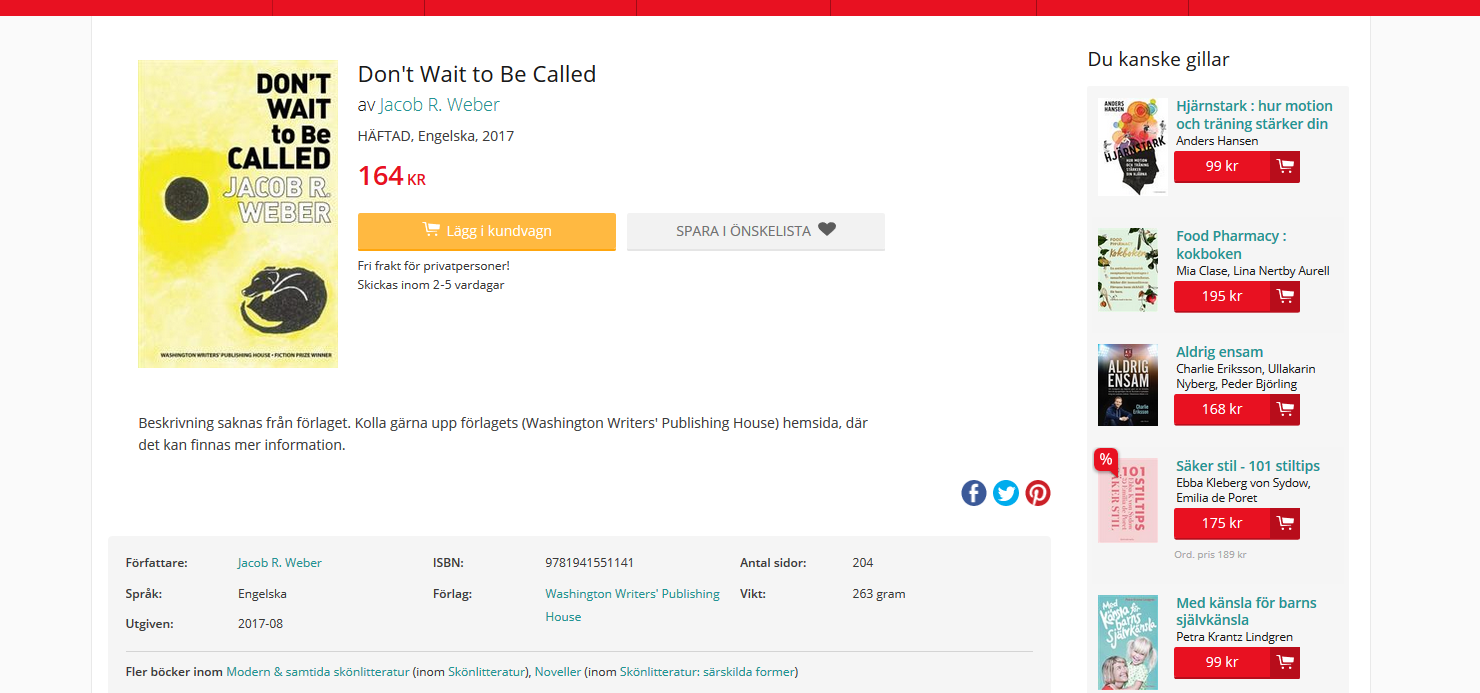
I'm guessing that 164 krona for the book, and that the language is therefore Swedish. I...am...confused. I mean, I guess they just link into some database, and if someone for some reason ordered one, they'd just order one themselves. It's not the same as a bookstore in Stockholm stocking an artsy book of short stories from a small American press, which would involve some sort of opportunity cost. But still, it's a weird place to find oneself. I already had a friend in Australia buy a copy, making me an international phenomenon. Dare I hope someone in Sweden will make me happening on three continents? No, I don't dare. That's stupid.

Tuesday, July 25, 2017

Confessions of a literary journal reader: overcompensating, and not the penis kind

I've written before about the fallacies, logical and otherwise, that might befall a literary journal editor, and how these fallacies might affect whether your story gets picked for publication. Editors are humans, and sometimes, the things we do are just weird.

You can control a lot with the way you write a story. Your skill as a writer can probably control, with about an 80% degree of accuracy, whether your story gets looked at more closely by the front-line readers or tossed aside. But when it gets down the the tough decisions of whether to publish the many stories a journal gets that deserve publication--many more than they can actually publish--there may be some things going on that you can't control.

Here's one I've caught myself doing lately

Although I neither like cars nor guns, in other ways, I kind of fit the male American stereotype. I like sports. I like sex. I like a particular kind of narrative voice, aggressive, quick-hitting and jocular, that tends to come from male writers. I'm aware of this tendency, and sometimes, I find myself overcompensating for it by intentionally trying to vote for female voices, sometimes even ones I don't really like. Maybe I'll vote down that hilarious story about the misogynistic womanizer with a secret soft side, or I'll vote up the story about consignment needlepoint workers in Kenya even though I could barely get through it. I don't exactly keep affirmative-action type quotas, but I am aware, usually, of whether the last few stories I voted for were written by men or women, or whether they featured male or female characters.

In case you were wondering--ladies--I do not drive a sports car. I have an old Corolla. So I'm not overcompensating. Or am I aware that people know men with sports cars are overcompensating, and I'm overcompensating for that? Hmmm...

This is similar to the other fallacy I wrote about, where I am more likely to vote for a story if I haven't voted for one lately, and less likely if I just recently voted for one. I'm not sure exactly what kind of cognitive bias this is--it's something like an availability heuristic, but maybe also something like the gambler's fallacy. I'd call it a fairness bias--a sort of one for you, one for me, incredibly clumsy kind of thinking.

Even being aware of it, this is still lurking at the back of my mind. I'm not only aware of it, I'm also aware of being aware of it. I don't want to give in to it, and I also don't want to swing too far the other way trying to avoid it. It's a very uncomfortable thought looking over my shoulder as I read and do my best to get it right.

There's really nothing you, as a writer, can do about this kind of thing. Which is why one point I keep trying to get across is to take all rejections with a grain of salt. It'll be a grain of salt in your wounds, I know, but really, just don't beat yourself up too much. 


Wednesday, July 5, 2017

A very special WIHPTS

This is now the fourth round of Would I Have Published This Story? (WIHPTS), and it's by far the weirdest. A little while ago, I thought I was going crazy. I picked up the summer edition of Prairie Schooner and went to the first story in it, which is a breezy little story called "Sometimes I'm Suzanne" by the Australian writer Merran Jones. Congratulations, Merran.

It's a quirky story of a boy named Matthew who has a second person rattling inside his brain, in this case, a middle-aged woman named Suzanne. She's there like some people might be born with an extra finger, not really malignant, just one of those things that happens from time to time and makes Matthew a little different. She sometimes takes over Matthew and does things an older woman would do. She and Matthew have some dialogue between them. But she's not always there, which is why Matthew says "sometimes" he's Suzanne. But sometimes, he's just himself. On his own, he's not particularly effeminate. His father, who had daddy issues of his own, eventually hates the girly behavior of Suzanne so much he leaves.

The thing is, I knew I'd read this story before. I just couldn't think of where.

Finally, it struck me. She submitted it to our journal, the one where I'm a volunteer editor. I remember it because we, the editors, talked about it a lot. We very nearly said yes to it. Two editors said yes, two said no, one said maybe. While we were kibitzing over it, the story got accepted by Prairie Schooner.

How did I vote? I voted no, with a great deal of hand-wringing. It was one of the first stories with a split vote I'd weighed in on. Might have been the very first. Here's my note in Submittable:

I see why there's division on this. It's witty and quick and ultimately kind of sweet, but it hits a few wrong notes. Beyond "fell into a sar-chasm" (wah-wah) there's the tell-not-show of "Kev could never escape his dad's Stockholm Syndrome-clutch." I'm voting down, although it feels like in doing so, I'm voting against moms. 
 A few days later, the story was withdrawn when it was accepted elsewhere. 

The "sar-chasm" joke, by the way, is still there in Prairie Schooner, so I guess they liked the joke that I didn't. The line about Stockholm Syndrome is there, too.  I feel some parts are edited somewhat from what we read, but I'm not sure. One of our other editors mentioned that Kevin, the father, seemed like something of a cut-out, just a one-dimensional boorish lout. I feel like the version that's in P.S. draws him a little fuller, but I might be totally mistaken about that. Maybe we just thought one thing about him and the editors at P.S. thought something different.

In any event, this story really proves what the WIHPTS series is supposed to prove: that fiction editing by literary journals is far from a science. I guess it's not a total crapshoot: the story did get our attention, so we treated it with more care than most of the stories we get. Both we and P.S. realized we had something worth taking a closer look at. But we still ultimately differed on whether it was "good enough."  

Three other things to think about: 1) This story ended up getting accepted by a top 50 journal, so just because an "easy" publication turns you down doesn't mean a "hard" one will, too. There's a good deal of luck involved no matter where you send it. 2) The first two votes on this story were yes for us. The third was maybe, which led to more editors taking a look. If voter #3 had just said yes instead of maybe, our chief editor very likely would have accepted the story then, and we might have gotten it before P.S. The difference for one editor between maybe and yes ended up leading to two more no votes, which, had P.S. not accepted it, might mean Jones would still be trying to get it published because of that one near-vote. 3) I think I'd maybe vote differently on this story now than I did then, after more than six months on the job. You can't control as a writer how experienced or smart your fiction reviewer will be. So just keep submitting.

It's also possible to draw this conclusion: what the fuck do I know?

Sunday, June 25, 2017

WIHPTS? "After Reading Peter Bichsel" by Lydia Davis

It's time for another round of Would I Have Published This Story (WIHPTS), in which I attempt to demonstrate the arbitrariness of short fiction publishing by taking stories that have earned critical praise and trying to guess if I'd have voted for them to be published in the small literary journal I work for if I'd have seen them come in without anything to flag them as special.

The first two times I did this, I was pretty confident I'd have voted to publish the acclaimed stories, which kind of undercut my theory of arbitrariness. Let's see what happens this time, with "After Reading Peter Bichsel," originally published in The Paris Review and later re-printed in the 2017 Pushcart Prize Anthology.

Here is my caveat about what this game means and doesn't mean:

This isn't really literary criticism, although I guess my opinion on the story will sort of come out in the wash as I try to guess what my own reaction might have been. The bigger point than just criticism of one story is to cast a light on how fickle publishing is. This is a story that has been deemed one of the year's best, but that doesn't mean it might not have met a different fate, that there wasn't some luck involved.

Short Answer: Would I have published this?

No! I'd have rejected it, probably with extreme prejudice, after reading perhaps two or three pages. And I'm relatively confident other editors would have agreed, and our journal would have rejected it with a non-personalized note. There is one other editor in particular I'm thinking of who would have called this story "thinly fictionalized memoir."

Synopsis

This is an achingly slow and subtle story, something the narrator (author?) offers a bit of apologia for early on. She recounts being given a book of stories by Swiss writer Peter Bichsel. She wants to read the book to improve her German while she is traveling throughout Germany and Switzerland. The narrator remarks on these stories that:

He (Bichsel) will also sometimes begin a story, or remark in the middle of a story, "There are stories that are hardly worth telling," or "There is almost nothing to say about X," and then sometimes follow that with a "but": "But I have wanted to tell this story for a long time now," or "But it has to be told, because it was the first story in my life, the first one that I remember." He then goes on to tell a lovely, quiet, modest story, a story that glows with human kindness, or love, or some combination of compassion, understanding, and honesty. (Or am I, these days, finding this quality so marked in his stories because I am seeking it?)

The narrator says, before launching into the main narrative, that this characteristic applies to her own story: "I wanted to say...that there was not much to tell...there was a scene, one that involved a peculiar character, and later a coincidence." Not very promising to be warned early on that there isn't really much of interest in the story.

Why would I have voted no on it?

1. I already alluded to the main reason: it feels like memoir. It sounds like a travel anecdote, barely fictionalized. I'd have wondered if the writer meant to send this to  the creative non-fiction category.

2. It's adjective heavy: In the first page after the main narrative launches, we get: "small, undistinguished, reliable, attractive, crowded, noisy, buxom, energetic, peaceful, small (again), large, placid, agreeable, vague, comfortable, companionable." I don't have quite the revulsion to adjectives that some writers/editors do. Sometimes, I'd rather have one succinct adjective rather than a long rendering of why the author applied that adjective. That is to say, sometimes, it's okay to tell, rather than show. But so much of this right at the outset of the story, after first being waylaid by a lengthy framing of the story, would have made me feel the story had something of an amateurish feel.

3. Putting in the bit about reading some Swiss writer--in the original German--felt to me like a humble brag on the part of the writer. Actually, if this had been presented as creative non-fiction, I'd have accepted this much more readily. But labelled as fiction, this felt like there was too narrow a distance here between the narrator and the author, and the author was trying to show off that she spoke a foreign language and that she read someone in that language. Given that I've pushed through my share of novels in foreign languages more difficult than German (my own humble brag), I wasn't that impressed.

Of course, we might have been totally wrong to overlook this story

The point I want to make through this WIHPTS series isn't that some stories get praise without deserving it. It's more than your story or mine that has been overlooked might not have deserved to be overlooked. With this story, I'd have applied some pseudo algorithms I've developed over time to help cut down on my work load and get through the slush pile more quickly. One is that if I don't want to keep reading after a page or two, neither will a magazine reader.

But reading this story not as a slush pile candidate but as an already validated and lauded story, I can see something of why people see value in it. The point of WIHPTS isn't criticism, so I'm not going to go into it deeply here, but there is definitely something interesting in the reaction of the narrator at a few points in the story. She hesitates to give a woman a pen, although she has a spare. She wants to ask something about the woman when she sees her again later, but she is overwhelmed by the logistics of getting through it in German. She reads to improve her German, but doesn't actually speak to anyone, which, of course, is also a way to learn German. At the end she sees a man on a train who is an avid reader like herself, and when the train moves, he braces himself against its movement. Is that what reading is to some people? Just a way to prevent being moved, being changed?

When I made myself read the story, I actually somewhat liked the non-hurried pace of it. So many literary magazine stories are frenetic, because we writers are told how critical it is to keep the story moving. This has a feel to it like a story from a century ago, when writers were still self-assured of their own raison d'etre they weren't always in a rush, didn't always have to have explosions.

So this story might very well deserve its place in an anthology of the year's best, although I'd still have rejected it from our small literary magazine in ten minutes or less. I'm pretty sure an unknown author would have had a very hard time publishing this story.


Thursday, June 22, 2017

Why I'm not using a Kirkus Review for my book

I kind of got a magical shortcut to a first book by winning a contest. I guess it's as good a way to get a book published as any. The nice folks at Washington Writers' Publishing House put together a pretty nice package for me:

-$1000
-They pay for the printing of the book
-They publicize it on their website and social media
-They got me a couple of readings for the fall at D.C. bookstores

However, there are a lot of ways in which I'm kind of on my own. Not totally on my own: they'll give me advice. But there are some steps related to publicity that are my responsibility:

-Contact venues for reviews
-Set up my own readings outside the ones they set up
-Get papers to publish announcements (papers? honest to god newspapers? who would read the announcement?)
-Generally promote myself

One of the suggestions they made was to get a Kirkus review. What's Kirkus? They used to be the book reviewer. From what I can gather, they kind of went belly up in 2009, but then re-emerged by selling their services to authors. They seem to especially market themselves to the self-published, suggesting a Kirkus review will make the book look more legitimate. It's $425 to get a review in seven to nine weeks. That review then shows up on Amazon and...other places? I'm a little hazy on this. Basically, it will increase the visibility of my book, I guess.

Okay, fine, but it's $425. That's on me to pay. No wonder the head of the publishing house said, when she told me I had won, "You're not going to make any money off this." They were expecting that $1000 would go to stuff like this, I'd guess.

Here's the thing. I kind of already told WWPH that I would donate the $1000 back to them. (I hasten to add that I did this on my own. They are allowed to advertise their contest in certain places because they offer a prize, and they didn't at all ask for the money back. I just was really impressed with this small, cooperative publishing house, and this was something I wanted to do. Everyone who wins is then supposed to help out the publishing house for a while. This is my way of helping. I don't have a lot of other talents. It's unlikely I'll be able to do much else for them of any value. )

The upshot is that $425 is a lot of money to me. Mrs. Heretic and I have had a kind of crappy run of luck money-wise, with unexpected bills popping up here and there this last year. That's a lot of money to me. (I apologize to my anonymous reader, who dislikes when I complain about money problems.)  Kirkus can't really promise that the money spent is going to result in a lot of sales. Or any extra sales, really. The last several winners of this contest said they used Kirkus. So far, only one winner has sold at least 1,000 copies of her book, and that was because it got picked up for D.C. schools, who bought a few thousand copies.

My former advisor from graduate school--with whom I had a nice conversation, including a post-mortem of what went wrong in graduate school--has promised to get the book reviewed on American Book Review. Another member of the publishing house will help get it reviewed at the Washington Independent Review of Books. I think I'm going to just call that enough. The book is just not going to sell that many copies. Most of the people who buy it are likely to be people who know me. I don't know that many people.

Another issue is that the review Kirkus gives you, about 300 words, is typically about 200 words of plot review. I have a book of 12 short stories that don't go together at all. Fuck they gonna say bout that? Nothing that will convince people to buy the book. 

In other words, I don't know really what I'm going to get for my money. I'm okay with the fact that this book isn't going to sell a lot. There's no way, though, that I'm going to pay what would be the first $425 of my son's college fund on some vanity project for myself.

Monday, June 19, 2017

Next round of WIHPTS: Kendra Fortmeyer's "Things I Know to Be True"

I had so much fun playing my first round of "Would I Have Published This Story?" I've decided to play again. The idea is pretty simple: I take a story that has won a fair amount of praise, in this case "Things I Know to Be True," from this year's Pushcart Anthology, and I try to guess if I would have voted to publish this story if it had come at random into the literary journal where I volunteer as a reader.

This isn't really literary criticism, although I guess my opinion on the story will sort of come out in the wash as I try to guess what my own reaction might have been. The bigger point than just criticism of one story is to cast a light on how fickle publishing is. This is a story that has been deemed one of the year's best, not only by the original journal that published it (One Story), but the editors of the Pushcart Anthology. But that doesn't mean it might not have met a different fate, that there wasn't some luck involved...

Short answer: Would I have published this story?

Probably, but I wouldn't have liked it. Sometimes, I vote for a story because I can see it was written well enough that it deserves to be published, even though I don't really like the story very much.

Synopsis

 It's the story of a Vietnam veteran, Charlie, struggling to get his shit back together after a traumatic experience...you know...back in 'Nam. He goes to the library every day and reads something, which then often triggers some reaction in him demonstrative of his anguished mental state. For example, while reading Poe's "The Cask of Amontillado," he believes that the existence of words describing a man who is encased means there really is such a person. A story of a fire makes him put the book under water to put the fire out. Charlie has a sign above his bedroom door, his "things he knows to be true," and they are responsible for his inability to tell fact from fiction. His list: 1) The past and the future exist through stories, 2) Stories are made of words, 3) Words make the future and the past exists.

There's a coping mechanism in there for dealing with the ghosts from Vietnam, but Charlie hasn't learned to use it right. He's victim of a sort of magical-realism break with reality, when what he needs is to learn how to use words to his advantage. The key is that if words make reality, then Charlie can re-write the story of his life to control the past. Charlie eventually learns this ability, which is the climax of the story.

What's good and bad about it

What I don't like about it has more to do with personal taste than critical assessment. In the last decade, there have been a LOT of stories about veterans with PTSD coming back from Iraq and Afghanistan. Some of them even are framed as stories written by veterans as part of their PTSD therapy. Vietnam was obviously before we had things like PTSD therapy writing sessions led by MFA candidates, but this does sort of have a Vietnam-standing-in-for-Iraq kind of feel to it. The narrative style of the mentally ill person writing the story reminded me rather too pointedly of Mark Haddon's The Curious Incident of the Dog in the Night-Time.

I also found the theme of narrative as a means to make the world whole again a little well-worn. I tend to be a little suspicious of themes in fiction that are about fiction itself. While it's true, of course, that the stories we tell ourselves greatly affect our outlook on life, there are also some wounds that words seem a little pathetic to try to fix. I don't think Charlie would really have a philosophy about stories like the one given to him; that's the author putting a list above Charlie's door for him, not Charlie. It's just a little too precious, fiction trumpeting the real-world value of itself. It's the kind of thing that's guaranteed to titillate editors at fiction magazines, which is why it did so well.

Still, I'd have probably voted for it. The narrative is crisp, it doesn't waste words, and it has a clear theme. (I prefer a theme I'd quibble with to a story whose theme I can't begin to fathom.) And much as the story might make too much of fiction's real-world power to overcome the past, it's probably much healthier than a story where the veteran is simply overwhelmed by his demons and can't make the center hold. Secretary of Defense James Mattis has suggested that much of the understandable impulse to help veterans of the two long wars overcome PTSD has actually led to the proliferation of a victim mindset. This story at least puts a weapon in the hands of its veteran and allows him to fight back.

A personal aside: what troubled me about reading this story

I just posted about a story I thought of on a Friday and got accepted for publication by Monday. Some of the things I've just said bothered me about "Things I Know to Be True" are things I myself did in my own story. It also uses the first-person narrative with a main character who is using writing as a means to overcome a trauma.

Rather than learning to write my stories my way, I wonder if I'm just learning to write the kinds of stories that literary journals will accept. It does seem that the stories I myself think are among my best are the ones I seem unable to get published.

Monday, June 12, 2017

Spamming the A button FTW

My son tells me that "FTW" is old and lame now, but I don't know another way to user gamer lingo to refer back to my "spamming the A button" technique of literary submissions I recently decided to follow. Basically, I decided to submit a lot more.

I kind of needed a win. 2017 started off pretty good, with a story getting accepted in January and then I got the call about the book in February. Since then, it's been a shut-out, even though I feel like what I'm putting out now is the best work I've done.

But two weeks into my submit-your-ass-off technique, Drunk Monkeys just accepted a story, so I'm off the schneid.

Actually, this is a story that wasn't even in my head until Friday night. I was driving to a friend's house for a reading discussion of The Enchiridion, when the story just sort of came to me. Parts of it fell into place while I was stuck in traffic, and I was actually tempted to skip my quaff of Lyon's Rum and an evening of camaraderie to hurry home and write before I lost it. Instead, I wrote down what I knew of the story on a receipt lying on the floor of my car, spent the evening with friends, made it home by 1 AM and wrote the beginning of the rough draft until 2. The next day, I went into work to catch up on some work I was behind on, then came home and finished the rough draft.

I showed Mrs. Heretic the rough draft, talked it over, fixed it up, and then sent it to Drunk Monkeys' 24-hour response on Sunday. Today, I got an acceptance. So a story I had never thought of 76 hours ago will now have a home soon.

Let me here just put in a plug for that 24-hour response. It's three bucks, which is what a lot of journals are now charging as a reading fee in order to wait for six months.


Friday, June 2, 2017

My book will have errors in it

The good folks at Washington Writers' Publishing House had a lot of good advice for me when they told me I'd won this year's contest and we started to get my book ready for publication. But one guy, the one who won last year, had a suggestion I couldn't implement: he said it would be a good idea to hire a professional editor.  He guessed it would cost about $300-$400, which was where I got off the train. I already spend enough time and money from the family treasury on my writing, but that was just too much. I couldn't justify it.

So three members of the WWPH and I did our best to error-proof it ourselves. I thought we were doing pretty well, but less than a month ago, one of the editors had a long list of suggested changes that involved moderate levels of remodeling to the stories. That was fine: they were good suggestions, but every time I write something new, I make new mistakes.

My orthography has gotten terrible of late. The words "of, on, or" come out in nearly a roulette-wheel fashion. Same with "it, is, in." My brain is just getting muddled. I think it's partly a result of trying to carry on so much of my life in different languages. Even my mother tongue is getting knocked around up in my synapses pretty badly. There are days I go to say a world I've been saying for decades and it's just..gone. Days later, it magically reappears. One wag of a country preacher I once knew might say I'd educated myself beyond my intelligence.

In any event, I've had to read my own stories front to back four or five times since March. I'm now very sick of my own stories. On my last read-through, the one done after receiving the early proofs of the interior of the book, I did the best I could, but at some level I just didn't have the requisite energy to really error-proof it fully. And I'm sure at least one correction led to another error.

But I'm okay with that. Any errors in there are my own, and they're the result of my negotiation between what I wanted the book to be and what I'm actually able to make it. At some point, the work is finished, and what happens to it is beyond my control. That point for me is now. Or maybe two weeks before it was actually supposed to be finished.


Thursday, June 1, 2017

Who steals my purse steals trash; who has my name and makes me invisible on Google makes me poor indeed

I've gone by Jake my whole life, pretty much, other than being "Weber" on sports teams and in the Marine Corps. My parents named me Jacob with the intention of using the nickname. Since that's what they called me and I lacked the energy to get new stuff with my name on it, I just kept using it. Growing up, I was the only Jake I knew. People criticized my mom for giving me a name that reminded them of old Jewish men. But about 20 years ago, Jacob became the most popular new name for boys and stayed that way until recently. I can't be anywhere with a sizable group of kids around and not hear my name called over and over. They took what used to belong just to me.

I get a similar feeling when I try to find myself on the Internet. Every time I've ever tried to Google myself since my first story came out a few years ago to see if I even exist, the results are so overrun by character actor Jake Weber that I can't even get to the end of him. Since he's older than me, I guess I can't really blame him for stealing my name, but it really is annoying to be completely eclipsed by someone else with your same name when you're trying to establish yourself. Maybe if my mom had just named me Assface Weber, I'd stand out. (Pronounced Ass-Fa-che; it's Italian.)

I had to tell the publisher the other day what name to use to draw my ISBN for the book. I decided to use Jacob, even though nobody has ever called me that except my grandmother. Even that, though, seems fraught with other choices. If you Google "Jacob Weber" right now, one of the first images you get is an imposing gentleman with a face tat that kind of makes him look like a pro wrestler. How can I compete with that kind of panache?

So I'm using Jacob R. Weber. I've now resolved two naming issues for the book, the title and my own name. I hadn't really thought those two things would be issues requiring brain cells to run when I used to dream of getting a book out. Since these little issues mean I AM, in fact, getting a book published, they're issues I'm happy to have. They're not even problems, and I'm not complaining about them. But everyone who ever published a book always warned me that when you do get a book out, it isn't like some publishing fairy comes along and decides all the little things for you. You've got to make a lot of decisions yourself, and you're going to be winging it sometimes.

From here, now that I just finished my final editing (more on that later), I'm supposed to start sending out the book to folks for reviews and doing other publicity things. None of that comes naturally to me. I'd probably blow it off altogether and live with terrible book sales (terrible, in this case, meaning eleven, whereas the upper limit I can realistically hope for if all goes well is like 500) if it weren't that I feel a responsibility to the small, co-op publisher to try to sell some books for them. When I look at the things they want me to do (like talk to people), I feel like my best bet is to get a second job and use the money to buy copies of my own book.